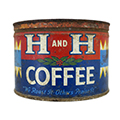
H and H Blend Coffee Tin
The house blend in metal — the most common H and H tin form in the collection, spanning half a century of litho and paper-label evolution.
Quick ID:
- Red and cream litho (or paper label on plain tin for pre-1920s examples)
- “We Roast It / Others Praise It” embossed on lid or as label copy on most examples
- Burnett Street address → pre-1932; Delaware Street → 1932 onward
- Keywind strip on bottom rim → post-c.1930; slip/friction lid → pre-c.1930
- “Light Housekeepers Size” callout → ½ lb tin, 1920s–1930s
Form
Standard round cylindrical coffee tin with friction or keywind lid. Lithographed in the H and H red-and-cream house colors; earlier examples use paper labels over plain tinplate. The “We Roast It / Others Praise It” slogan (USPTO Reg. 160,728, 1922) appears on most label eras as embossed lid text or label copy.
Size variants
| Size | Label name | Notes |
|---|---|---|
| ½ lb | “Light Housekeepers Size” | Distinctive small litho tin; 1920s–1930s era; two examples in collection |
| 1 lb | Standard / Regular | Most common form; keywind from 1930s onward |
| 2.5 lb | Unlabeled size description | Paper-label era only; one example (Comfort, 2014) |
| 3 lb | Three-pound | Round and rectangular forms; paper-label and litho eras |
| ~28 oz | “Family size” | Houston-address variant; keywind; one example |
Label eras and dating
Paper-label era (c.1910s–1920s): Plain tinplate with applied paper label. Look for “Perc-O-Drip” grind callout on 1920s–1930s labels; “High Grade” name on pre-H&H-Blend transition tins. Address reads Burnett Street.
Early litho era (c.1920s–1930s): Red and cream lithography applied directly to the tin body. Rectangular three-pound tins in the collection carry the painted “We roast it — Others praise it” slogan. Address transitions from Burnett to Delaware Street after 1932.
Keywind era (c.1930s–1960s): Keywind opening strip replaces slip-lid. Grind callouts (Drip, Regular, Medium Ground) appear on the label panel. One-pound keywind with lid is the most common surviving form.
Grind callouts
Documented on collection tins: Regular Grind, Medium Ground, Drip, Perc-O-Drip. The grind system was standardized with the Crystalvac/glass-brewer era of the 1930s.
Manufacturer
Container: New Orleans Can Company (documented cooperative ad partner, 1923 — see companies/new-orleans-can-company.md); American Can Company for later examples. Can company attribution varies by era and cannot always be confirmed from inspection alone.
Label / lithography: Simpson & Doeller Co., San Antonio TX — directly documented on the blend tin via a bottom-panel marking visible in HH-COLL-0000-0062. Simpson & Doeller were the primary H and H lithographer through the keywind era.
Artifacts
In the collection
- HH-COLL-0000-0007 — H and H Coffee Blend 2.5 lb tin
- HH-COLL-0000-0027 — H and H High Grade Three Pound Tin
- HH-COLL-0000-0033 — Half-pound “Light Housekeepers Size” litho rectangular tin (lid missing)
- HH-COLL-0000-0039 — Family Size keywind tin with matching top (~28 oz, Houston address)
- HH-COLL-0000-0062 — Simpson & Doeller Co. bottom-panel marking on H and H Blend tin
- HH-COLL-0000-0063 — Light Housekeepers Half-Pound Tin (Feb 2017)
- HH-COLL-0000-0065 — We Roast It / Others Praise It — H and H Blend Embossed Lid
- HH-COLL-2015-0020 — H and H Blend Coffee, Round Tin, Top
- HH-COLL-2015-0021 — H and H Blend Large Tin
- HH-COLL-2015-0025 — High Grade Three Pound Tin
- HH-COLL-2015-0031 — H and H Blend Coffee, Round Tin, No Label
- HH-COLL-2015-0063 — H and H Blend round tin, Comfort TX (2015-09-20)
- HH-COLL-2015-0064 — H and H Blend round tin top, Comfort TX (2015-09-20)
- HH-COLL-2026-0003 — H and H High Grade three-pound vacuum-packed tin (clean second example, 2026-04-23)
Reference
- HH-REF-0000-0001 — H and H Blend Coffee Three Pound Tin (documented, not owned)
- HH-REF-0000-0002 — H and H Blend one-pound Medium Ground tin (Mac Johanson collection)
- HH-REF-0000-0101 — H and H Coffee Blend 2.5 lb tin (Instagram archive)
- HH-REF-0000-0109 — H and H Family Size Keywind (Instagram archive)
- HH-REF-0000-0110 — H and H Half Pound Blend Tin (Instagram archive)
- HH-REF-0000-0111 — H and H High Grade One Pound Tin (Instagram archive)
- HH-REF-0000-0112 — H and H High Grade One Pound With Lid (Instagram archive)
- HH-REF-0000-0117 — H and H Simpson Doeller Blend Tin (Instagram archive)
- HH-REF-0000-0123 — H and H high grade 1lb tin
- HH-REF-0000-0127 — H and H Blend Coffee tin
Wanted
None documented.
Open questions
- Does the “Family Size” (~28 oz) Houston-address tin predate or postdate the Delaware Street standard keywind era?
- Are paper-label tins from the Burnett Street address documented in sources other than the Comfort 2014 lot?
- Was New Orleans Can Company the sole can supplier through the 1930s, or did American Can take over earlier?
See also
- H and H Blend Coffee — brand guide
- H and H Product Line
- New Orleans Can Company — documented cooperative ad partner, 1923