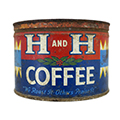
H and H Advertising Sign
Five substrate types put the H and H brands into grocer windows, cafe walls, and outdoor billboard space across the brand’s active period — cardboard litho counter signs, lithographed tin signs, flat metal panels, hand-painted plywood boards, and heavy-paper price signs. The cardboard litho and tin formats distributed through the retail grocery channel; the painted plywood and wall signs served on-premise institutional accounts.
Quick ID:
- Cardboard litho counter sign — horizontal format (~19×9 in), “Fragrant…” rose graphic left + painted H&H Blend tin center + H AND H COFFEE banner right; Continental Litho. Corp. Cleveland credit in lower-right margin; “NO. 2” stock mark at lower left on documented examples
- Texas Girl tin sign — rectangular litho tin, cream block letters on a red field (in-collection example) or magenta field (Grimsley reference, Kansas); portrait vignette absent — wordmark-only design
- Texas Girl metal panel sign — flat black-painted metal with rounded corners; “AN H and H PRODUCT” crest above the Texas Girl wordmark; “WE ROAST IT / OTHERS PRAISE IT” slogan
- Master Chef plywood sign — large ~4×8 ft hand-painted board, red field, white display lettering; “WE SERVE” header; chef portrait carries a heavy handlebar mustache and direct expression — distinct from the round-faced jolly chef on the tin cans
- Price/POS sign — ~7×12 in heavy paper (~20 lb stock), printed in red ink; retail shelf or counter use
Sign types
Cardboard litho counter sign (H and H Blend Coffee). Horizontal format designed for grocer counters and windows. The layout reads left to right: a painted one-pound H and H Blend Coffee tin in the red-white-blue label (“Steel Cut 100% Pure”), a trailing illustrated rose picking up the “Fragrant…” script, and the H AND H COFFEE banner with “Hoffmann-Hayman Est. 1899 Co.” and the “We roast it — others praise it” tagline. Stock numbers (“NO. 2” visible on HH-COLL-2019-0003) suggest a numbered run of related designs. Printer: Continental Litho. Corp., Cleveland (credit on HH-COLL-2019-0003).
Texas Girl tin sign. Rectangular lithographed metal sign for retail display. The in-collection example (HH-COLL-0000-0045) uses a red field with cream block letters; a second example documented by Darin Grimsley and found in Kansas (HH-REF-0000-0018) shows a magenta field, indicating at least two color variants. The tin sign design drops the portrait vignette used on the Texas Girl tins in favor of a single bold wordmark. Tin sign fabricator undocumented.
Texas Girl metal panel sign. Flat black-painted metal with rounded corners (HH-COLL-2026-0001). Carries the “AN H and H PRODUCT” crest above the Texas Girl wordmark and the “WE ROAST IT / OTHERS PRAISE IT” slogan. Distinct from the tin litho format — applied paint rather than lithography, likely intended for longer-term display in a trade setting.
Master Chef painted plywood sign. Large (~4×8 ft) hand-painted board on thin plywood with nail-head mounting evidence along top and bottom edges (HH-COLL-2014-0003). Red field, white mixed-case brush lettering for “Master Chef,” “WE SERVE” across the top. A small diagonal black banner with yellow “H and H” type tucks into the M; “COFFEE” in black block capitals sits in a yellow sunburst, lower right; a mustached chef fills the lower left. The chef portrait — handlebar mustache, direct expression — is a distinct design from the open-faced grinning chef on the tin cans. On-premise sign, not a later reprint. Attributed to Stevens Outdoor Advertising.
Price/POS sign (Master Chef). Heavy paper (~20 lb stock), ~7×12 in, printed in red ink (HH-COLL-2015-0016). Acquired unused from New Braunfels, TX. Format suggests retail shelf or counter display rather than window or wall mounting.
Outdoor billboard. A 1929 employee photo (HH-COLL-2018-0003) documents a large “Fragrant…” billboard — possibly a supersized execution of the same Continental Litho cardboard design — with Hoffmann-Hayman staff posed in front (the photo is the left half of a two-billboard Summerville panorama). No physical billboard survives in the collection; the employee photo is the primary documentation. (The companion HH-COLL-2018-0004 in the same lot is the 1933 “In Step with N.R.A.” factory-steps photo, not a second view of the billboard.)
On-premise wall signs (institutional). Master Chef Coffee signage appears on the Mi Tierra Cafe exterior at 218 Produce Row in the UTSA Ray Howell photograph collection (HH-REF-9020-0001) and in a 2024 Witte Museum exhibit of Al Rendón’s work (HH-REF-2024-0001). “Serving H&H Coffee” storefront signage appears at the Oriental Cafe (HH-REF-0000-0025). No physical examples from this format are in the collection.
Dating
Signs are the hardest H and H item type to date precisely — no newspaper launch coverage documents the cardboard litho run, and the plywood painted sign carries no date mark. Anchor points:
- 1929: Earliest dated sign documentation — the employee billboard photo (HH-COLL-2018-0003), now re-dated from 1934.
- Continental Litho cardboard sign: Depicts the keywind-era H and H Blend tin (“Steel Cut 100% Pure”), placing production after c.1930. The “Hoffmann-Hayman Est. 1899” legend confirms pre-1962 (pre-Continental acquisition).
- Texas Girl tin sign: Graphics read as 1930s retail; exact issue date unconfirmed.
- Master Chef plywood sign: Predates the 1962 Continental acquisition; West Texas provenance suggests active display through the late 1950s–early 1960s.
Manufacturer
Cardboard litho signs: Continental Litho. Corp., Cleveland — directly documented via printer credit on HH-COLL-2019-0003 (“Continental Litho. Corp. Cleveland” in the lower-right margin). No company file exists in the KB for Continental Litho.
Painted plywood/outdoor signs: Stevens Outdoor Advertising, San Antonio (Silas P. Stevens) — documented as the fabricator of H and H signs and billboards including the Master Chef plywood sign (see companies/stevens-outdoor-advertising.md).
Tin sign fabricator: Undocumented. No bottom-panel markings or printer credits have been confirmed on any Texas Girl tin sign example.
Metal panel signs: Fabricator undocumented. The flat-painted construction differs from the litho process and may have been produced locally.
Artifacts
In the collection
- HH-COLL-0000-0045 — Texas Girl Coffee tin sign (red litho, cream block letters)
- HH-COLL-2014-0003 — Master Chef 4×8 ft hand-painted plywood sign (West Texas, 2014)
- HH-COLL-2015-0016 — H and H Price Sign (~7×12 in heavy paper, red ink; unused)
- HH-COLL-2018-0003 — 1929 “Fragrant…” billboard with Hoffmann-Hayman employees (photo; left half of the Summerville panorama)
- HH-COLL-2018-0004 — “In Step with N.R.A.” 1933 employee group on the factory steps (same 2018 lot; “Buy Now” display signs)
- HH-COLL-2019-0003 — H and H Coffee cardboard litho counter sign (Continental Litho. Corp. Cleveland)
- HH-COLL-2019-0004 — Detail: painted H&H Blend tin + “NO. 2” stock mark on cardboard sign
- HH-COLL-2019-0005 — Detail: H AND H COFFEE banner + Continental Litho. Corp. credit on cardboard sign
- HH-COLL-2019-0025 — H and H Coffee “We Roast It, Others Praise It” cardboard sign
- HH-COLL-2026-0001 — Texas Girl Coffee black metal sign panel (rounded corners, “AN H and H PRODUCT”)
Reference
- HH-REF-0000-0015 — H and H cardboard counter sign (~19×9 in; not in collection)
- HH-REF-0000-0016 — Texas Girl Sign (reference)
- HH-REF-0000-0018 — Texas Girl Coffee framed tin sign, magenta field (Darin Grimsley; found in Kansas)
- HH-REF-0000-0025 — “Serving H&H Coffee” storefront signage, Oriental Cafe and Bar, San Antonio
- HH-REF-2024-0001 — Master Chef Coffee wall sign visible in Witte Museum exhibit (Al Rendón retrospective, 2024)
- HH-REF-9020-0001 — Mi Tierra Cafe, 218 Produce Row — Master Chef Coffee exterior signage (UTSA Ray Howell collection p9020coll4/412)
Wanted
None documented.
Open questions
- Three sign artifacts currently cataloged as
nomenclature_term: "sign"appear to be misclassified: HH-COLL-2016-0019 (Edible SA magazine spread showing the Mi Tierra Master Chef sign — should beperiodical), HH-COLL-2023-0004 (1932 newspaper reprint — should beclippingorprint), and HH-REF-1932-0002 (GW Mitchell factory interior photo — should bephotograph). These are excluded from the artifact lists above pending reclassification. - Does the “Fragrant…” design on the 1929 employee billboard (HH-COLL-2018-0003) match the cardboard litho counter sign in the collection? If so, the “Fragrant…”/rose motif was in use by 1929 — which sits in tension with the post-c.1930 reading of the Continental Litho cardboard (above) and would suggest the motif had an earlier execution than the surviving cardboard sign.
- What other stock numbers in the Continental Litho counter-sign run exist? Only “NO. 2” is documented.
- Has a Texas Girl tin sign been found with a printer credit?
- Is there a Continental Litho. Corp. entry in any trade directory that would date the sign run more precisely?