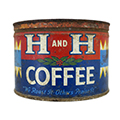
Master Chef Coffee Tin
The hotel-trade brand’s consumer tin — red litho keywind, chef mascot, H AND H diamond lockup — first documented in retail form in the Corpus Christi market in 1952, though the brand itself dates to c.1927.
Quick ID:
- Bright red litho with white chef’s-toque mascot — no other H and H tin uses this color/mascot combination
- “Master Chef Coffee” lettering + H AND H diamond lockup on label panel
- “Finest Hotel Coffee For Home Use” strapline → classic keywind era (c.1935–c.1957)
- Brighter red with revised chef art → mid-century redesign (c.1957+)
- “Free 250 Trading Stamps” sticker on lid → trading-stamp era (c.1960–c.1962)
- Keywind strip present on all documented retail examples — no slip-lid Master Chef tin is known
Form
Round cylindrical keywind tin with a flat friction lid. Lithographed in bright red with the white chef’s-toque mascot, “Master Chef Coffee” lettering, and the H AND H diamond mark. The red-and-yellow color scheme distinguishes it from the red-and-cream H and H Blend tins.
Size variants
| Size | Grind callouts | Notes |
|---|---|---|
| 1 lb | Regular, Drip, Pulverized, Fine grind | Most common form; keywind |
| 2 lb | Regular | One example in collection (2018) |
| 3 lb | Drip, Regular | Keywind; early 1960s examples documented |
Label eras and dating
“Cafe Coffee” era (1932): The earliest copy reads “Master Chef Cafe Coffee” — the “Cafe” suffix disappears by 1935 as the brand moves toward retail. No tin from this era is documented in the collection.
Classic keywind (c.1935–1957): Red litho, chef mascot, “Finest Hotel Coffee For Home Use” positioning strapline. One-pound standard.
Mid-century redesign (c.1957+): Brighter red, revised chef art; Jourdanton-area example documented in the collection showing the transition. “Master Chef Instant Coffee” appears as a separate line in this era.
Trading-stamp era (c.1960s): “Free 250 Trading Stamps” sticker on lid; one example in collection. Late red livery.
Grind system
Keywind tins carry explicit grind callouts on the label panel: Regular Grind, Drip, Pulverized (the finest), and a special Fine grind for glass brewers marked with a blue sticker on some examples.
Manufacturer
Container: American Can Company (Canco) — documented in the collection accession records and confirmed by physical Canco imprints on collection artifacts (2026-05-24). The round cylindrical keywind form is the standard American Can format of the 1930s–1960s. Canco imprints typically appear on the base or underside of the lid; specific mark text, plant codes, and date codes have not yet been transcribed from the collection specimens — photograph and transcribe to anchor label-era dating. See American Can Company.
Label / lithography: Simpson & Doeller Co., San Antonio TX — the same lithographer documented on H and H Blend tins (HH-COLL-0000-0062). Attribution for Master Chef tins is by inference from the established Simpson & Doeller / H and H relationship; a direct bottom-panel marking on a Master Chef tin has not yet been documented.
Artifacts
In the collection
- HH-COLL-0000-0006 — Master Chef 1 Pound Tin (classic keywind, early example)
- HH-COLL-0000-0008 — Master Chef 3 lb Tin
- HH-COLL-0000-0075 — H and H Master Chef One-Pound Keywind Tin
- HH-COLL-2008-0001 — Master Chef 1 lb Tin (2008 acquisition)
- HH-COLL-2015-0026 — Master Chef Updated One Pound Tin (mid-century redesign)
- HH-COLL-2015-0076 — H and H Master Chef one-pound tin (Nov 2015)
- HH-COLL-2016-0012 — Two Master Chef Pulverized 1-pound Keywind Tins (1950s bright red livery)
- HH-COLL-2017-0024 — H and H Master Chef tin with matching lid; trading stamps (2017)
- HH-COLL-2019-0031 — One-pound Regular Grind with FREE 250 Trading Stamps sticker
- HH-COLL-2019-0032 — H and H Master Chef One-Pound Keywind Tin (2019)
- HH-COLL-2023-0002 — Master Chef Two Pound Tin Front
- HH-COLL-2023-0003 — Master Chef Two Pound Tin Lid
- HH-COLL-2023-0005 — Master Chef two-pound tin front (Jan 2023)
- HH-COLL-2023-0006 — Master Chef two-pound tin top (Jan 2023)
- HH-COLL-2026-0005 — Master Chef two-pound tin, c.1962+ (lot tin #1)
- HH-COLL-2026-0006 — Master Chef two-pound tin (lot tin #2) — white-script livery, earlier label generation
Reference
- HH-REF-0000-0005 — Master Chef reference (Instagram archive)
- HH-REF-0000-0006 — Master Chef reference (Instagram archive)
- HH-REF-0000-0033 — Master Chef reference
- HH-REF-0000-0034 — Master Chef reference
- HH-REF-0000-0035 — Master Chef reference
- HH-REF-0000-0114 — Master Chef reference (Instagram archive)
- HH-REF-0000-0144 — Master Chef reference
- HH-REF-0000-0145 — Master Chef reference
- HH-REF-0000-0146 — Master Chef reference
- HH-REF-0000-0147 — Master Chef reference
- HH-REF-1942-0001 — Master Chef c.1942 reference
- HH-REF-1954-0001 — Master Chef c.1954 reference
- HH-REF-1961-0001 — Master Chef 1961 reference
Wanted
None documented.
Open questions
- Has a Simpson & Doeller bottom-panel marking been documented on any Master Chef tin? (Would confirm lithographer attribution.)
- Is the “Cafe Coffee” suffix (c.1932) attested on a surviving tin, or only in print advertising?
- Are 2 lb tins documented before the 2018 West Bend percolator-premium acquisition?
See also
- Master Chef Coffee — brand guide
- Mi Tierra Café — documented long-term Master Chef customer
- American Can Company
- H and H Paper Sample Cup
- Master Chef Label Evolution