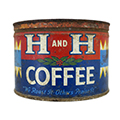
Hoffmann-Hayman Coffee Company
Hoffmann-Hayman Coffee Company
The Hoffmann-Hayman Coffee Company of San Antonio — also written “Hoffman-Hayman” — was incorporated in February 1912 as successor to two predecessor businesses. It operated under various names and eventually became the H and H Coffee Company.
Founding (1912)
William R. Hoffmann died January 10, 1912 (see William R. Hoffmann). His widow and business partner W. E. Hayman reorganized the business within weeks.
Charter filed: February 5, 1912, Austin, Texas (Department of State) Capital stock: $20,000 (three-fourths paid in at charter) Charter term: Fifty years (expires 1962) Purpose: General merchandising (wholesale coffee, tea, spices, extracts)
Incorporators and first-year directorate:
- W. E. Hayman
- Mrs. William R. Hoffmann (Minnie Menger)
- Gustave Menger
- J. C. Neeley (directorate only)
Successors to:
- The wholesale coffee, tea, and spice business of Wm. R. Hoffmann (est. ~1899, operated at 228 East Commerce Street)
- Merchants Coffee Co. — a local San Antonio concern owned by W. E. Hayman (per the 1923 “New Home” retrospective). Hayman brought this company into the merger, explaining his position as first president.
Founding date — resolved
October 1904 is the confirmed founding date for the H and H brand. Two independent 1934 sources establish this:
- The “30 Years of Progress” illustration (Oct 12, 1934) shows 1904 as year one, with caption “Original Hand Roaster used by William R. Hoffmann in creating the famous Hand H Blend Coffee 30 years ago.”
- The “Thank You” anniversary ad (Oct 19, 1934) states: “Just thirty years ago this month, the first H and H Product was sold.”
The 1934 article text reads “Wm. R. Hoffman, in 1914…” — this is a typo for 1904.
Founding year appears differently across sources — all consistent with the ~1899–1904 period:
| Source | Year | Context |
|---|---|---|
| 1921 article | 1900 | “established here in 1900 by the late William R. Hoffman” |
| 1923 retrospective | ~1898 | “one quarter of a century ago” (from 1923) |
| 1932 ads | 1899 | “Coffee Importers and Roasters Since 1899” (company’s own claim) |
| 1934 anniversary | 1904 | “thirty years ago this month, the first H and H Product was sold” |
Best interpretation: Hoffmann entered the San Antonio coffee trade around 1899–1900, working initially as a clerk at George C. Sauer’s grocery on Alamo Plaza. He created the specific H and H blend in October 1904, which the company later treated as the brand’s founding moment. The company used “Since 1899” as their official founding claim in advertising.
Location
| Period | Address | Notes |
|---|---|---|
| pre-1912 | 228 East Commerce Street | Hoffmann’s original wholesale business |
| ~1899–1904 | George C. Sauer’s grocery, Alamo Plaza | Where Hoffmann first began roasting (as a clerk) |
| 1912 | 1223 West Commerce Street | At incorporation; phone 3025 (old: 7803) |
| by 1922 | 307 North Medina Street | Documented Dec 1922; photo of multi-story brick building |
| 1923–1932 | 331 Burnett Street | “New home” confirmed in Aug 1928 fire report; sources also give 211 Burnett |
| 1932– | 601 Delaware Street | Final major plant; see 601 Delaware Street Plant |
Operations
February 1912 (opening):
- Wholesale green and roasted Coffee, Teas, Spices, and Extracts
- Roasting capacity: 75 bags per day
- Job roasting by either gas or coke
Early years (Hoffmann era): Hoffmann “solicited during the day and roasted and packed coffee during the evening, delivering the following day.” Original roaster capacity: 300–400 lbs/day.
January 1920 (San Antonio Express-News, Jan 30, 1920):
- Two large roasters, capacity frequently reaching 10,000 pounds daily
- H and H Blend sold throughout Southwest Texas
August 1921 (San Antonio Light, Aug 14, 1921):
- Three roasters, each 200 lbs/hour; average daily output: 14,480 lbs (96 bags)
- 17 employees operating machines; 2 traveling + 4 city salesmen
- Factory: 7,000 sq ft
- H and H tea in first year: 65% store distribution in San Antonio; “surpassed all expectations”
December 1922 (San Antonio Light, Dec 10, 1922):
- 90% of city grocers carry H and H products; practically all grocers within 100-mile radius
- Business “better this summer than it ever has been since H and H was placed on the market”
Products
| Brand | First documented | Notes |
|---|---|---|
| H and H Blend Coffee | 1904 (founding) | Flagship blend; created by Wm. R. Hoffmann with hand roaster |
| H and H Orange Pekoe Tea | by 1923 | Sourced from Ceylon |
| H and H Spices | by 1923 | Black/white pepper, cinnamon, nutmeg |
| H and H Extracts | by 1923 | Lemon documented |
| H and H Pure Soluble Cocoa | by 1923 | Soluble, guaranteed |
| Sam Houston Coffee | by 1934 | Named brand; one of three “famous” products |
| Texas Girl Coffee | by 1933 | Named brand; featured in 30th anniversary |
| H and H Drip Grind Coffee | by 1941 | See H and H Drip Grind |
See H and H Product Line for full detail.
1913 — Morrison Coffee Company fire
A fire at the Morrison Coffee Company plant, 214 South Comal Street, on August 13, 1913, destroyed approximately $3,000 worth of coffee, tea, and spices. This was a competing roaster, not the Hoffmann-Hayman plant. The cause was believed to be a lighted cigar stump thrown into a sawdust-filled cuspidor. The building was owned by Fest & Trawalter ($1,200 value; insured for $800); stock insurance amounted to $8,000.
This event is notable because in 1917, Hoffmann-Hayman acquired the Morrison Coffee Company and its assets, doubling their production capacity. (Source: GW Mitchell blog, Jan 2017 — secondary source; confirm with primary.)
1914 — Ft. Sam Houston order
According to the GW Mitchell blog (2017), in 1914 the company “filled the largest ever order for San Antonio coffee — a bulk purchase carried by eight wagons and sixteen horses to Ft. Sam Houston.” (Secondary source — no primary confirmation yet.)
1917 — Morrison Coffee Co. acquisition
The company doubled production capacity by acquiring the Morrison Coffee Company and its assets. (Source: GW Mitchell blog — secondary; confirm with primary.)
1919 — Advertising campaign launch
The San Antonio Light, November 11, 1919, announced “the largest coffee advertising campaign ever put on in San Antonio,” launched by the Hoffmann-Hayman Coffee Company. This first ad of the campaign appeared in that issue.
At this date, the company occupied a portion of the Caffarelli Brothers building, North Medina and West Travis Street — an intermediate address between the 1912 W. Commerce St location and the 1922 N. Medina address.
W. E. Hayman (quoted): “We owe our success largely to two factors… The first is quality. We have insisted on quality in our coffee at all times… The next is the growth of San Antonio which has caused a parallel growth in every business concern.”
The article also notes the company’s daily output was “frequently 10,000 pounds of coffee” by 1919.
1920 — Menger family takeover
In 1920, W. E. Hayman’s interests were bought out by G. P. Menger, who became president. R. W. Menger became secretary-treasurer. Mrs. Hoffmann (by then remarried as Mrs. William J. Schlosser) retained her full interest as Vice-President and Director.
Leadership as of August 1923
| Name | Role |
|---|---|
| Gus R. Menger | President |
| Mrs. (Dr.) William J. Schlosser | Vice-President and Director |
| R. W. Menger | Secretary-Treasurer |
| T. J. Menger | Credit Manager |
| L. B. Menger | Custodian of Accounts |
| R. A. Nagel | Office Manager |
| Chris Jasso | Superintendent, Packing Dept. |
| Paul Rochs | Pioneer Coffee Salesman (11 years’ service) |
| Joachum Morales | City Salesman |
| P. J. Smith | City Salesman |
| E. E. Knous | Restaurant Specialist |
| Mrs. Clara H. Allred | Special Demonstrator |
| Miss Irene Brown | Demonstrator |
See Menger Family for full detail on family roles and succession.
Leadership as of October 1934
| Name | Role |
|---|---|
| G. P. Menger | President |
| Mrs. Wm. J. Schlosser | Vice-President |
| R. W. Menger | Secretary |
| T. J. Menger | Treasurer (was Credit Manager in 1923) |
| Paul A. Rochs | Sales Manager (was pioneer salesman in 1923) |
| A. V. Fitzgerald | Field Superintendent (new by 1934) |
Distribution by 1934: retail grocers in 150 cities in Texas.
New plant (1932)
Built during the Depression. See 601 Delaware Street Plant for full detail.
- Address: 601 Delaware Street, at Southern Pacific tracks
- Cost: $130,000; 16,000 sq ft; two-story fireproof
- Occupancy: ~November 1932
- Open House: December 21, 1932, 6:30–10:30 PM; broadcast on WOAI
- Previous address: 331 Burnett Street (~1922–1932)
1932 officers (December, at new plant opening)
| Name | Role |
|---|---|
| Gus P. Menger | President |
| Mrs. Schlosser | Director (former widow of Hoffmann; wife of Dr. Wm. J. Schlosser) |
| William P. Hoffman | Vice President (likely son of founder Wm. R. Hoffmann) |
| R. W. Menger | Secretary |
| T. J. Menger | Treasurer |
William P. Hoffman appears as VP for the first time in December 1932 — a significant finding. Given his age (~20 in 1932), he is almost certainly the child of William R. Hoffmann and Minnie Menger. His appearance in the VP role suggests the founding family’s next generation joined the leadership.
1937 expansion
By November 1937, additional vacuum packing machinery had been installed at 601 Delaware for 1 and 3-pound cans (tin), complementing the Crystalvac glass jar line.
Product formats available by 1937:
| Format | Description |
|---|---|
| Paper bag | Economical option |
| Vacuum can | Tin, 1 and 3-pound sizes |
| Vacuum jar (Crystalvac) | Reusable glass, wide distribution statewide |
Grinds: drip grind (glass brewers), all drip, regular grind (percolators). Texas Girl in drip or regular.
The Nov 21, 1937 SA Light confirmed: “Thirty-three years ago this month, the first H and H Product was sold” — placing the founding in November 1904. The Oct 1934 ad said October; the one-month variance across ads is unresolved.
Note: a competitor, Aviation Coffee Company (119 S. Medina St), suffered a complete loss by fire on Feb 27, 1937 — shortly before Hoffmann-Hayman’s expansion was announced.
Crystalvac (1932)
See Crystalvac. The vacuum-packed reusable glass jar, launched June 1932, was a major innovation. Crystalvac equipment cost $10,000+; Three Rivers Glass Company supplied 250,000 jars. First vacuum-packing of coffee in glass in Texas.
Slogans
- “We Roast It, Others Praise It” — primary slogan, registered as a U.S. trademark (Reg. No. 160,728; Serial No. 161,907; Class 46 — Foods and Ingredients of Foods; filed April 10, 1922 by Hoffmann-Hayman Coffee Co., San Antonio). The Patent Office filing claims use since 1917, pushing the documented slogan use back from the previously-known 1923 reference. (Source: USPTO Official Gazette clipping in collection.)
- “A Square Deal Here or No Deal” — added by 1934
Advertising (1923)
Advertising handled by the Pitluk Advertising Co. (State and Baxter Bldg., San Antonio). Campaign included: newspaper advertising, illuminated bulletins, motion picture films and slides, window displays, store displays, demonstrations, road signs.
Company slogan: “We roast it, others praise it” — described in 1923 as a “famed national slogan.”
Market penetration: “More than fifty per cent of the housewives of San Antonio are consistent users of one or more H and H quality products” (1923).
1960 — Leadership succession
In May 1960, Albert G. Menger (age 42, son of G. P. Menger) was elected president. G. P. Menger moved to the newly created role of Board Chairman. See Menger Family for full succession detail.
Products as of 1960: Master Chef Coffee, Master Chef Instant Coffee (new), H and H Coffee, Texas Girl Coffee, plus other consumer and institutional brands. The firm served more than half of San Antonio area restaurants, cafes, and institutional coffee users.
1960s — Continental Coffee acquisition
In the mid-1960s, the Hoffmann-Hayman Coffee Co. was purchased as a division of Continental Coffee. This ended the company’s independent operation after more than six decades as a San Antonio family business. (Source: GW Mitchell blog, Jan 2017 — secondary; no primary source confirmed.)
The original Delaware Street factory was listed for sale in 1972.
Building additions (601 Delaware Street)
- 1949 — significant addition to second story
- 1955 — additional second-story expansion
- The factory building was eventually listed for sale in 1972; as of 2017 was “being prepared as a historical site”
Open questions
- What was the Merchants Coffee Co., and who owned it before 1912?
- When did the company name change from “Hoffmann-Hayman” to “H and H Coffee Company”?
- What role did J. C. Neeley play beyond the first-year directorate?
- Was “Broncho Coffee” (shown in a period ad image alongside H and H Blend, Sam Houston, and Menger Brand Peaberry) an H and H brand or a competitor?
- Primary source confirmation needed for: 1914 Ft. Sam Houston order; 1917 Morrison acquisition; 1960s Continental Coffee sale.
See also
- William R. Hoffmann
- W. E. Hayman
- Western Coffee Company
- H and H Drip Grind Coffee
- 1223 W. Commerce St. (stub — page not yet created)