Packaging and Preservation
Coffee goes stale. Every packaging decision Hoffmann-Hayman made from 1932 onward was an argument against that fact.
The first argument was Crystalvac: a vacuum-packed, reusable glass jar introduced in June 1932, described in the Express-News as “revolutionizing the local coffee industry” and “the first apparatus of its kind in the state.” A 250,000-jar initial order from Three Rivers Glass Company. The slogan — “It’s Days Fresher, and It Stays Fresher” — made freshness the brand promise. A Crystalvac jar on the roof of the new Delaware Street plant, visible for blocks, made it the company’s literal landmark.
The second argument was Flav-O-Tainer: a heat-sealed, cellophane-lined paper bag introduced in December 1942 when the War Production Board restricted civilian tin. The name was a portmanteau — Flav (flavor) + O + Tainer (container) — and the ads were explicit: “One lb. of critical metal is saved with every 3 Flav-O-Tainers!” The bag disappeared from the record by late 1943, when rationing eased.
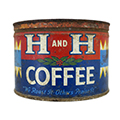
Between them: paper bags, vacuum tins, keywind cans, and the H and H Drip Grind Coffee line tied to glass brewers (Pyrex Vaculator promotion, 1941). The packaging format was never just logistics — it was how H and H positioned freshness, price, and modernity in each decade.