When “N.R.A.” Meant Recovery, Not Rifles — The National Recovery Administration (1933–1935)
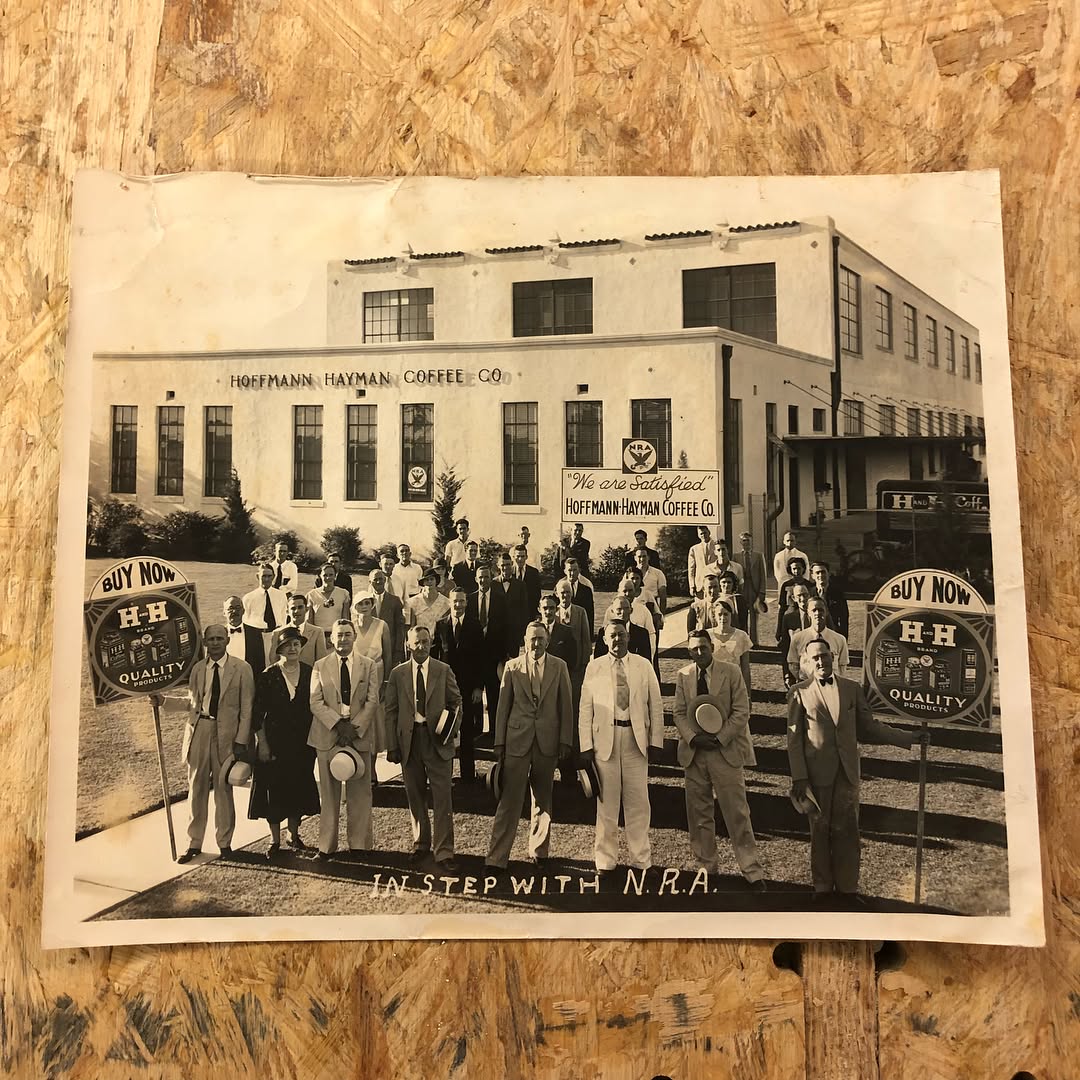
Hoffmann-Hayman staged this factory publicity shot on the San Antonio plant steps: National Recovery Administration eagle disks, hand-lettered satisfaction copy, and the IN STEP WITH N.R.A. caption tie the firm visually to the federal recovery drive — not to firearms. Provenance and second print from the same lot: 1934 Hoffmann-Hayman Employees at the “Fragrant…” Billboard.
On Depression-era packaging and newspaper grocery pages, you will also see the letters “N.R.A.” paired with a stylized blue eagle and slogans such as “We Do Our Part.” Today many readers first think of the National Rifle Association — same initials, completely different story. In the 1930s grocery trade, “N.R.A.” almost always meant the federal National Recovery Administration, one piece of President Franklin D. Roosevelt’s New Deal.
This note is a short field guide for museum visitors who encounter those marks on H and H materials or other San Antonio–area ephemera.
What the National Recovery Administration did
Congress passed the National Industrial Recovery Act (NIRA) in 1933. Title I created the National Recovery Administration to help stabilize the economy after the crash of 1929. The idea was to pause cutthroat competition — widespread discounting and wage cuts — by bringing employers and workers together under “codes of fair competition” by industry. Once a code was approved, participating firms could display the program’s symbol and advertise their compliance.
General Hugh S. Johnson led the NRA at first; the agency’s active phase was intense but brief. The Supreme Court struck down central parts of the NIRA in 1935 (Schechter Poultry Corp. v. United States), and the broad federal code machinery wound down. Even so, the visual campaign — especially the Blue Eagle — left a deep imprint on 1933–1935 advertising.
The Blue Eagle and “We Do Our Part”
Businesses that signed on could use the Blue Eagle emblem and the motto “We Do Our Part.” On shelves and in newspapers, that pairing signaled participation in the recovery program, not a firearms organization. Alongside coffee, spices, and canned goods, you also find the eagle on displays for mustards, dressings, and other packaged foods sold under grocery brands of the period.
Codes varied by trade: some addressed hours and wages; others focused on pricing and fair selling practices. Not every detail mapped cleanly to every firm, and historians debate how much the NRA helped recovery versus paperwork — but for reading old ads, the important point is practical: the initials referred to an economic recovery agency, not gun policy.
H and H in the Register (29 December 1933)
A December 1933 Hoffmann-Hayman grocery display in the San Antonio Register shows how the Blue Eagle program looked on the printed page: the N.R.A. initials, the eagle symbol, and “WE DO OUR PART” sit in the same panel readers would scan for brand trust — not firearms messaging, but New Deal compliance branding beside house-product copy.

Hoffmann-Hayman in the collection
Where we have clear artifacts, the museum ties the general history to San Antonio examples:
- Factory publicity: The “In Step with N.R.A.” lead image above is from the collection’s circa-1933–1935 Hoffmann-Hayman press prints — plant steps, Blue Eagle disks, and the painted banner across the foreground. See the full write-up and companion billboard shot in 1934 Hoffmann-Hayman Employees at the “Fragrant…” Billboard.
- Grocery advertising: A November 1933 News display for H and H Dutch Lunch Mustard carries the “WE DO OUR PART” Blue Eagle panel beside the jar illustration — typical period grocery placement. See H and H Dutch Lunch Mustard — display ad (The News, 25 Nov 1933).
Those pieces do not prove every Hoffmann-Hayman product line carried an eagle mark; they show how the firm participated visually in the national campaign when it ran newspaper and promotional material during the Blue Eagle years.
How to read “N.R.A.” on old paper
When you see N.R.A. on 1930s coffee or food advertising:
- Check the decade — the recovery administration’s public symbol campaign aligns with 1933–1935.
- Look for the eagle or “We Do Our Part” — strong hints it is the New Deal program.
- Remember the alternate meaning — today’s gun-policy NRA is a different organization with the same initials; context and date usually disambiguate historical sources.
If you are transcribing old clips for research, spelling out “National Recovery Administration” once in a note saves the next reader the same moment of confusion — without rewriting original headlines that used only the initials.
Further reading (general reference)
- National Archives: Federal records and context on NIRA and New Deal agencies — a stable starting point for deeper archival work.
- Standard U.S. history surveys covering 1933–1935 explain the NRA’s rise and the 1935 court decision that curtailed the code system.
For this site, the takeaway is simple: on H and H factory photos and 1930s grocery ads, “N.R.A.” belongs to the National Recovery Administration and the Blue Eagle recovery drive — not the rifle association that later dominated the same initials in American politics.


