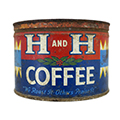
H and H Coffee Roaster Equipment Lifecycle
From a 25-pound hand drum in the Spahn Bakery shack to four Jabez Burns Jubilee roasters sold to Monterrey after Continental Coffee left the building — this is the documented arc of Hoffmann-Hayman’s roasting hardware. No production roaster from the H&H line survives at 601 Delaware Street today; the lifecycle is reconstructed from newspaper coverage, family papers, one plant photograph, and dealer reference photos of comparable machines.
1904 — Hand roaster (founding)
In October 1904, William R. Hoffmann bought a small hand coffee roaster (~25-pound capacity; 20 pounds in the 1923 Light caption) for “a few dollars” and installed it in a shack behind the Spahn Bakery on East Commerce. He solicited orders by day, roasted at night, delivered by horse and buggy. The Studer Studios photo in the 22 July 1935 Express-News feature shows the machine: horizontal drum on an open four-legged stand with an end crank — not the enclosed fire-box form of later merchant roasters.
The roaster became a company relic: displayed at the December 1932 Delaware Street open house (“hardly larger than a 50-pound lard can”) and still hanging in Hoffmann-Hayman offices in 1937. Whereabouts after the 1960s are unknown.
1904–1912 — Bricked-in Jabez Burns (family papers)
Nancy Draves (2015, family-paper paraphrase) records that Hoffmann traveled to New York between 1904 and 1912 and bought a 150-pound bricked-in Jabez Burns roaster. This is a separate machine from the Spahn hand roaster — production scale, fixed installation. No invoice or trade-press confirmation on this site yet.
By 1921 — Three roasters, Burnett Street
At 331 Burnett Street, H&H ran three roasters at 200 lbs/hour each; average daily output reached 14,480 pounds with 17 machine operators (August 1921 Light). Make and model are not named in that source.
1923 — Huntley Monitor line documented
The 26 August 1923 San Antonio Light H&H Day spread is the strongest primary documentation for plant equipment: Huntley Manufacturing Company Monitor roasters, with William F. Fischer credited for personal installation. Interior photos caption “HUGE H AND H ROASTERS” and “AUTOMATIC WEIGHER AND PACKER.” By 1927 the plant added three additional roasting machines, doubling capacity (Light, 7 April 1927).
Whether Monitor hardware carried into the 1932 Delaware Street build is undocumented — an open question on the Huntley company page.
Pre-Jubilee Burns — archive print (pat. 1912)
Collection print HH-PHOTO-2019-0002 shows an operator at a production drum roaster with Hoffmann-Hayman sacks behind. Drum embossing reads ROASTER and PAT. FEB. 6, 1912. — a Jabez Burns generation before the Jubilee line (JUBILEE ROASTER / PAT. FEB. 9 - 1915.). Huntley Monitor attribution for this print remains open until the Huntley catalog comparison (TODO-12).
H&H likely ran Burns and Huntley hardware in parallel across plant generations — not a clean single-vendor line.
Delaware Street — four Burns Jubilee roasters
By the 601 Delaware era the plant operated four Jabez Burns Jubilee roasters. Chris M. Jasso recalled in a 8 July 1971 letter (paraphrased by Nancy Draves) that the machines were already old when H&H “hooked them up” roughly 30 years earlier (~1940s install) — which may mean new-to-the-plant installation of used equipment, not necessarily a 1940s manufacture date.
Dealer reference photos ingested 2026-05-25 document a surviving Jubilee model 14R46 (PAT. FEB. 9 - 1915 on nameplate) — plausible visual match for the machine class Jasso described, though not proven to be from 601 Delaware.
| Attestation | Detail | Reliability |
|---|---|---|
| Chris Jasso (1971) | Four Jubilee roasters at H&H; hooked up ~1940s | mixed (family letter paraphrase) |
| Nancy Draves (2015) | Hoffmann NY Burns purchase 1904–1912; Mengers “used Burns forever” | mixed |
| Newspaper (1923) | Huntley Monitor at Burnett Street | high |
| Archive print (2019) | Burns ROASTER pat. 1912 at H&H plant |
high (photo); make inferred from plate |
1962 — Continental acquisition; equipment stays in building
December 1962: H&H sold assets including plant contents to Continental Coffee Company of Chicago, with a 10-year building lease (Nancy Draves notes). Roasting continued at 601 Delaware under Continental branding through at least the early 1970s. Retired roaster Lupe Valdez and Jasso were still visiting “the old gang” at the plant in 1970–1971.
1971 — Jubilee roasters sold to Monterrey
In 1971, Continental sold all four Burns Jubilee roasters to Señor Ernesto Gonzales of Monterrey, who transported them across the border and installed them there. Gonzales later retained Jasso and Valdez to commission the line; Valdez successfully restarted production (500 lbs in a test batch). One TEMPO-VANE electronic thermostat failed to cut off on time and was replaced; Jasso documented 420°F as the uniform-roast cutoff.
This is the best post-1962 documentation of major roasting equipment disposition — exported to Mexico rather than scrapped on site. See 1971 — Burns Jubilee roasters sold to Monterrey.
Today — what remains at 601 Delaware
- Old Roaster power box — cream-enamel door with embossed OLD ROASTER label; in-situ roasting-line infrastructure (Old Roaster switch).
- No drum roasters — Jubilee line gone by 1971; hand roaster lost; Monitor and vacuum-packing / Crystalvac machinery unaccounted for.
- Comparable search targets: open-frame ~25 lb hand roaster (Spahn-era form); Huntley Monitor (1923 documented vendor); Burns Jubilee 14R46 class (dealer reference only).
Open questions
- When exactly were the four Jubilee roasters installed at Delaware — new in 1932, or later used-equipment adds (~1940s per Jasso)?
- Did the 1932 roasting line include Monitor, Burns, or both?
- Where did the 1904 hand roaster go after the 1960s?
- Can any invoice or trade-press name Burns vs. Huntley for a given plant generation?
See also
People
- Chris M. Jasso · Lupe Valdez — 1971 Monterrey commissioning
- Ernesto Gonzales
- William R. Hoffmann — Spahn shack origin
Places
- 601 Delaware Street Plant — machinery open questions
Events
- Burns Jubilee roasters sold to Monterrey
Companies
- Huntley Manufacturing Company
- Jabez Burns & Sons
Stories
- Factory Modernization — plant build narrative (1923–1937)
Future
- 601 Delaware — Operational Roastery Framing Decision
- Listening Tour — Coffee Industry