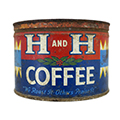
Mystery
A slow-motion mystery, in progress since April 2014. The historical subject is the Hoffmann-Hayman Coffee Company of San Antonio (1899/1904 founding through 1972 corporate closure); the research arc is the multi-year reconstruction of that company’s brands, people, buildings, suppliers, and customers from the artifacts and paper that survive in our hands and in the city’s archives.
This page is the research-agenda anchor for the mystery: open questions the site has not yet closed with primary sources and consistent narrative, plus resolved questions kept here as short pointers into Facts so the chapter that solved each one stays legible. Each cluster is a possible chapter in the slow-motion mystery — resolved entries link out to the page where the answer now lives; open entries name what artifact class, archive, or contact would close them.
For addresses, customers, and related firms already collected on the site, see Related Companies. For the Three Rivers Glass thread and bottle inventory, see Three Rivers Glass Bottles and the Crystalvac posts in the blog archive.
Resolved chapters
These were open questions on this page at one point in the slow-motion mystery; each is now substantially closed by primary sources logged in Facts. Listed as a short pointer — click through for the resolved record.
- What is the complete list of brands they produced? — The corporate hub carries a brand portfolio chronology chart and table plotting 21 retail brands plus 2 packaging-tech wordmarks on a 1900–1970 axis. See also the Brands hub.
- Were there parallel or successor firms? — Yes. Predecessors: Merchants Coffee Company (W. E. Hayman’s pre-merger firm, merged February 1912) and Morrison Coffee Company (acquired January 1917). Hayman’s post-1920 venture: Tucker Coffee Company (Aviation brand). H&H’s 1962 acquirer: Continental Coffee Company of Chicago (per HH-CLIP-1987-0002).
- Who was Mr. W. E. Hayman? — Working sketch at W. E. Hayman with co-founder role, pre-merger Merchants firm, and 1920 retirement to Tucker Coffee Company.
- Who designed sales routes and institutional accounts? — The Master Chef production, distribution, and customer ecology section names the 1923 H&H sales force: E. E. Knous as restaurant specialist (institutional / cafe-trade channel), Paul A. Rochs as territorial salesman, and Joachum Morales / P. J. Smith / A. V. Fitzgerald in supporting roles. The 1923 San Antonio Light H&H Day feature is the primary employee-series source — see the corporate hub’s 26 August 1923 SA Light feature section.
- What patents were awarded? — Two on-site federal filings documented so far. The Crystalvac packaging-tech wordmark is registered “Reg. U.S. Pat. Off.” (1932). The “We Roast It, Others Praise It” slogan was registered as No. 160,728 on April 10, 1922 (Class 46, Goods: Coffee; per H and H Product Line § Trademark). Master Chef Coffee artifacts carry “Reg. U.S. Pat. Off.” marks but no separate Master Chef filing has been catalogued yet.
- Was there a warehouse fire in the 1930s that forced new construction? — No. Accounts of an early-1930s warehouse fire refer to the 331 Burnett Street plant; the only documented fire there is the slight-damage incident in the 31 August 1928 San Antonio Light clip. The 1932 Delaware build was driven by ordinary growth, not fire damage.
- How do the documented San Antonio addresses line up? — The corporate hub’s Location section and the cross-linked place pages walk the five plant addresses in order: 208 East Commerce Street (1908) → 1223 West Commerce Street (1912) → 307 North Medina Street (1916–1922) → 331 Burnett Street (1923–1932) → 601 Delaware Street Plant (1932–1972). Each place page links to its immediate predecessor and successor.
- Three Rivers Glass / Owens-Illinois — which produced what? — Crystalvac § Glass supplier succession (1932–1947+) walks the three-firm arc, now read as overlapping rather than sequential (corrected 2026-07-21): Three Rivers Glass Company (1932–1936/37, in receivership from 1932) with Owens-Illinois Glass Company concurrent from at least 1936 through 1947+ (plant-7 date codes 1936–1939 on collection jars), and a Ball Brothers Glass stage (1936–?) inferred from the corporate record — no Ball-marked Crystalvac is documented in the collection. The Crystalvac wordmark spans the full arc without trade-dress change.
- Factory design and construction. — The 601 Delaware plant was designed by Morris, Nooman, and Wilson (period sources also spell “Noonan”) and built by George W. Mitchell Construction in 1932. Architecture and GC firms each have their own KB records.
- What world events belong on the H&H history timeline for perspective? — Filed May 2026. 14 world-context entries added to
events/withtimeline: true, spanning 1898 (Spanish-American War / Fort Sam Houston staging) through 1968 (HemisFair ‘68), each tied to a documented H&H decision per the “explains an H&H decision” inclusion test. The full History timeline now carries 63 entries. Strongest national-policy / H&H-decision pair: November 1942 OPA coffee rationing aligns precisely with the Flav-O-Tainer paper-bag run. Remaining sub-thread: SA population growth (~53k in 1900 → ~654k in 1960) is not a single event and was not filed as a timeline entry — it stays a candidate for a city-scale milestone marker rather than a discrete event. - Is the Morrison/H&H brand “Broncho” or “Bronco”? — Broncho (with H) is the firm wordmark on the 1912 Morrison market column, 1917 acquisition notice, factory sales forms, and tin lithography; Bronco without H appears only as newspaper or third-party editorial drift (e.g. 1924 Trade Week feature, auction URL slugs). See Broncho Coffee § Canonical spelling (resolved).
- Was there a factory or distribution point in Houston? — Yes. Houston distributing plant (Patrick Shipside Warehouse) — a Gulf Coast satellite established by November 1939, per a primary Houston Port Book trade notice: distribution and on-site roasting for Sam Houston, Texas Girl, and H. & H. brands, manager F. H. Kelley, green coffee imported through the Port of Houston. A possible physical trace — a weathered “HOFFMAN[N] & HA[YMAN] / HOUSTON” stencil photo — is catalogued as HH-REF-2026-0001 but its legend and provenance are still tentative (TODO-47). Remaining sub-questions (street address, opening/closing dates, F. H. Kelley’s vitals) live on the place page’s own Open Questions.
Partially closed — open gaps remain
Facts has substantial material on these but the chapter isn’t fully written yet.
What happened to H and H Coffee?
Status: 1962 acquisition by Continental Coffee Company of Chicago (per HH-CLIP-1987-0002); firm continued operating at 601 Delaware under Continental branding until August 1972, when Continental returned its rail-spur rights (25 Aug) four days before the real estate transferred to the Wagners (29 Aug). Corrected 2026-07-20: the previous ≥1975 end date rested on an unattributed step-van classified that belongs to the Wagner/B&W toy occupancy. 2026-05-25 update (Nancy Draves BKB notes): December 1962 asset sale with plant contents; 10-year building lease; Continental-era gold H&H cans with bilingual label errors (1970); four Burns Jubilee roasters sold to Monterrey (1971). Tejano market pronunciation “a-chi y a-che” (Chase & Sanborn salesman, family memory). Open gaps: acquisition terms partially filled by family notes but letters not scanned; whether Albert G. Menger stayed as president under Continental; brand retirement timeline (H&H name confirmed on shelves through 1970 — end date undocumented). Sysco lineage resolved (2026-07-21): Continental Coffee (Chicago, 1915) → CFS Continental (1973) → Staley Continental (1985) → sold to Sysco (1988). H&H-specific asset survival resolved (2026-08-18): the Master Chef trademark reached Massimo Zanetti Beverage USA through this chain. 2026-09-05 narrative synthesis: the Continental Coffee Company § The foodservice pivot and 601 Delaware’s wind-down section now reads the Bowman corporate history against the documented San Antonio events: Continental’s mid-1960s decision that it was a foodservice company (not a coffee company) is the structural explanation for the plant’s wind-down — the route-man-with-roasting-plant model H&H represented became obsolete within the parent’s strategic framework, even as the routes themselves remained valuable.
What brands belonged to Hoffmann, Merchants, and Morrison Coffee Companies before they merged?
Status: Morrison’s five 1917 acquisition brands are documented: Wesco, Misa, Broncho, Juanita, and Texco, plus the 1912 Morrison-era market-column siblings (Auto Blend, El Merito, Metropolis, Border) — plus two more Morrison-era lines surfaced 2026-07-21: Harvest Jubilee Coffee and Club Chocolate (1914 product-montage clip, no specimen or dedicated page). 2026-07-21: the Hoffmann pre-merger roster is no longer bare — Gold Elephant Tea and Hoffmann’s Package Coffee (20¢–40¢, five price points) are both attested in two 1907–1908 ads ([HH-CLIP-1907-0004](/galleries/newspaper-1899-1911/#hh-clip-1907-0004), [HH-CLIP-1908-0002](/galleries/newspaper-1899-1911/#hh-clip-1908-0002)), already documented in prose at William R. Hoffmann § Early brands. None of these four (Harvest Jubilee, Club Chocolate, Gold Elephant Tea, Hoffmann’s Package Coffee) has a surviving specimen or dedicated brand page — deliberately not created as stubs, since these are single-ad-attestation predecessor-firm products with no realistic acquisition path, unlike the live 1942 H&H SKUs. Merchants Coffee pre-merger brands — resolved 2026-09-05 (negative finding): A systematic newspapers.com search for “Merchants Coffee Co” in Bexar County (1904–1912) returned 5 attestations — a government supply contract (10,000 lbs bulk coffee, March 1911), two wholesale-only display ads (December 1911, January 1912), the Jobbers directory listing, and the February 1912 merger ad — and none names a branded retail product. Every source positions Merchants Coffee as a wholesale-only, price-competitive roaster selling bulk coffee to dealers outside SA. The company name was itself the only trading identity. Hayman’s contribution to the 1912 merger was not a brand portfolio but a wholesale distribution network and a broader product range (the merger ad documents “Coffees, Teas, Spices and Extracts” from day one). See Merchants Coffee Company § Wholesale-only business model.
Who worked at the factory, and what roles did they hold?
Status: The 1923 SA Light H&H employee profile series gives a snapshot of office, sales, and floor staff: R. A. Nagel, Chris M. Jasso (extended through 1971 in family letters), Clara H. Allred, Irene Brown, Paul A. Rochs, Joachum Morales, P. J. Smith, E. E. Knous, and A. V. Fitzgerald. Roaster Lupe Valdez named in Jasso’s 1971 letter. The 1934 officer list and the Menger family genealogy extend coverage to the executive bench. Open gaps: workforce continuity 1923–1972 beyond named individuals; WWII-era staff.
Where did they source green coffee?
Status: J. Aron & Company is the documented Gulf-port green-coffee importer for H&H. 2026-05-25: Houston branch imported green coffee through the Port of Houston for on-site roasting (Houston Port Book, Nov 1939 p. 28 — primary). 2026-06-02: G.P. Menger family narrative (read aloud at May 2026 listening session) fills in critical sourcing detail: Santos 4s (Brazil) named explicitly — Gus bought 30,000 lbs at 21¢/lb in April 1920 from broker Morrison representing Hard and Rand of New York; took a $4,200 loss when prices collapsed to 7¢ by October 1920. Gus then adopted a policy of buying only one week’s supply at a time. Later, when he judged prices had bottomed, he went personally to New Orleans to buy 18 months’ forward supply contracts. Documented origin blend from a product reference in the log: Guatemala, Salvador (El Salvador), Paraná (Brazil), Colombia, Mexico. Reference corpus holds a 1939-40 Guatemalan import sack (132 lbs, “Product of Guatemala”). Master Chef 1961 ads: “rare coffees from high in the Andes of South America.”
Open gaps: Specific brokers for Central American (Guatemala, El Salvador, Mexico) and Colombian origins — did J. Aron cover all origins, or were there separate brokers per origin? Contract structure for the San Antonio plant post-1932 vs. Houston post-1939. Whether the “18-month forward supply” strategy persisted or reverted after the 1920 loss.
Where did they source tea, spices, and extract raw materials?
Status: Partially resolved. Tea: H and H Blend Ceylon-India Tea launched June 1921; the 1921 San Antonio Evening News ad explicitly shows the carton label “H AND H BLEND CEYLON-INDIA TEA.” Documented sourcing regions: Ceylon (Sri Lanka), India, and Java Orange Pekoe grades. Specific import broker unknown; 2026-07-22: web search for H. W. Taylor Company (the Philadelphia firm named in the 1923 tea copy) found no independent trace — the firm is too obscure for general web indexing, a genuine dead end rather than an unattempted lead. Spices (33+ by November 1932): David G. Evans Coffee Company (St. Louis) documented as spice co-packer for H&H — some spice tins carry “Packed for Hoffmann-Hayman” legend, indicating co-packing rather than in-house production for at least some spice lines. 2026-07-22: Evans’s own corporate history is now well-documented (Flint-Evans predecessor, St. Louis 1858; David G. Evans Coffee Co. from 1916; Old Judge brand; sold to Chock Full o’Nuts lineage 1964) — see David G. Evans Coffee Company § Corporate history. The project’s own “Anchor” brand identification for the H&H spice tins is not independently corroborated by this research; Evans’s documented brand names are Star and Old Judge. Raw commodity spice sourcing brokers unknown. Extracts (vanilla, lemon, almond): Raw inputs for the extract line — vanilla beans, citrus oil, bitter almond oil — are undocumented in the KB. Standard 1930s vanilla bean sources were Madagascar/Bourbon, Mexico, and Tahiti; lemon oil from Florida, California, or Sicily; almond from California or as synthetic benzaldehyde. Whether H&H sourced raw materials directly or bought processed extract bases from a specialty processor is unknown. Cocoa: H and H Cocoa is documented as a product but sourcing is entirely unknown.
Open gaps:
- Tea: who was the tea import broker for the Ceylon/India/Java line? Was it a Gulf-port importer (like J. Aron for coffee) or a New York/Boston specialist tea importer? H. W. Taylor Co.’s own history remains untraceable by general web search.
- Spices: did David G. Evans supply only certain lines, or the full 33+ roster? Did H&H buy raw spices in bulk and grind/blend at 601 Delaware, or receive finished ground spice product for repackaging? Is “Anchor” actually an Evans brand, or a misidentification?
- Vanilla: did H&H source vanilla beans and extract in-house, or buy finished vanilla extract from a flavors house?
- Were there separate brokers for different spice origins (e.g., pepper from Malabar, cinnamon from Ceylon, capsicum from domestic)?
Research angles: Tea and Coffee Trade Journal (1920s–1940s) for Texas regional tea distributors; San Antonio business directories listing tea importers; flavor-house industry directories for 1930s SA area extract suppliers. (David G. Evans’s corporate history is now resolved — see above; the remaining Evans questions are about the H&H relationship specifically, not Evans’s own background.)
Who did they sell coffee to (retail vs. wholesale, geography)?
Status: Mi Tierra Cafe is the clearest documented café-trade customer (1951 storefront photograph with the H and H Master Chef Coffee exterior sign). The Master Chef brand’s production, distribution, and customer ecology section outlines the sales-channel structure. The corporate hub names institutional accounts at the San Antonio Jail (Bexar County) and the Alamo National Bank (Menger family employer). 2026-05-25: Houston distributing plant — primary source: Houston Port Book Nov 1939 p. 28 (1939-11-port-of-houston-magazine-hoffmann-hayman-houston-plant); Patrick Shipside Warehouse, manager F. H. Kelley; Sam Houston / Texas Girl / H&H brands; green coffee via Port of Houston with on-site roasting. Nancy Draves paraphrase (2015) independently matched this passage.
What did the inside of the factory look like at peak operation?
Status: 601 Delaware Street § Features catalogs the 1932 plant build (16,000 sq ft, 60+ employees, modern roasting and vacuum-packing equipment, Crystalvac container on the roof as landmark). The page’s Factory finds section documents physical artifacts recovered from the building today. 2026-06-08 (Peché): David L. Peché’s father, an H&H delivery driver, gave Peché a guided tour of 601 Delaware in 2012 when the building owner allowed public access. Father identified the roasting area, lunch area, and dominoes spot by name — the only documented guided interior tour by someone who worked in the building. Peché’s Downtown San Antonio (Arcadia) chapter includes the story and a photo. See Community Memory — November 2024 Facebook Discovery. Open gaps: peak-operation interior photography (1940s–1960s); Sanborn fire insurance maps showing machinery layout; floor-level employee snapshots; whether Peché’s 2012 visit produced photos. Research angles: San Antonio Light / Express photo morgues (Trinity University archives, UTSA Institute of Texan Cultures); private employee snapshots in surviving worker families; Peché contact (LinkedIn outreach sent 2026-06-08).
Still open — book-shaped chapters
Chapters Facts does not yet answer, written so they could later anchor coffee-table book chapters. Each is meant to be actionable (who might know, where to look first, what artifact class would falsify a guess).
What did their coffee taste like — and what did the factory sound and smell like?
Taste is mostly unrecoverable, but a book chapter can treat sensory history honestly across all three registers. Sound and smell are fully recoverable because the physics of roasting haven’t changed — the H&H factory experience can be described precisely, calibrated to documented equipment and scale.
Sound. The H&H plant ran three Monitor-line drum roasters at 200 lbs/hour each by 1921 (~14,000 lbs/day). The dominant sound was a constant low rhythmic tumbling — heavy beans rolling against cast iron, a room sound felt as much as heard. Underneath that ran the two signature events every roaster listened for: first crack (~385–400°F), a rapid series of sharp individual pops as bean cell walls ruptured under steam pressure — like popcorn but distinct, filling the room — then a lull, then second crack (~435–450°F), faster and closer together, a sustained crackling like Rice Krispies. With multiple drums running overlapping batches, the Delaware Street plant would have had a near-continuous layer of crack-and-tumble noise across the workday. Dump and cooling added a rush of beans onto the tray and the mechanical raking and fan noise — a different, harder texture.
Smell. Green beans (stored in J. Aron & Co. Gulf-port sacks) smell grassy and hay-like — nothing like coffee. As roasting begins the grass burns off into toast, then fresh bread. Approaching first crack the first recognizable coffee aroma arrives — bright, almost fruity. Through the roast it deepens through caramel, chocolate, nuts. At second crack and beyond it becomes the “diner coffee” smell — rich, slightly smoky, bittersweet. Chaff peeling off the silverskin adds a dry, papery note underneath throughout. The smell penetrated every surface — walls, equipment, workers’ clothes — and reached Delaware Street and the Southern Pacific tracks beyond. The 1923 SA Light open house brought visitors through; they left carrying the smell. Forty years of daily roasting saturated the neighborhood.
Taste (partially recoverable). H&H’s own copy positions the blend as mild and smooth (“We Roast It, Others Praise It”; the 1932 Crystalvac copy emphasizes freshness through vacuum packing). The simultaneous use of a percolator grind (regular) and a drip grind by the late 1930s suggests they tracked consumer equipment shifts. Whether H&H ran light, medium, or dark by period standards is undocumented; trade-journal context and San Antonio fair premium records may give a calibration point. Research angles: Tea and Coffee Trade Journal for 1920s–1940s Texas regional roast-style norms; San Antonio fair premium books; any surviving customer correspondence or buyer specification sheets.
The sealed tins — a primary sensory source in the collection. The collection holds two sealed Master Chef one-pound keywind tins from the 1950s:
- [HH-CAN-2019-0006](/accessions/#hh-can-2019-0006) — sealed keywind tin with a 250 trading-stamp offer sticker (condition: good; acquired 2019). The trading-stamp sticker is itself a period marker — trading-stamp promotions peaked in the 1950s.
- [HH-CAN-2018-0003](/accessions/#hh-can-2018-0003) — unopened keywind tin (condition: unknown; draft record, no dedicated photography yet).
These are the single closest available primary sensory source for H&H’s coffee. Vacuum-sealed keywind tins from the 1950s preserve their ground coffee contents under near-original atmospheric conditions. If opened carefully, the compressed grounds would release smell that is as close as the collection can get to the H&H factory experience — decades-aged but still the actual product.
This creates a curatorial question the KB does not yet answer: open one tin for sensory documentation, or preserve both sealed as artifacts? The case for opening: a controlled smell-and-photograph session, perhaps with a coffee professional present, would produce a primary sensory note that no amount of research can substitute. The case for keeping sealed: two examples is a thin safety margin; sealed examples are rarer than empty tins; the artifact value (trading-stamp sticker intact, vacuum seal unbroken) is significant. One possible resolution: keep HH-CAN-2019-0006 sealed (better condition, richer surface documentation) and open HH-CAN-2018-0003 (condition unknown, draft record only) for sensory access.
For the book, the sealed tins are also a narrative moment in their own right: two one-pound cans of 1950s Master Chef coffee, still sealed, sitting in San Antonio seventy years later.
Where did delivery vehicles go, and where are they now?
Research angles: fleet photos in newspapers; insurance or motor carrier registers; San Antonio trucking history groups; museum collections of commercial vehicles (long shot but specific ask).
Why did the factory require steel I-beam repairs on the first floor, and what was on the roof that required extra support?
Resolved (2026-07-22). Physical evidence in the building: visible 45-degree diagonal cracks in the first-floor concrete ceiling beams, with steel I-beams retrofitted beneath them to carry the load. The 45° crack angle is the fingerprint of shear failure — not settlement or bending. Curator Brett Elmendorf has confirmed the retrofit sites are mounting/reinforcement points for an overhead crane rail — a traveling-crane or hoist track spanning the production floor, ordinary material-handling equipment for a plant of this type and era. A traveling crane’s concentrated, moving wheel loads are a textbook cause of diagonal shear cracking near beam supports, and the I-beam retrofit is a straightforward strengthening of the beams to carry that load. This supersedes the earlier candidate hypotheses — a rooftop gravity fire-reserve water tank, the Crystalvac vacuum-packing compressor, or bulk green-coffee storage bins — which were reasonable guesses before the crane-rail mounting was identified but are no longer the leading explanation. Full evidence at 601 Delaware Street § Open Questions.
Correction — this is not a “ceiling rails” mystery, and it is not connected to 301 Primera. Brett had initially read the second-floor “paprika piece of wood” and these same I-beam repair sites as possible remnants of rail-like overhead hardware, which prompted a parallel to Ted Menger’s overhead rig at 301 Primera. Brett has since confirmed this was a misinterpretation: the factory never had ceiling rails in that sense. The “paprika piece of wood” is very likely part of the same ordinary crane-rail installation described above, not a remnant of the Burns Jubilee transmission line and not related to Primera.
Where are the original factory machines?
The 1904 hand roaster was preserved as a 1932 Open House display piece (per the December 21, 1932 plant-opening copy), but the larger Monitor roaster line (Huntley Manufacturing supply, 1923 documented; plausible 1932 continuation), the vacuum-packing equipment that launched Crystalvac, and post-1932 machinery are unaccounted for after the 1962 Continental of Chicago transition and the 1972 real-estate closeout. Research angles: auction notices when Continental left the plant; scrap metal dealers; other roasters’ “used equipment” ads in Tea and Coffee Trade Journal; museum accession files for industrial food equipment (Witte Museum and Texas industrial-history collections); 1960s–1970s San Antonio auction-house records.
What is the youngest datable Crystalvac jar in the collection, and does it cap the manufacturing story?
Research angles: Owens-Illinois date codes on bases; cross-check against plant codes. The Crystalvac Jars page is the mold-mark survey destination once jars are dated — its existing open questions cover production-endpoint and lid-design chronology.
What does the newspaper record show that the collection does not yet hold?
Period newspaper coverage — ads, features, open-house copy, cooperative trade spreads — pictured or named specific H&H products, packaging formats, equipment, and branded materials. Many of those items have never appeared in the collection. Systematically surveying the newspaper archive with the question “what is shown or named here that we don’t have?” would generate a prioritized acquisition target list grounded in primary sources.
Known gaps from sources already in the KB:
- 26 August 1923 SA Light feature (the richest single source): line art depicting 10 product columns on page 66 (H and H Coffee, Texco, Spoon, Broncho, Menger Peaberry, H and H Cocoa, H and H Spices, H and H Tea, H and H Extracts, Border) — most of these are documented wordmarks with no physical specimen in the collection. The illustrated tin and pail shapes are visible; no matching physical example has been catalogued for Border, Texco, Spoon, or Menger Peaberry.
- Interior photos from the same spread (“HUGE H AND H ROASTERS,” “AUTOMATIC WEIGHER AND PACKER”) — the Monitor roasting and weighing/packing equipment is depicted but no equipment artifact has survived into the collection.
- 1932 Delaware plant opening copy and photos: the large replica Crystalvac jar on the factory roof is mentioned but no photograph has been located (see Crystalvac Jars § Wanted item #4).
- 1934 “30 Years of Progress” illustration: depicts the 1904 hand roaster as a keepsake display. Last documented location was the 1932 Open House; whereabouts after 1964 unknown.
- 1937 SA Light expansion feature: names paper bag, vacuum can (1- and 3-lb tin), and Crystalvac jar as simultaneous retail formats — collection coverage skews toward glass and tins; paper-bag specimens are absent.
- 1942 wholesale price sheets: list 17 SKUs across package and bulk lines including BIG VALUE and SAN ANTONIO Coffee — no labeled specimens for either brand have been identified in the collection.
- Various ads show branded premium items (cup-and-saucer sets tied to specific brands in 1942 sheets, wooden grips on Crystalvac jars, wire bail handles) — partial coverage only.
Approach: For each newspaper source already registered in raw/_index.md, read the visual register against the accession and artifact catalogs and flag any item class that appears in the source but has no matching HH-COLL-* or HH-REF-* entry. The result is a research-grade Wanted expansion, grounded in what period sources show existed — not just collector intuition.
Systematic sweep completed (2026-07-21). Every newspaper-clip gallery has now been read in full against the catalog and existing Wanted lists — 600 total artifact records across galleries/newspaper-1899-1911.md through galleries/newspaper-1990-present.md and galleries/branding_newspaper.md. New finds compiled into their target pages: an 1916 match box premium and a Feb 1930 Menger Brand coupon-dishware premium (both → synthesis/premiums.md), July 1958 H&H tea bags (→ brands/h-and-h-tea.md), a Dec 1966 “decorator cannister” Master Chef can naming (→ brands/master-chef-coffee.md), a 1924 automatic coffee labeler (→ stories/h-and-h-coffee-roaster-equipment-lifecycle.md), and a Master Chef tea-bags date correction (1950s → 1966–68). Several other candidates were checked and correctly excluded as already-documented or not new (Gold Elephant Tea, Hoffmann’s Package Coffee, Harvest Jubilee Coffee, Club Chocolate — see § Hoffmann/Merchants/Morrison brands above). This closes the “systematic sweep” research angle for the newspaper-clip corpus specifically; the branding_newspaper gallery’s 1913–1963 span was cross-checked as part of the same pass with zero new gaps found — it was already the most thoroughly Wanted-tracked gallery in the KB.
Research angles remaining: the known-gaps list above (10-product-column illustrations, Crystalvac roof jar photo, 1904 hand-roaster post-1964 whereabouts, paper-bag specimens, BIG VALUE/SAN ANTONIO specimens) still names physical-acquisition targets, not further newspaper research — those need a collector/estate-sale lead, not another archive read.
Who else collects H and H memorabilia, and who holds the deepest comparative collections?
Kevin Mackey (near Three Rivers, TX) is the deepest documented contributor to date — most pre-1930s San Antonio Express clippings and the 1961 Broggi Master Chef radio transcription disc came from his collection. The Witte Museum holds Border Premium pails as documented in the Border Coffee § Reference photography section. Open gaps: other H&H private collectors; broader museum holdings (regional history museums sometimes hold single labeled tins); Texas bottle and advertising clubs’ membership rolls.
Web sweep (2026-07-21), negative result: searched general web, eBay-adjacent, and Texas bottle/advertising-club channels (Painted Soda Bottle Collectors Association shows, antique-bottles.net) for H&H-brand collectors or museum holdings beyond what’s already documented. No new leads surfaced — most queries return this project’s own public site (handhcoffeefactory.com) as the dominant or only H&H-specific result, confirming this is a narrow, poorly-cross-indexed collecting niche not reachable by broad search. One false lead ruled out: a Cowan’s/Freeman’s auction lot for a “Hoffmann’s” coffee tin and advertising mill (Don L. and Retta Park collection) is John Hoffmann & Sons Co. of Milwaukee, Wisconsin — an unrelated same-surname coffee company, not Hoffmann-Hayman of San Antonio. Remaining research angles unchanged: museum registrars (direct outreach, not searchable), Texas bottle/advertising club membership rolls (require direct contact, not public web indexes), and eBay saved-search alerts over time — all need a human with continuity, not a one-shot search.
Producing a book — Slow-motion Mystery
Working title: Slow-motion Mystery (slowmotionmystery.com). The KB is now substantial enough to anchor the book. The research base covers the full corporate timeline 1899–1972, 21 documented brand lines with a visual timeline, the complete four-generation Menger family tree, 20+ documented vendors, 173+ registered primary sources, and 700+ gallery items. The mystery page’s chapter structure already reads like a proto-table of contents.
What we still need before a book is complete
Research gaps that matter for a book:
- What happened in the decade between the 1962 Continental of Chicago acquisition and the 1972 real-estate closeout — substantially filled (2026-09-05) by the narrative synthesis reading Bowman’s corporate history against the San Antonio evidence. Newspapers.com search (2026-09-05) resolved the three remaining gaps: (1) Albert G. Menger was “company president” in Oct 1962, became “Continental’s San Antonio branch manager” by June 1970; (2) Hoffmann-Hayman company name disappeared from newspaper advertising by late 1962 (Sommers grocery ads show transitional dual-branding Oct 1962, then nothing), though the retail brand persisted on shelves through at least 1970; (3) new personnel discovered: John Charles Burkholder, VP and regional sales manager from 1944 to 1966 (died June 1967), and a June 1970 feature article quoting Menger on Continental’s institutional coffee price increase to $1.09/lb. Second pass (2026-09-05) added four more attestations: October 1968 coffee-equipment technician ad (earliest post-1966 evidence of plant machinery operation); July 1970 sales awards article documenting SA salesmen Allan Zinsmeyer and Maynard Koehn recognized for 1968–69 performance, with Alvin Cohn (chairman) and Robert Cohn (president) presenting; January 1971 multi-day hiring campaign at 601 Delaware (phone 533-1277); and a June 1971 route salesman campaign at increased salary ($150/week). The 601 Delaware operation is now documented continuously from October 1968 through June 1971. Third pass (2026-09-05) resolved the Master Chef brand shelf end date via newspapers.com systematic search: “Master Chef Coffee” returned 417 matches in San Antonio 1963–1968 (declining from 122 in 1963 to 43 in 1968) then zero from 1969 onward; the latest San Antonio ad is October 31, 1968 (Shoppers World, SA Light). The brand survived in Laredo through April 27, 1970 (Alfredo Santos grocery, Laredo Morning Times) and in Montana (Billings area) through October 22, 1969 — but no newspaper anywhere carries “Master Chef Coffee” after spring 1970. The bracket is closed: the brand’s retail end date is spring 1970, consistent with the 1971 roaster sale
- Peak-operation interior photography from the 1940s–1960s — the factory during prime years has no interior images
- Rights clearance for San Antonio Light / Express-News newspaper images (Hearst owns the Express-News archive; the Light is defunct — rights situation unresolved)
Production prerequisites:
- All collection specimens re-photographed to print resolution (300 DPI minimum) — gallery images are web-optimized, not print-ready
- Texas Glass by Michael David Smith (already in the collection) is the closest comparable: regional illustrated reference, small press — calibrate format and length against it
Publishing routes
| Route | Fit | Notes |
|---|---|---|
| Traditional regional press | Best if a co-author has an existing publisher relationship | Trinity University Press (San Antonio) and University of Texas Press both publish Texas regional history; a primary-source-depth + family-artifact-access pitch is credible |
| Premium self-publishing | Right if the goal is a museum-quality collector object | Blurb or Artifact Uprising for a limited-run large-format edition; full creative control, no bookstore distribution |
Draft chapter structure the KB can already support
| Chapter | Hook | KB anchor |
|---|---|---|
| 1 — The roaster | Hoffmann begins in a back room, 1899 | William R. Hoffmann |
| 2 — The marriage that made a company | Hoffmann + Minnie Menger; his death; the 1912 merger | Minnie Menger Schlosser |
| 3 — The Menger years | Family takeover 1920; the 1923 SA Light portrait of a firm at full stride | Menger Family |
| 4 — The new factory | 1932 Delaware Street — Depression-era ambition in concrete | 601 Delaware Street Plant |
| 5 — The glass jar | Crystalvac, Three Rivers Glass, first vacuum-packed coffee in Texas | Crystalvac · Crystalvac Jars |
| 6 — War and rationing | Flav-O-Tainer, tin shortage, keeping the plant alive | Flav-O-Tainer |
| 7 — The full house | 1950s peak: Master Chef, Mi Tierra, the jail contract, 21 brands | Hoffmann-Hayman Company |
| 8 — The long goodbye | Continental Coffee, 1972 real-estate sale, G. P. Menger’s death 1974 | Continental Coffee Company |
| 9 — What survives | The collection, the building, the collectors, the mystery still open | Mystery |
How this page evolves
When a question above gets a dated primary source or a consensus interpretation backed by artifacts, move it to the Resolved chapters section (or shorten the partially-closed gap) and link out to the KB page where the answer now lives. The goal is not an ever-longer list — it is a queue of book-shaped chapters shrinking as evidence accumulates, with the resolved set growing as a chronological reading order for the slow-motion mystery itself.
Related: Facts · Research · History · Open Questions
See also
People
- Nancy Draves
Brands
- Broncho Coffee
- Auto Blend Coffee — 1912 Morrison-era market-column sibling
Future
- Listening Tour — Coffee Industry
- Listening Tour — Family Network
- Listening Tour — SA History Community
- Listening Tour — The Book
- Listening Tour
Book
Synthesis
- 1937 — H&H Inflection Year
- Community Memory — November 2024 Facebook Discovery
- Related Companies — full company/address roster
- Open Questions — auto-aggregated index this page’s research agenda complements
- Wanted — by-page index — auto-aggregated index this page’s research agenda complements