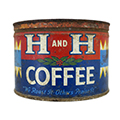
A Large Bulk-Size H and H Blend Coffee Tin — Same Early-1920s Slogan, Bigger Format

Two photographs of a single, very large, square-cross-section H and H Blend Coffee tin acquired on 20 May 2023. Side-by-side, the two frames show two adjacent painted faces of the same tin — the narrow side panel with the firm’s familiar vertical “H & H” monogram and, in the same frame, an oblique view of the front face carrying the early Hoffmann-Hayman slogan “We roast It / others praise It”; and the opposite broad face square-on, carrying the company’s full early product guarantee.
What makes this piece worth its own entry isn’t a new branding element — every visual element on the tin is already documented elsewhere on the site. What’s new is the format.
What’s actually on the tin
Side panel — vertical “H & H” monogram.
A narrow panel: a deep blue field framed by a red double-line border on a cream ground, with three small red cream-bordered rectangular cartouches running top-to-bottom down the middle of the field carrying, in cream serif capitals, “H”, then an ampersand “&”, then “H”. This is the firm’s tall vertical “H & H” monogram in its early-1920s form, painted onto the metal rather than printed on a paper label.
Front face — “We roast It / others praise It.”
A broader panel: again a deep blue field with a red double-line border, with a single ornate vertical red rectangular cartouche centered on the panel carrying in cream script-and-roman lettering the slogan:
“We roast It, others praise It.”
This is the same slogan that appears, embossed in metal, on the Crystalvac jar lid and on the smaller H and H Blend embossed-lid tin already in the museum collection — and the same slogan called out on the existing three-pound rectangular H and H Blend tin from Euless, TX, where the project’s existing post explicitly identifies it as early-1920s branding (dated against an H and H Coffee advertisement printed in the Hondo Anvil Herald on 29 March 1924).
Back face — the full guarantee.
The opposite broad panel, photographed square-on: same blue-and-red-on-cream framing, but here the centered cartouche is a tall red rectangle with cream double-line border, and inside it nine lines of cream serif capital text carry the firm’s full product guarantee:
THIS IS A BLEND OF HIGH GRADE COFFEES SELECTED AND ROASTED WITH CARE AND IS GUARANTEED TO PLEASE
Above and below this guarantee cartouche, two smaller red cream-bordered cartouches each centered with a single serif “H” — bracketing the guarantee panel with the firm’s initial. The “blend of High Grade coffees” wording is, again, already documented on the Euless three-pound H and H Blend tin post as one of the firm’s early product phrases, the kind of prose that places the tin in the 1920s rather than later.
Top.
Visible in both photographs, the top of the tin is an unpainted, heavily oxidized flat square plate with a circular recessed lid well stamped into its center. The lid that originally seated into that well — most likely a press-fit or friction-fit metal disc — is missing in these photographs, leaving the recess exposed. That kind of recessed-well lid arrangement is a common construction on bulk grocer-counter / family-size coffee tins of the period: large square boxes with a press-fit metal closure that grocers could pop off to scoop ground coffee into a customer’s bag, and that customers (or shopkeepers) routinely lost.
What’s new about this tin
Every painted element matches the early-1920s H and H Blend tins the project already documents — same palette, same slogan, same guarantee, same monogram. The format is what’s new:
- The existing three-pound rectangular H and H Blend tin in the museum collection is a retail consumer tin — a tall narrow rectangular box sized for a three-pound parcel-post-style sale.
- The existing one-pound rectangular H and H Blend Medium Ground tin (Mac Johanson collection, in the Reference gallery) is the next size down again — a single-pound retail tin.
- This new tin is square in cross-section rather than rectangular, substantially larger in capacity judging from the proportions in the frame, and carries a recessed circular lid well at the top consistent with a press-fit metal lid rather than a screw band, key-strip, or paper-tape closure.
In other words this is the bulk / family / counter-display variant of the same early-1920s H and H Blend tin family already documented on the site at one and three pounds — a fourth size point in the run, sitting above the three-pound retail tin in capacity.
Where it sits in the H and H Blend tin run
Adding this piece, the documented H and H Blend tin formats now include, from smallest up:
- The one-pound rectangular H and H Blend Coffee Medium Ground tin (Mac Johanson collection, Reference gallery).
- The half-pound paper-label cylindrical tin and other small-format variants in Our Collection.
- The three-pound rectangular H and H Blend tin from Euless, TX in the museum collection, plus a second three-pound rectangular variant documented in the Alamy reference photograph.
- And — newly added here — this large bulk-size square H and H Blend tin with the same early-1920s slogan and guarantee, the same vertical monogram on its sides, and a recessed circular lid well consistent with a missing press-fit closure.
The slogan ties into a small slogan-network across the site: this tin’s painted “We roast It / others praise It” matches the embossed slogan ring on the Crystalvac jar lid, the embossing on the small H and H Blend We Roast It embossed-lid tin, and the painted slogan on the Euless three-pound tin — the same line in three different production techniques (paint on body tin, embossed metal lid, embossed Crystalvac lid) on at least four different format families, all consistent with H and H’s early-1920s identity for the H and H Blend brand.
Provenance and use
The acquisition photos show the tin on a green marble side table in what appears to be a domestic interior — wood floor, white interior doors, and a black tripod-style chair leg in the upper right of the frame. The two frames pair as adjacent faces of one object, so the side-panel monogram, front-face slogan, and back-face guarantee can be documented together as a single inventory record.


