“Febrero 11 – 53” — A Pencil Date on the Seam Between the Expansion and the Original Plant
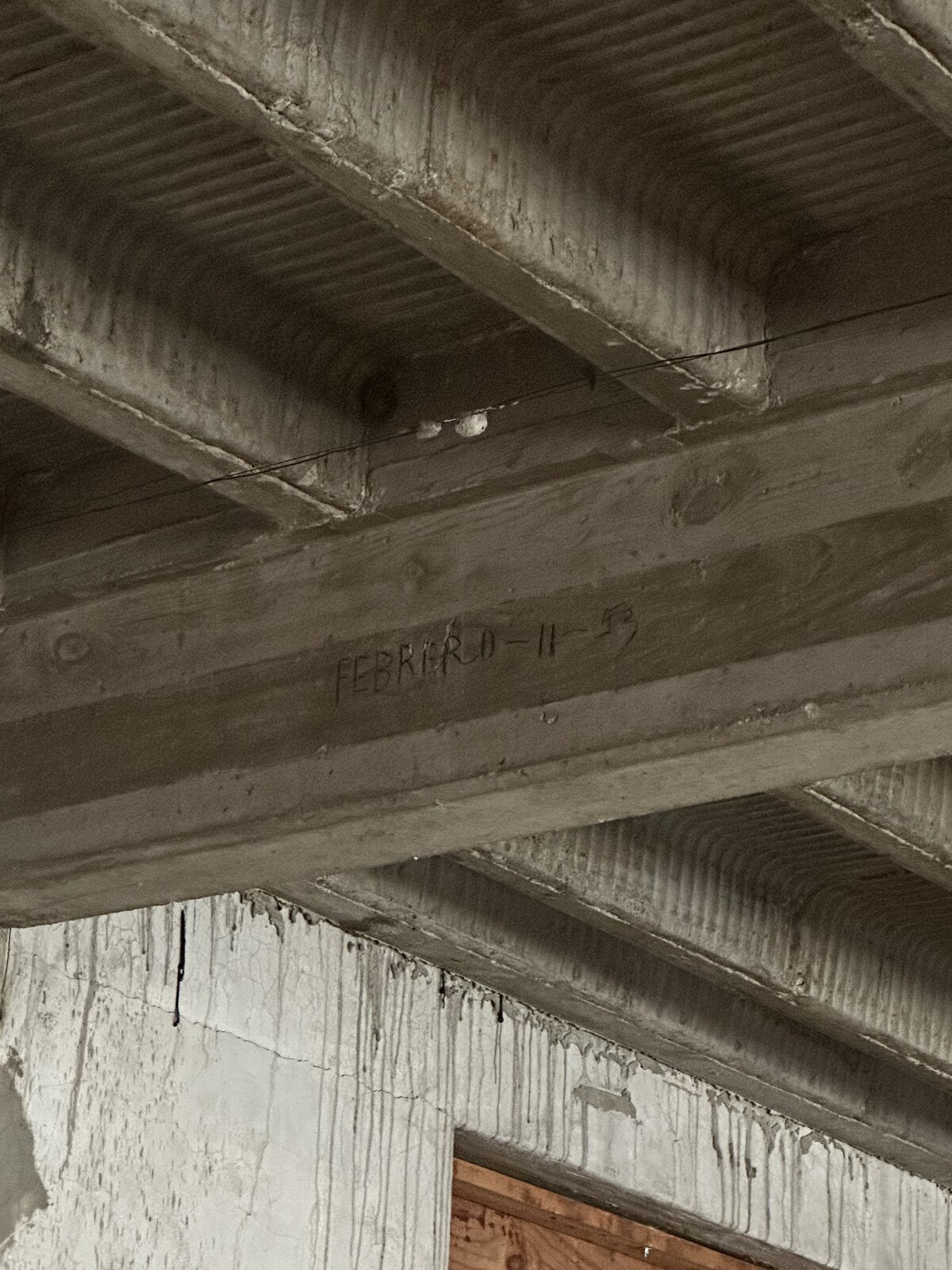
This frame is two things at once: another pencilled date in the upstairs expansion room above the office, and a frame that documents a construction seam in the building’s own history.
The inscription: “Febrero 11 – 53”
On the flat face of a concrete ceiling joist — different joist from the one marked “Agosto 8 – 56”, though visible in the same room on the same afternoon — a cursive graphite-pencil inscription reads:
FEBRERO – 11 – 53
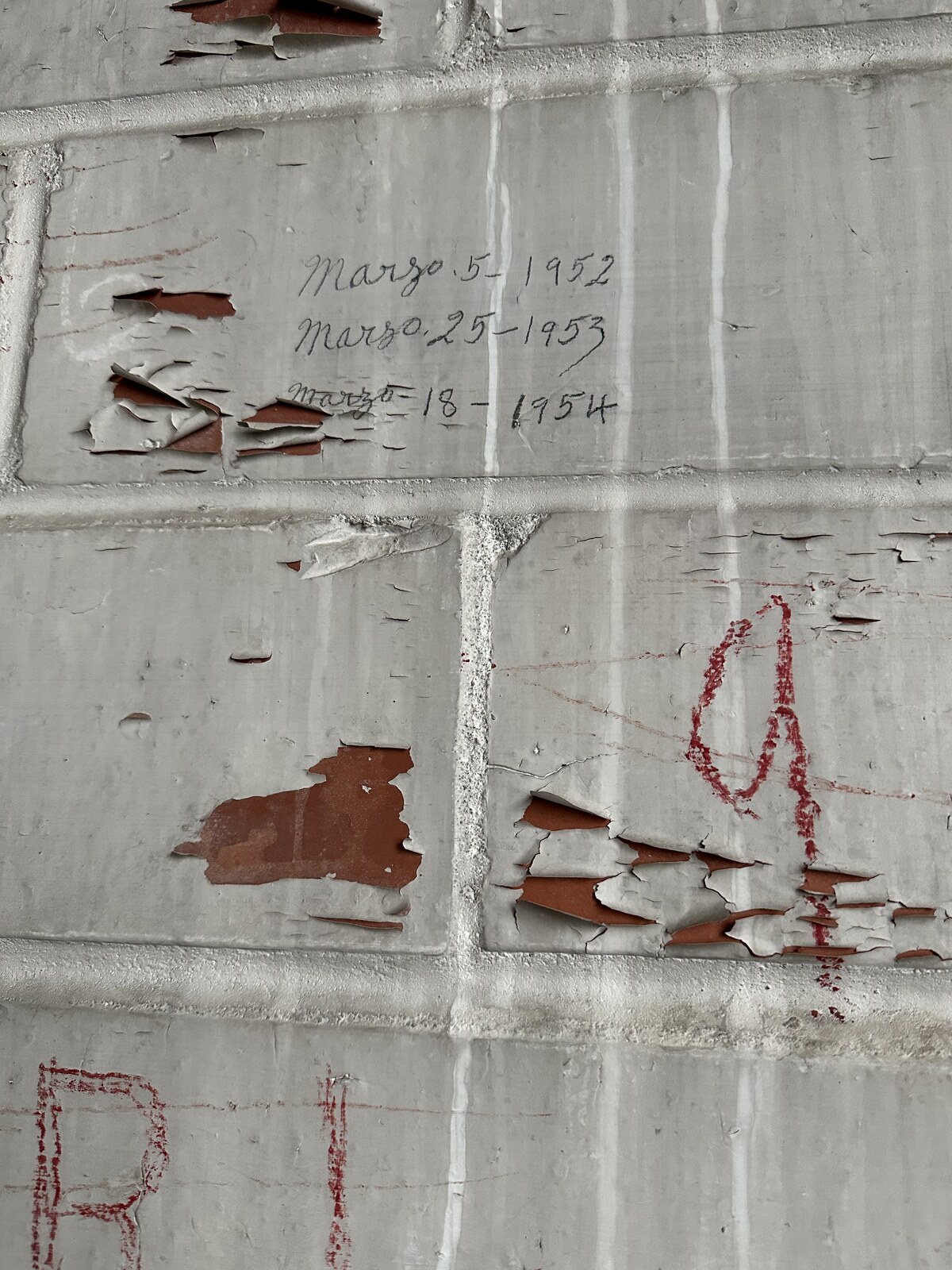
February 11, 1953. A fifth Spanish pencil date recorded in this room, and the one that tightens the 1953 window: the three east-wall “Marzo” dates now read, in chronological order:
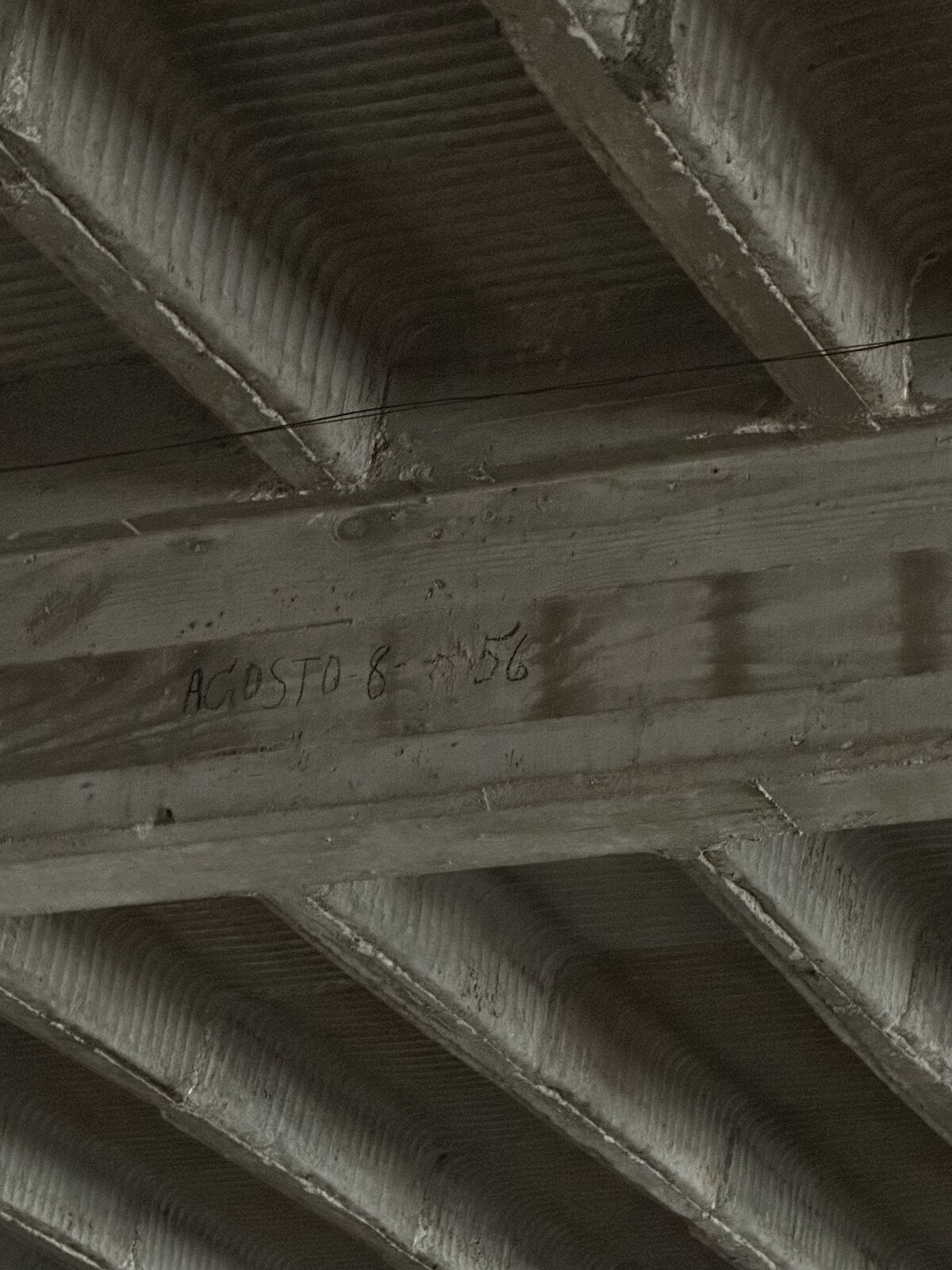
Marzo 5 – 1952 · Febrero 11 – 53 · Marzo 25 – 1953 · Marzo 18 – 1954 · Agosto 8 – 56
The Febrero date sits six weeks before the 25 March 1953 mark on the east wall, same year, different surface of the same room. Whether a single worker wrote all five across those five years or whether later marks were by a second person picking up a habit that was already up on the walls and ceiling of this back room, the marks are clearly a practice tied to this specific space rather than to one writing surface.
The architecture: the expansion ceiling meeting the original face
The upper two-thirds of the frame is the now-familiar pan-formed reinforced-concrete joist ceiling of the expansion room — parallel flat-sided concrete joists with board-formwork grain and round knot-hole imprints pressed into their faces (the knots in the wood planks that formed the joist sides cast directly into the cured concrete), and the ribbed corrugated-pan soffit bays between joists, exactly as in the adjacent “Agosto 8 – 56” frame.
The lower third is where the frame becomes structurally interesting. The ceiling soffit meets the top of a masonry wall whose finish, texture, and surface condition are different from the scored-plaster east wall that carries the Marzo dates. Specifically, that wall below shows:
- Long, blobby vertical whitewash drip-runs cascading down its face from the ceiling-wall junction, exactly the pattern you get when a ceiling was whitewashed after the wall below was already in place and the whitewash ran down over an older, rougher surface.
- A rougher, painted-masonry finish consistent with a wall originally designed to be seen from outside the building — not the scored imitation-brick interior finish on the east wall.
- At lower-right, the edge of a wooden jamb in what appears to be a cut opening through that older wall — likely a post-expansion alteration where a new interior doorway or pass-through was cut through what had originally been an outside wall.
The most natural reading is that this wall is one of the original 1932 exterior faces of the plant, enclosed when the second-floor expansion above the office was built out. The pan-formed slab and joists above are the expansion’s floor/roof system; the wall below is a 1932 exterior face that has since found itself inside a room. The whitewash ran because someone painted the new enclosed ceiling and didn’t mask the now-interior outside wall. And in between, on one of the brand-new (in 1953) expansion joists that closed this space in, a worker reached up and pencilled the date.
That’s why this frame is worth its own entry rather than being treated as just another joist shot. In one view it shows:
- The 1932 structural system of the expansion itself (pan-formed concrete joist floor).
- A piece of the 1932 original plant preserved as an interior surface (the former exterior masonry face, with its whitewash drips and an alteration in it).
- The construction seam between them (the soffit-to-wall junction).
- A dated occupancy mark pencilled right across that seam in the same decade (1953).
Almost a cross-section of the building’s layered history in a single frame.
Where it sits in the chronology of inscriptions
The running chronology of human inscriptions on the building’s interior surfaces, with this frame added:
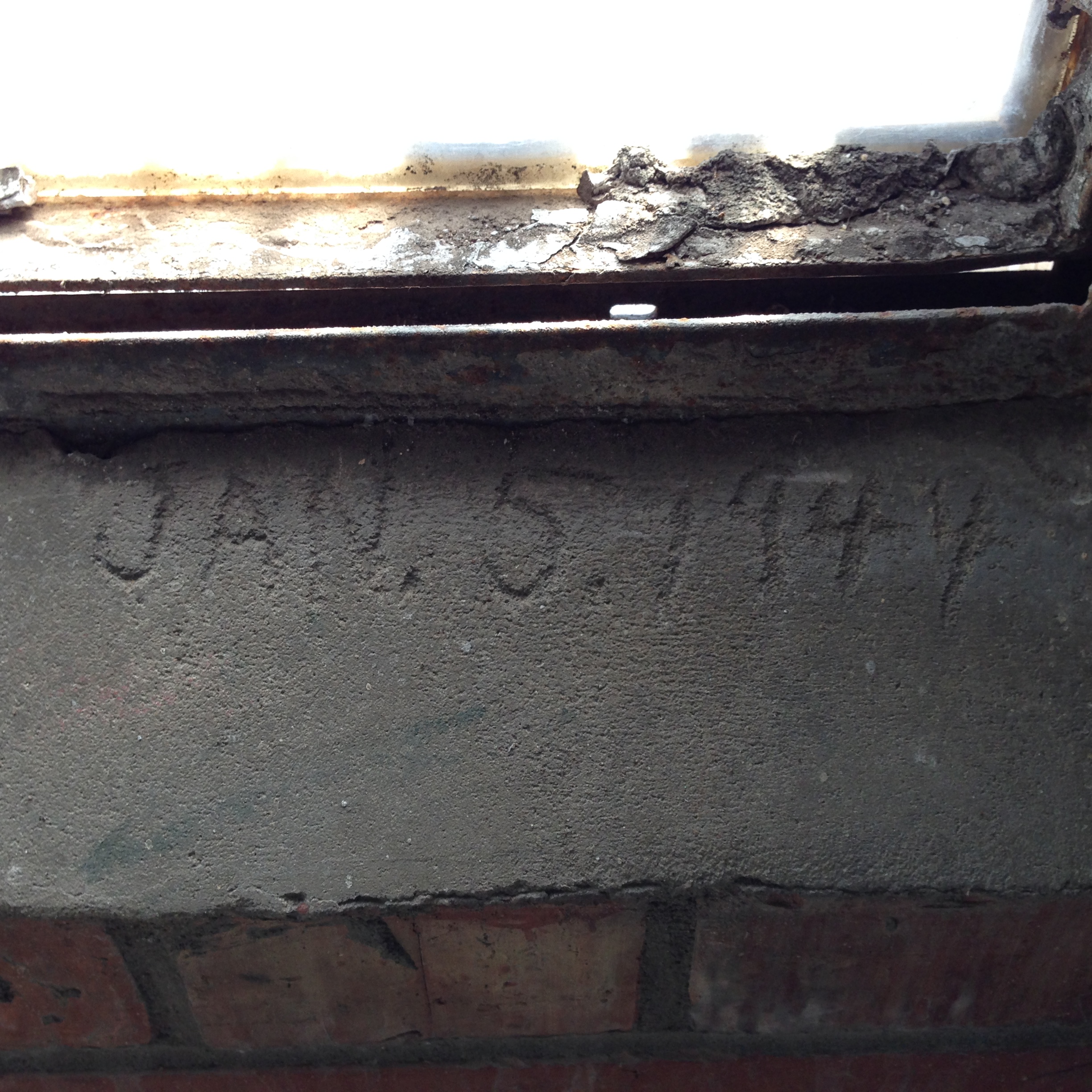
- The second-floor expansion date carved into a window sill — 1930s construction.
- Marzo 5 – 1952 on the east wall — start of the 1950s cluster.
- Febrero 11 – 53 on a ceiling joist (this frame) — six weeks before the next east-wall mark, directly above the expansion-to-original-face junction.
- Marzo 25 – 1953 and Marzo 18 – 1954 on the east wall — continuing the cluster.
- Agosto 8 – 56 on a different ceiling joist — closing the cluster two years later.
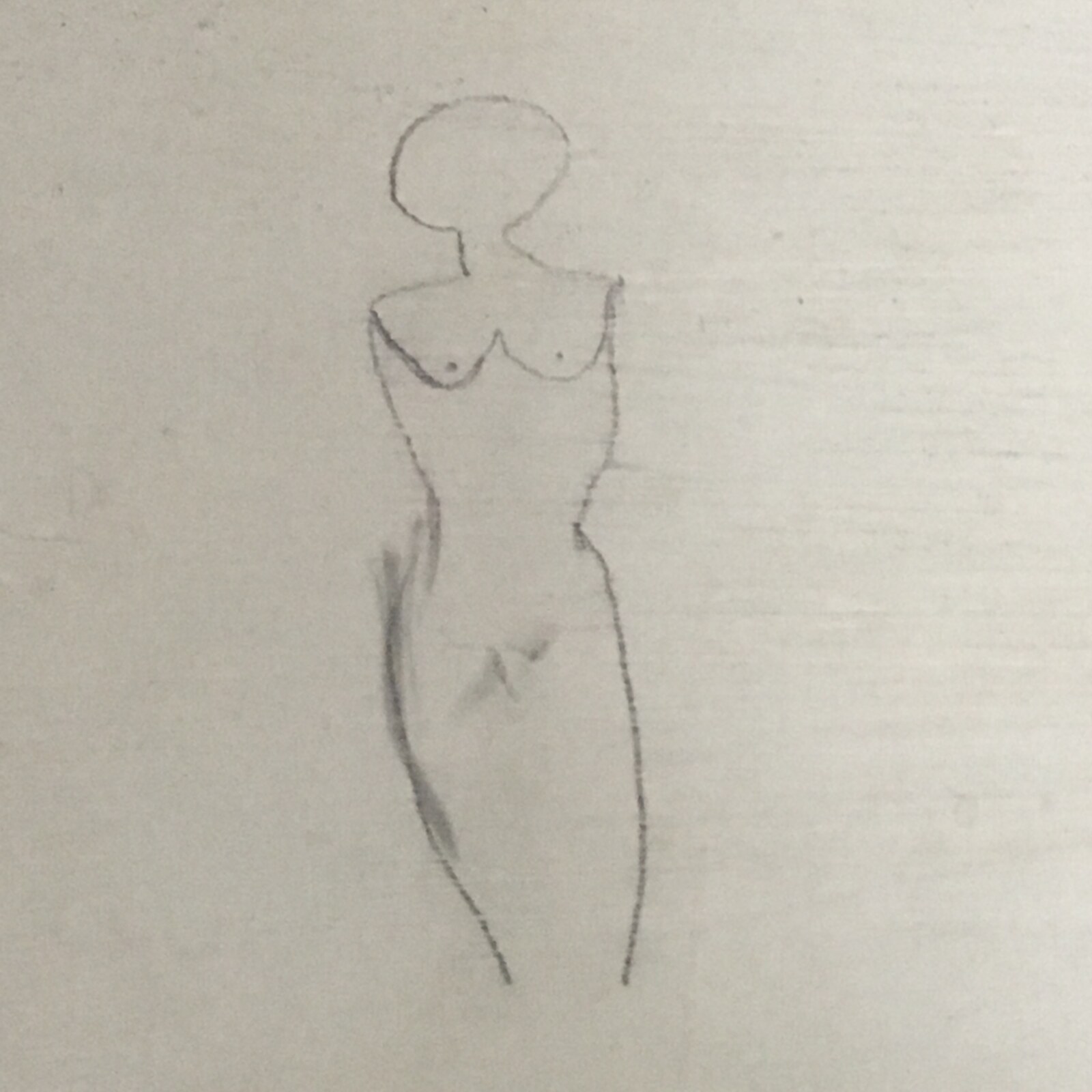
- An informal pencil figure study on an upstairs stucco wall — undated.
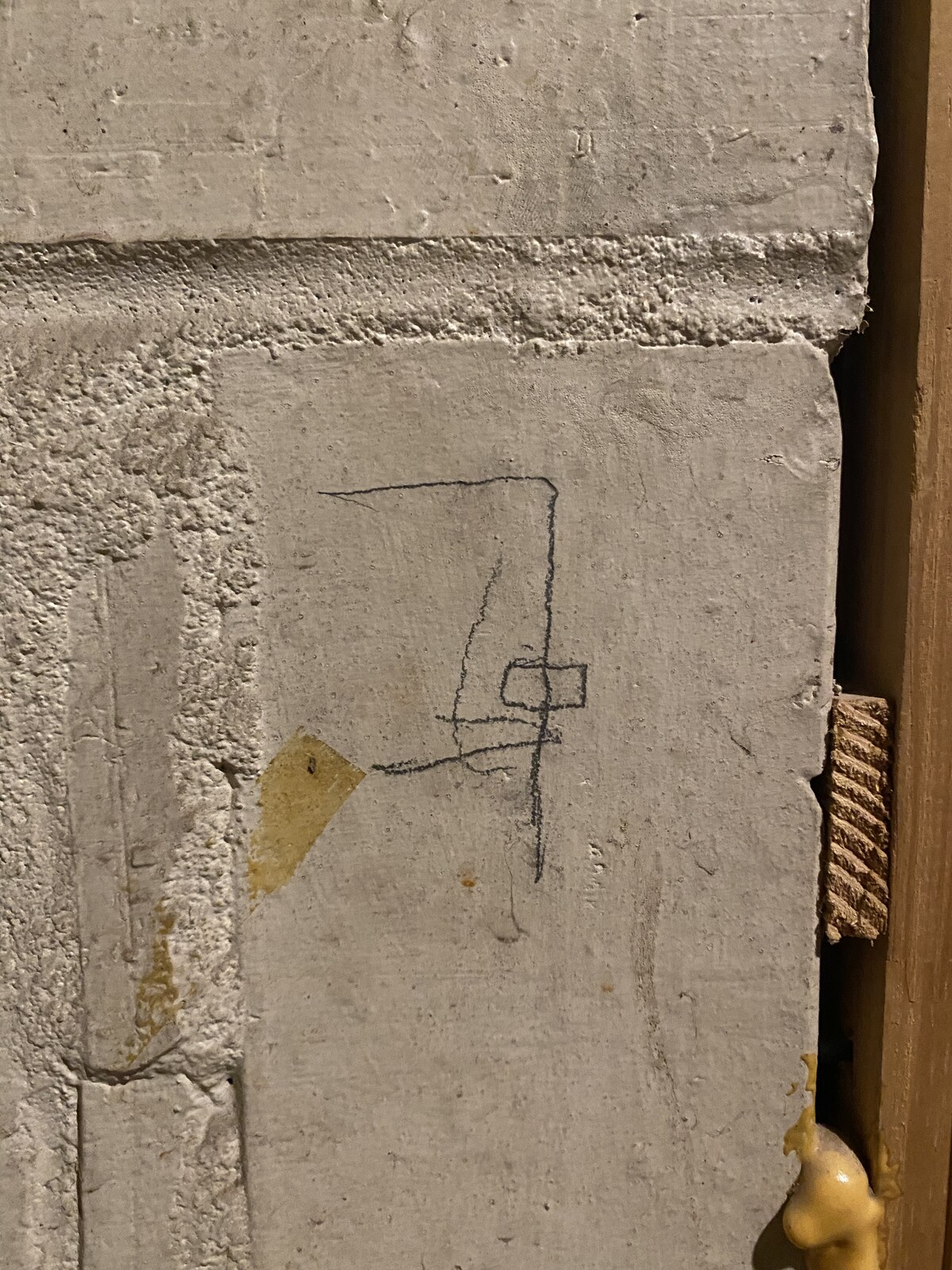
- A downstairs schematic pencil sketch at the foot of the stairs to the second floor beside a later-cut secondary doorway into a first-floor bathroom — a post-1930s alteration to the original fabric.
Five dated pencil marks in one small upstairs room, two on the ceiling and three on the east wall, running 1952 through 1956. With this Febrero frame added the sequence no longer reads “three Marzo wall dates, then later ceiling dates” — it reads as one interleaved cluster that spans both the walls and the ceiling of the same room across the same handful of years.