“Marzo 5 – 1952 / Marzo 25 – 1953 / Marzo 18 – 1954” — Three Pencil Dates on the Upstairs East Wall
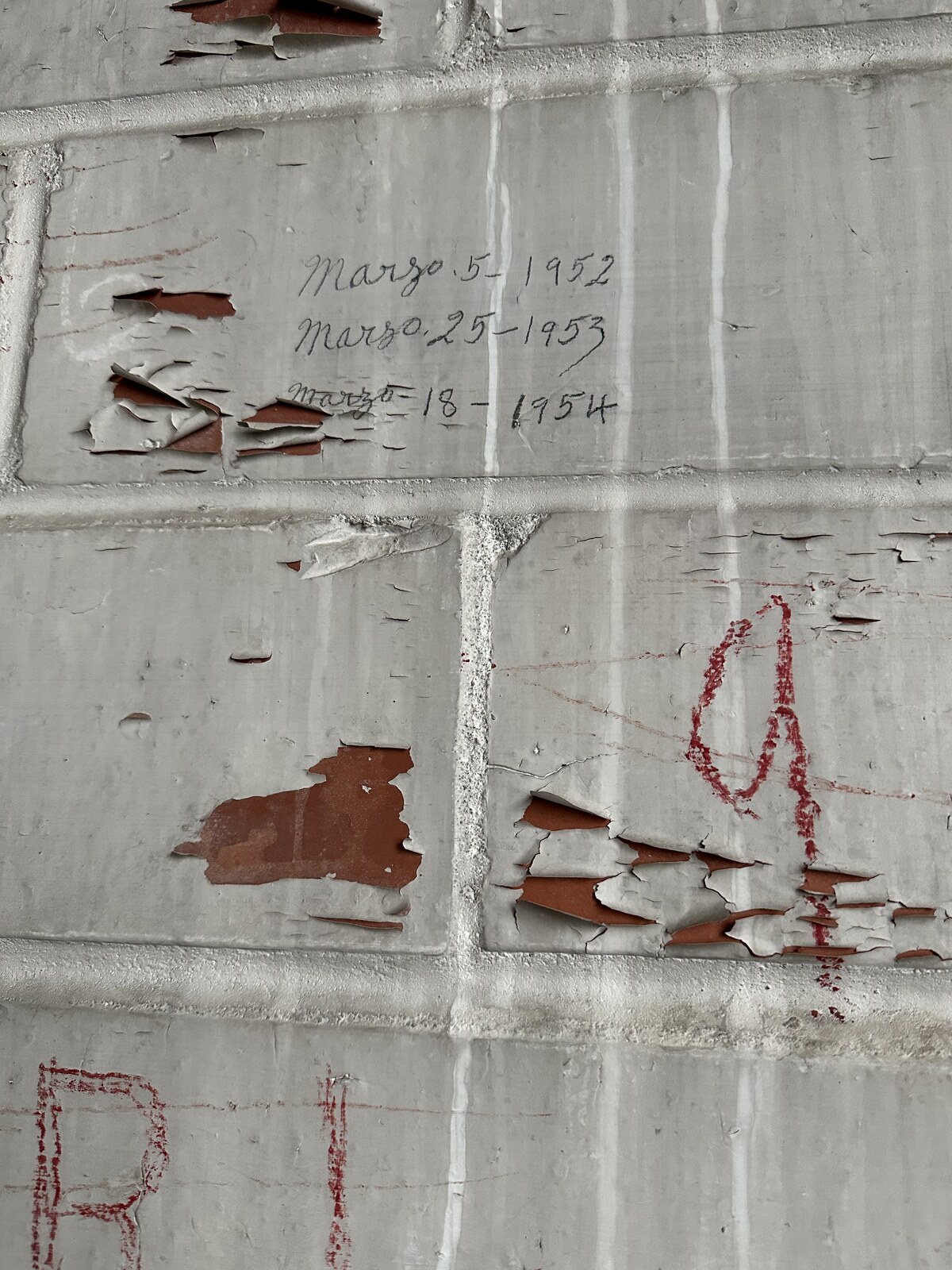
On the east interior wall of the second-floor expansion room above the office at the 1932 Hoffmann-Hayman Coffee Co. factory — a room whose finishes have been left largely untouched for decades — someone pencilled three dates on the wall across three consecutive years:
Marzo 5 – 1952 Marzo 25 – 1953 Marzo 18 – 1954
All three are in cursive graphite in the same hand, stacked one above the next in the upper-centre of the wall. Each is a mid-March date — the 5th, the 25th, and the 18th — written in Spanish (“Marzo”). None of the three dates lands on Easter for its respective year (Easter fell on 13 April 1952, 5 April 1953, and 18 April 1954), so the ritual isn’t following the liturgical calendar in any obvious way. The most natural reading is a recurring personal mark — a birthday, a saint’s day, a wedding anniversary, or simply a “I was up here this March” — made by a worker or office staff who climbed the stair to this back room each March for three years running and reached for a pencil. Who the person was, and what they were counting, isn’t recorded anywhere else in the building that we’ve found.
The wall itself is a piece of evidence too. The plaster has been scored with raised mortar-joint lines in a regular grid, an old decorative finish that imitates brick coursing on an interior surface — horizontal bed-joint lines and vertical head-joint lines trowelled into the rendered coat while still wet. Over that, a white paint layer was laid down; seven-plus decades on, that paint is delaminating extensively, flaking away in irregular sheets and exposing the warm red-brown substrate underneath — either the actual red brick behind the render or a red-oxide primer coat on top of the plaster. A large T-shaped paint spall at center-left is the cleanest exposure in the frame; smaller flakes are scattered across every tier. The fact that three dates from 1952–1954 are still legible in pencil on the painted surface, with no overpainting, means this wall has effectively not been redecorated in more than seventy years.
In the lower half of the frame the same wall carries additional, separate marks in red crayon / lumber-keel — large peaked / triangular shapes on the right that could be roof-profile doodles or a child’s drawing, and, right at the bottom edge, a partial red capital “R” and the start of another letter. These are independent of the pencil dates and in a different hand.
This frame belongs to a small chronology of human inscriptions left on the building’s interior surfaces that now runs across roughly ninety years:
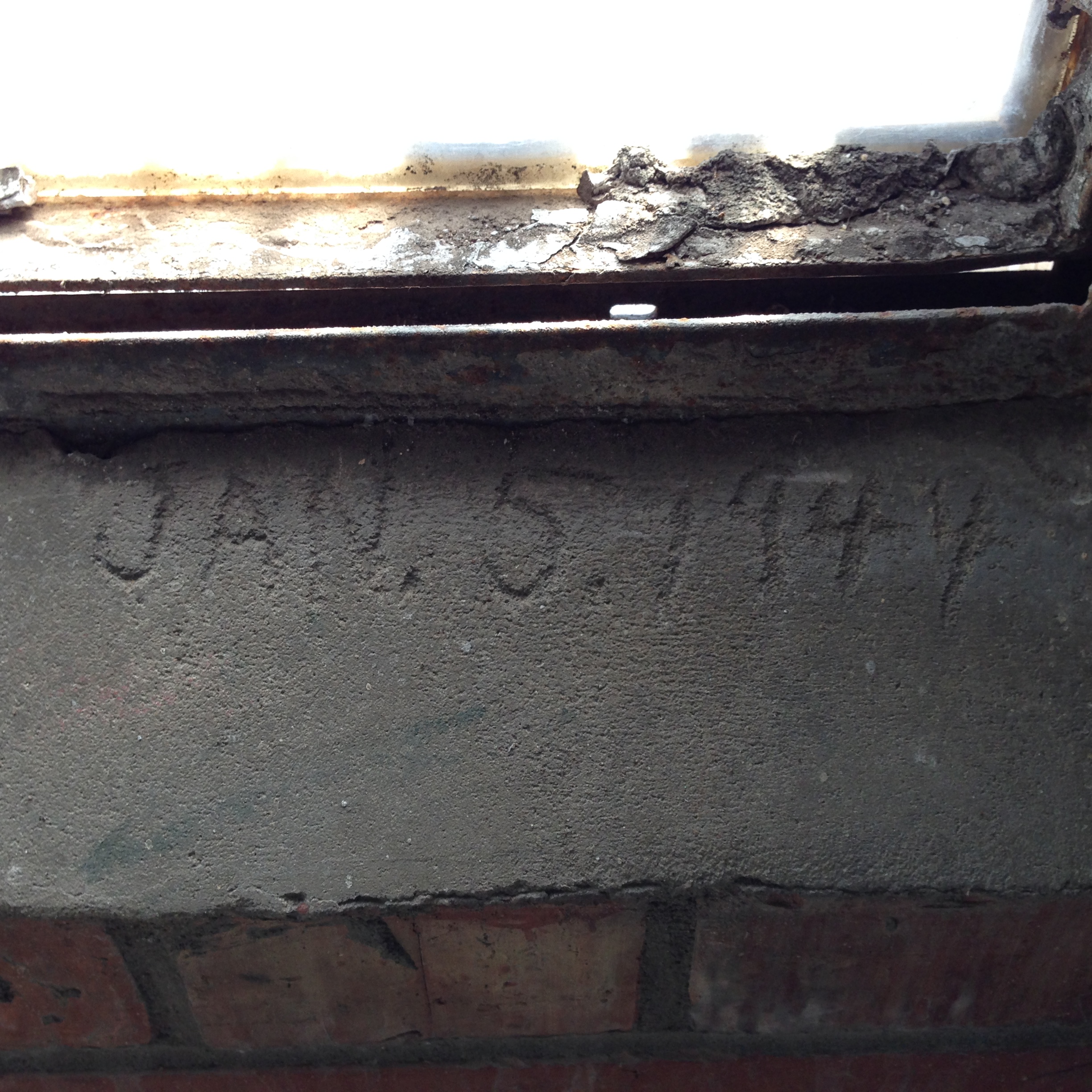
- The second-floor expansion date carved into a window sill — from the 1930s construction itself.
- These three 1952–1954 “Marzo” pencil dates on the upstairs east wall — occupancy-era marks, mid-twentieth-century.
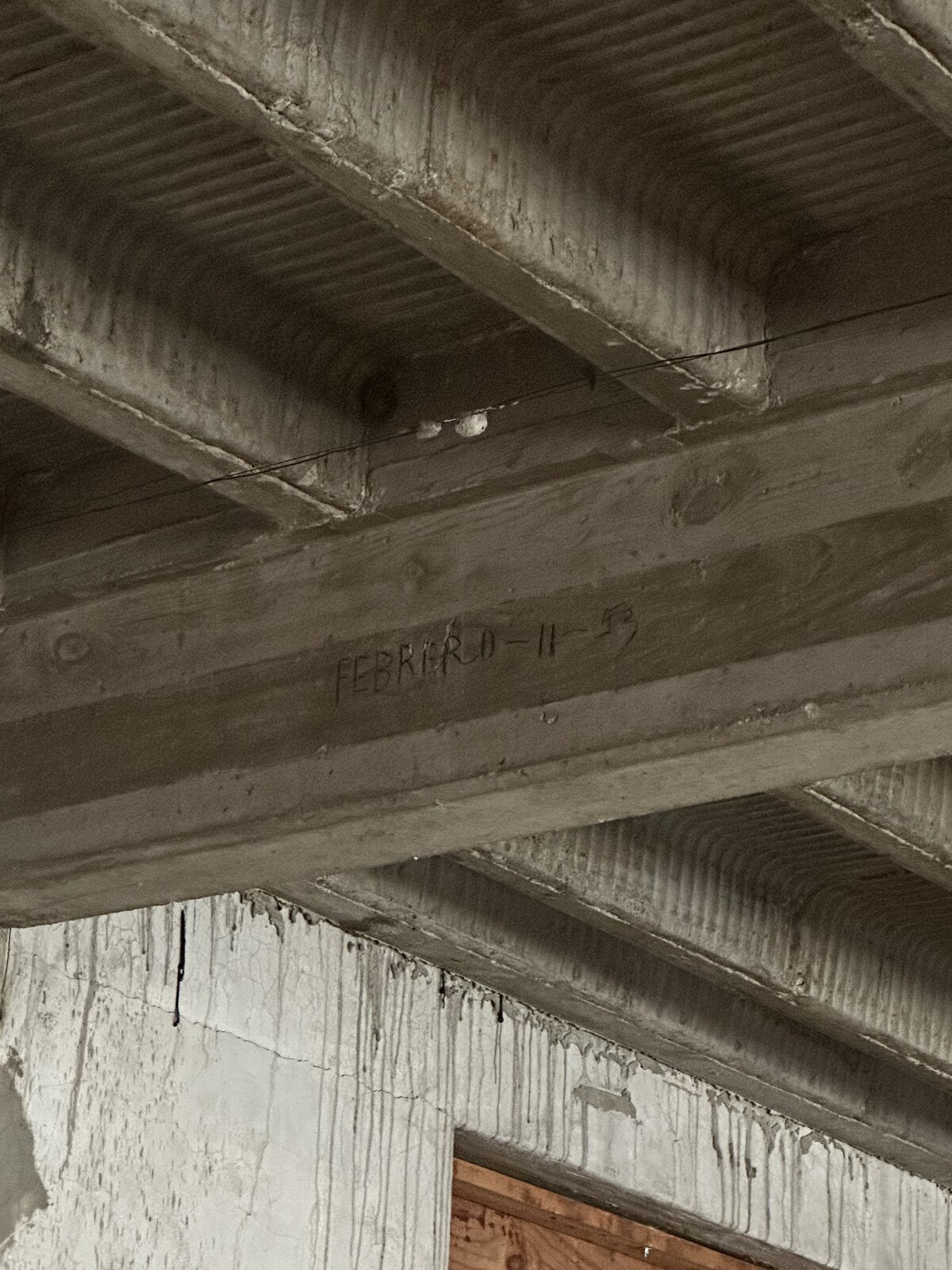
- A fourth pencil date on a concrete ceiling joist of the same room, “Febrero 11 – 53” — photographed the same afternoon, falling in sequence between the 5 Mar 1952 and 25 Mar 1953 wall dates, which tightens the cluster to the same 1953 window.
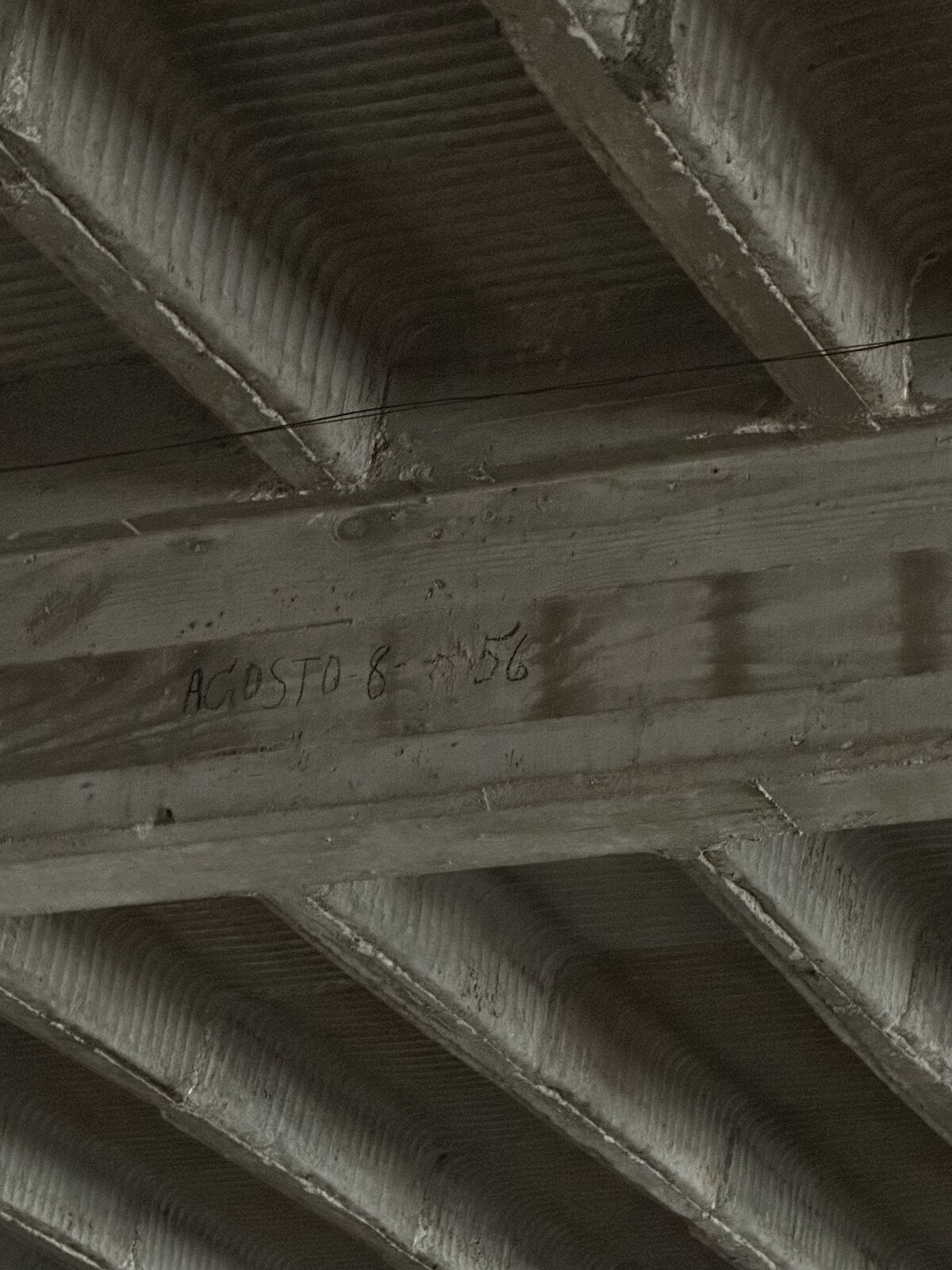
- A fifth pencil date on a different ceiling joist of the same room, “Agosto 8 – 56” — extending the same 1950s pencil-date practice onto the ceiling two years after the Marzo series stops.
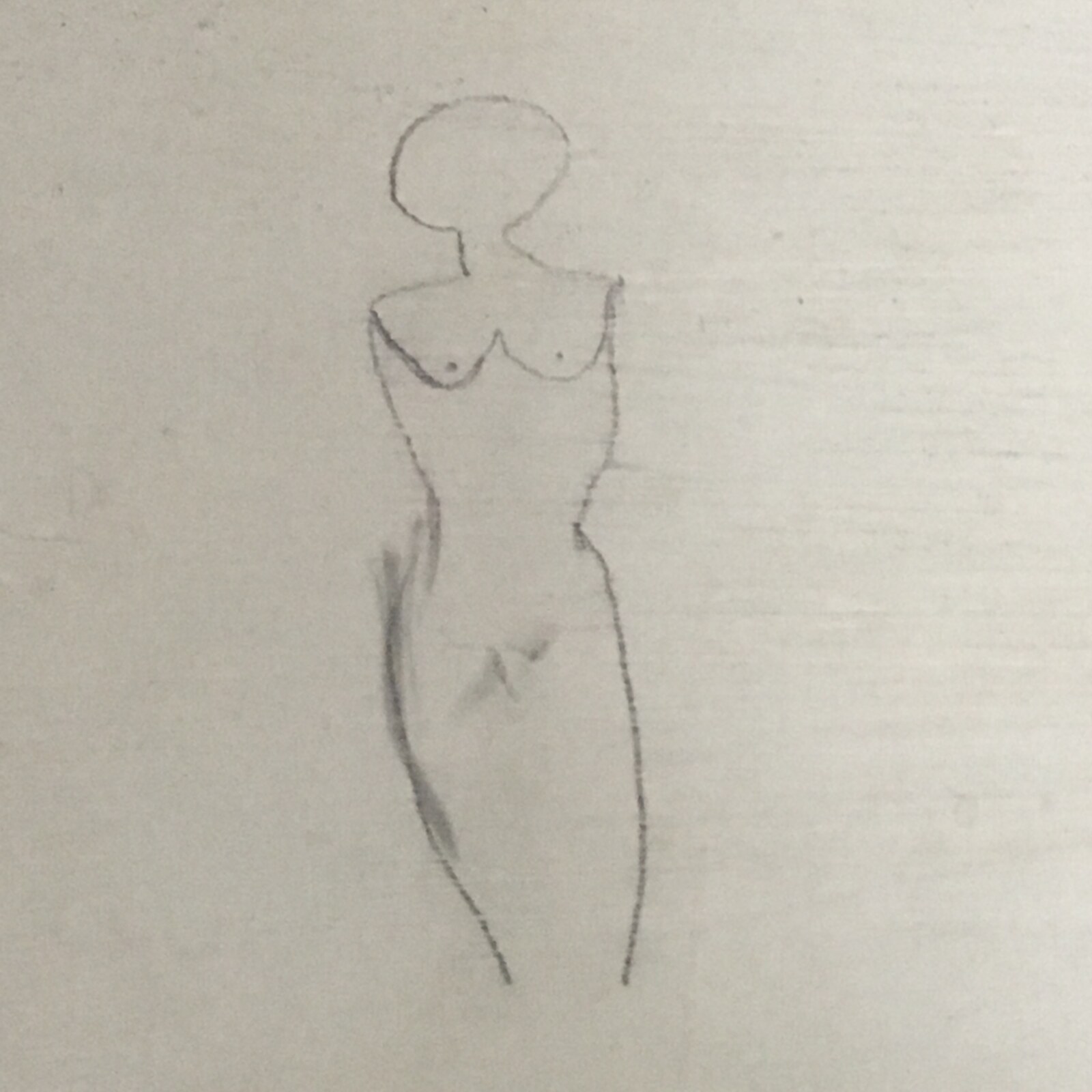
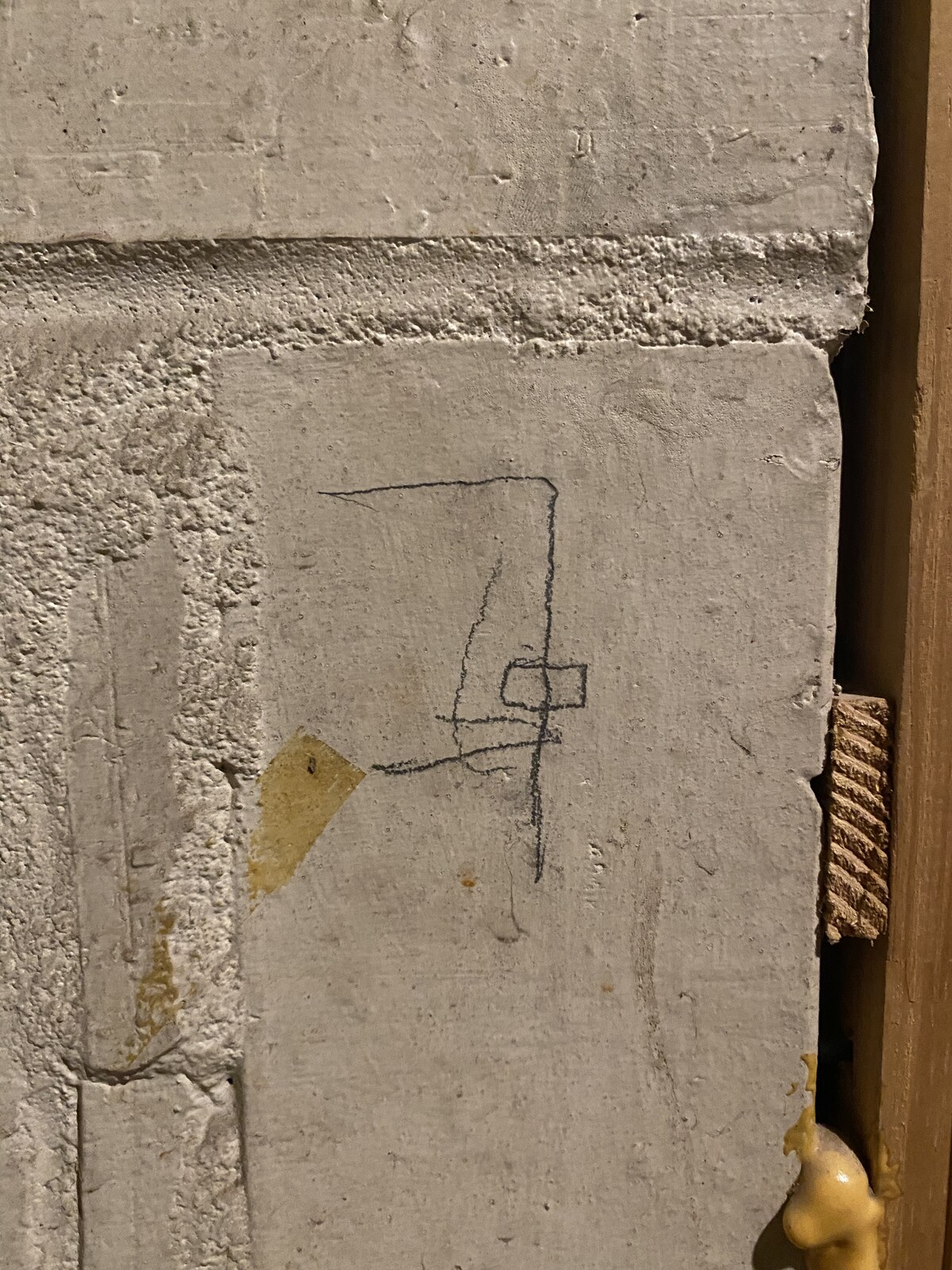
- An informal pencil figure study on an upstairs stucco wall — another informal mark by someone in the building, date unknown.
- A downstairs schematic pencil sketch at the foot of the stairs to the second floor, beside a later-cut secondary doorway into a first-floor bathroom — itself a post-1930s alteration to the original fabric.
Together they’re a quiet record of the people who worked here and, occasionally, marked the walls they worked among.