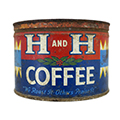
H and H Extract and Spice Bottle
H and H’s grocery extension beyond coffee — extracts (vanilla, lemon, and related baking flavors) and spices — would have been sold in small glass bottles, but no confirmed H&H-branded bottle specimen is in the collection. The two collection artifacts are views of a single small Kork-N-Seal bottle with “H & H” cast into the base, acquired in 2015 from a Virginia estate; its attribution to Hoffmann-Hayman or Haig & Haig (Pinch Scotch whisky) remains unresolved. The bottle was filed in both the collection and not_our_h_and_h galleries, reflecting that unresolved status.
Quick ID:
- Kork-N-Seal bottle — small glass bottle; “H & H” cast on base; Kork-N-Seal stopper closure (c.1911–c.1945); estate provenance from Vinton, Virginia (not Texas)
- Attribution ambiguous — bottom “H & H” could be Hoffmann-Hayman Coffee Co. (San Antonio) or Haig & Haig (Scottish whisky, makers of Pinch); both use the H & H abbreviation; no paper label survives to resolve it
- No confirmed H&H extract/spice bottle is known. The H and H Extracts and Spices lines are documented from 1923 onward but no labeled specimen has been located.
H and H Extracts and Spices
Hoffmann-Hayman sold H and H Extracts — baking flavors including vanilla, Extract of Lemon, and related essences — alongside H and H Spices (pepper, cinnamon, paprika, etc.) as a grocery-shelf extension of the coffee business, using the same plant, dryers, and distribution network. Both lines are documented in the 26 August 1923 San Antonio Light special edition and on the H and H Puzzler box lid (“H and H Spices and Extracts”). Extracts and spice powders were standard glass-bottle formats in this era. No bottle bearing an H&H label has been documented in any collection or archive, making bottle specimens a priority gap in the corpus.
See H and H Extracts — brand guide and H and H Spices — brand guide.
Kork-N-Seal bottle — attribution question
A small glass bottle with a Kork-N-Seal-type stopper closure and “H & H” cast into the base was acquired May 2015 via eBay from an estate in Vinton, Virginia, listed as “Antique H & H Coffee spice, possibly vanilla, extract jar.” Two features complicate the H&H attribution:
Shape. The bottle’s form does not match any known Three Rivers Glass mold documented in the collection or in Smith’s Texas Glass: An Illustrated History. Three Rivers Glass was H&H’s documented Crystalvac jar supplier, but no Three Rivers form for extract bottles has been established.
Alternative: Haig & Haig. Haig & Haig, the Scottish whisky firm, also used “H & H” as its abbreviation and was active in the American market from 1893. Their “Pinch” brand used a distinctive triangular dimpled bottle; the Kork-N-Seal bottle in question does not match the Pinch form, but Haig & Haig used other bottle shapes. The Kork-N-Seal closure dates c.1911–c.1945 (patent 1906, commercial use from 1911; widespread through WWII), which overlaps both H&H’s extract era and the Haig & Haig American trade period.
Virginia provenance. The bottle came from a Virginia estate, not Texas. H&H’s documented distribution was primarily Texas and surrounding Southwest markets — a Virginia origin weakens but does not rule out the H&H attribution (bottles travel with households).
The project filed the bottle in both the collection gallery (HH-COLL-2015-0007/0008, provisional H&H) and the not_our_h_and_h gallery (HH-OTH-2015-0002/0003, titled “Pinch Brand”), acknowledging the unresolved status. No grocery circular, trade ad, or labeled H&H extract bottle has been found to settle the question.
Three Rivers Glass context
HH-REF-2017-0002 — a Three Rivers Glass Co. promotional wall calendar with February 1931 grids, photographed at the April 2017 glass collectors’ show in Three Rivers, Texas — documents TRGCo’s product range. The calendar’s bottom strip lists beverage bottles, milk bottles, and packers ware alongside the “3 RIVERS STAR BOTTLES” logo and a factory interior photograph captioned “HERE’S WHERE GLASS SAND STARTS ON A THREE AND A HALF DAY TRIP.” The calendar establishes that Three Rivers made bottles across multiple categories, but no specific H&H extract or spice bottle form is identified in TRGCo documentation. The Crystalvac jar is the only confirmed H&H product from the Three Rivers supply relationship.
See Three Rivers Glass Company.
Not-H&H context
Two additional bottle items in the not_our_h_and_h gallery are part of this nomenclature class but excluded from the artifact lists:
- HH-OTH-2015-0002/0003 — “Pinch Brand Small Kork-N-Seal Bottle” — the same bottle as HH-COLL-2015-0007/0008, filed as Haig & Haig
- HH-OTH-2017-0001 — Javo bottled coffee, aqua glass bottle — a completely separate brand; filed as context for how other early-20th-century roasters packaged liquid or bottled coffee products
Manufacturer
No glass manufacturer is confirmed for any H&H extract or spice bottle. Three Rivers Glass is documented as H&H’s Crystalvac jar supplier and as a producer of packer ware, but no specific H&H bottle mold attribution has been made. No base mark or mold number has been documented on the Kork-N-Seal specimen.
Artifacts
In the collection
- HH-COLL-2015-0007 — Small Kork-N-Seal bottle, profile/front view; “H & H” base mark; estate provenance, Vinton, Virginia (attribution unresolved)
- HH-COLL-2015-0008 — Same bottle, base view showing “H & H” cast mark
Reference
- HH-REF-2017-0002 — Three Rivers Glass Co. promotional wall calendar (1931 grids), photographed April 2017 glass show; documents TRGCo bottle product range (“3 RIVERS STAR BOTTLES”; beverage, milk, packer ware)
Wanted
No labeled H&H extract or spice bottle has been located. A specimen with a surviving paper label identifying Hoffmann-Hayman and the product type (vanilla extract, cinnamon, etc.) would be the first confirmed H&H bottle in the collection and would resolve the question of glasshouse supplier.
Open questions
- Is the Kork-N-Seal bottle’s “H & H” base mark Hoffmann-Hayman or Haig & Haig? The Virginia provenance, the non-Texas-roaster bottle form, and the not_our_h_and_h filing all suggest Haig & Haig, but no definitive evidence settles it. A grocery circular or trade ad showing an identically shaped bottle used by H&H for extracts would resolve the question.
- What glass supplier produced H&H extract and spice bottles? Three Rivers Glass made packer ware and is documented as the Crystalvac jar supplier, but no H&H extract bottle mold attribution exists.
- Were H&H extract bottles distributed with paper labels or embossed lettering? No labeled example is known.
- Why did the Kork-N-Seal bottle appear in a Virginia estate? H&H’s documented distribution was Southwest Texas; Virginia provenance is geographically unexpected.
- Does the Three Rivers Glass promotional calendar (HH-REF-2017-0002) identify any bottle forms used by H&H? The calendar lists packer ware broadly but does not name H&H as a customer for bottles.
See also
- H and H Extracts — brand guide
- H and H Spices — brand guide
- Three Rivers Glass Company — documented Crystalvac jar supplier; possible extract bottle supplier
- Crystalvac Jar — HH-ITEM-0001; confirmed Three Rivers Glass product