Uncommon Grounds — The History of Coffee and How It Transformed Our World by Mark Pendergrast

By Mark Pendergrast · Basic Books · 2010 revised edition (paperback)
Bibliographic detail
- Title: Uncommon Grounds: The History of Coffee and How It Transformed Our World
- Author: Mark Pendergrast
- Edition held: 2010 revised edition (Basic Books) — confirmed 2026-05-26. Updated statistics and added third-wave-coffee chapters relative to the 1999 first edition.
- Publisher: Basic Books
- ISBN: 978-0-465-01836-9
- Pagination: ~500 main-text pages plus back matter (Acknowledgments, Notes, Index)
- Format: Paperback
Physical description
Standard Basic Books trade production, paperback. The held edition is the 2010 revised — citation pagination is the ~500-main-text-page 2010 revised edition (not the 1999 first edition’s ~520 pp).
Provenance
Physically in-hand prior to formal library accessioning; registered to the library 2026-05-24. Accessioned as HH-BOOK-2026-0016.
Why it matters
Uncommon Grounds is the definitive narrative history of coffee for the modern reader — Pendergrast traces coffee from Ethiopian legend to modern commodity markets, weaving botany, labor, advertising, and war economies into a single accessible narrative. For the H and H research corpus, this is the big-picture context volume: when a regional brand story (H and H) bumps into global supply chains, regulation, or consumer fashion, Uncommon Grounds provides the framing.
Specifically:
- Period framing for H and H operating decades — Pendergrast covers the early-twentieth-century American coffee trade (the era of Ukers’s Coffee Merchandising and All About Coffee) in narrative form. Useful for visitor-facing exposition.
- Wartime / commodity-market context — H and H operated through both world wars and multiple coffee-price-control regimes; Pendergrast documents the trade’s broader response.
- Mexican-coffee-origin context — H and H’s documented Mexican green-bean sourcing connects to Pendergrast’s chapters on Mexican/Central American coffee production (also covered first-person in San Antonio Nexapa (Seargeant, 1952)).
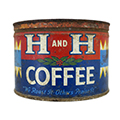
- Advertising and branding history — Pendergrast on coffee advertising provides the comparandum for H and H’s surviving print ads and tin labels.
Pairs in the library with the rest of the modern coffee shelf: Home Coffee Roasting (Davids), The Art and Craft of Coffee (Sinnott), The Blue Bottle Craft of Coffee (Freeman), The Coffeeist Manifesto (Ward), and ties into the early-twentieth-century trade shelf via Ukers.
Notable contents
- Ethiopian legend through commodity-market modernity — single accessible narrative.
- Coffee in war economies (Civil War, WWI, WWII, Vietnam).
- Major-brand histories (Folgers, Maxwell House, Hills Bros., Chock full o’ Nuts, Starbucks).
- Labor, plantation economics, and consumer-side advertising.
- 2010 revised edition adds 2000s-era industry coverage (third-wave specialty rise).
Open questions
- Are any H and H predecessors/competitors named? A close index check for Hoffmann-Hayman, Hayman, H and H, Texas-Mexican coffee trade names would be informative.
- What does Pendergrast say about the regional/independent-roaster ecosystem that H and H was part of? vs. the national-brand consolidation he focuses on.
Related: Home Coffee Roasting (Davids, 2003) · The Art and Craft of Coffee (Sinnott, 2010) · The Blue Bottle Craft of Coffee (Freeman, 2012) · The Coffeeist Manifesto (Ward, 2015) · All About Coffee (Ukers, 1935) · San Antonio Nexapa (Seargeant, 1952) · Library