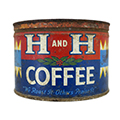
601 Delaware Street Plant
The Hoffmann-Hayman Coffee Company’s major new facility, built in 1932. Described at opening as “the Southwest’s finest modern coffee roasting plant” and “one of the largest and finest in the entire South.”
Address
601 Delaware Street, between South Cherry Street and Hoefgen Avenue, at the Southern Pacific tracks, San Antonio, Texas.
Construction
- Groundbreaking: July 25, 1932
- Architects: Morris, Nooman, and Wilson (Builders Exchange building; period sources also spell “Noonan”)
- General contractor: George W. Mitchell Construction (G. W. Mitchell, 313 Builders Exchange building)
- Size: 14,000 sq ft per floor plate × 2 floors = 28,000 sq ft total (period sources round to “16,000 square feet”)
- Cost: $130,000
- Construction type: Two-story, fireproof
- Target occupancy: October 15, 1932 (revised to November 15; actual occupancy ~November 1932)
Architectural type — daylight factory
Curator research into Albert Kahn (2026-07-16) identified the building’s place in the national typology: 601 Delaware is a late regional example of the daylight factory — the early-20th-century American industrial building type defined by a fireproof reinforced-concrete frame that carries all loads, non-load-bearing curtain walls hung between the structural members, and bays filled with the largest steel-sash windows the frame allows, flooding deep floor plates with natural light in the era before cheap fluorescent lighting and air conditioning.
The type was developed in American reinforced-concrete practice (Ernest Ransome’s United Shoe Machinery plant, Beverly, Mass., 1903–06) and popularized by Albert Kahn of Detroit — Packard Plant Building No. 10 (1905, using brother Julius Kahn’s “Kahn System” trussed-bar reinforcement) and the Ford Highland Park plant (1910, the “Crystal Palace”). The term itself was canonized by Reyner Banham in A Concrete Atlantis: U.S. Industrial Building and European Modern Architecture (MIT Press, 1986), which traces how the type became the iconography of European modernism.
Every defining feature of the type is independently documented in this building:
| Daylight-factory feature | Evidence at 601 Delaware |
|---|---|
| Fireproof reinforced-concrete frame | Period press: “fireproof”; Sanborn sheet 269: Fireproof Constn., concrete floors and roof; walkthrough: columns and beams in three layers |
| Non-load-bearing curtain walls | Sanborn: brick curtain walls (north wall tile); walkthrough: hollow brick/CMU infill “non-load-bearing and knockable-out” because the structure rests on the beams |
| Maximal steel-sash glazing | Walkthrough: steel-sash windows roughly 8 ft tall, pivot-hung, filling the structural bays |
| Multi-story loft plan, flat roof, rail-served | Two-story 14,000 sq ft floor plates; roof supported process loads; dedicated railroad siding |
Attribution caveat: this is a typological identification, not an attribution — the architects were Morris, Nooman, and Wilson of San Antonio, working in what was by 1932 a mature, nationally standardized type. Kahn’s own practice had already moved on to single-story steel-framed sheds (Ford River Rouge, from 1917), which makes 601 Delaware a late instance of the concrete daylight factory — built at the end of the type’s run, which is part of why its fabric (frame, curtain wall, steel sash with original ≈⅛-inch glazing sheet) survives so legibly.
Interpretive payoff: the term gives the building a recognized name in the national architectural literature — usable in the Statement of Significance, NRHP/THC designation arguments, and museum panels — and pairs with the architecture-deskilling thesis: the daylight factory is precisely the kind of place-specific, materially legible industrial fabric that is no longer produced.
Features
- Modern coffee roasting and vacuum-packing equipment (Huntley Manufacturing Company Monitor roasters were the documented H&H roaster vendor in 1923 and a plausible continuation into the 1932 plant pending direct documentation)
- 60 or more employees
- Showers and lounge rooms for both men and women
- Commodious company cafeteria
- Garage and workshop for fleet maintenance
- Special railroad siding arrangement for simultaneous loading/unloading of several freight cars
- A large H and H Crystalvac container placed on the roof — visible for blocks in all directions
Open House
Wednesday, December 21, 1932, 6:30–10:30 PM
75 Lions Club members attended a luncheon and tour on December 28. Open House broadcast over Station WOAI at 8 PM December 21.
The original hand roaster used by William R. Hoffmann in 1904 — “hardly larger than a 50-pound lard can” — was given a place of honor in the new plant, a tribute to the company’s founding.
Previous location
The company had been at 331 Burnett Street for approximately ten years before this move (so ~1922–1932). Earlier locations: 1223 West Commerce Street (1912), 228 East Commerce Street (Hoffmann’s original business).
Factory finds (non-coffee paper, wood, and metal)
The plant at 601 Delaware is easy to read as a coffee-only story (roaster hardware, keywind tins, newspaper ads), but on a walk-through what comes out of walls and outbuildings still advertises the full brand grid the office wrote up — tea, spices, signage, shipping collateral. These are site-recovered finds, not dealer stock, and they confirm the company’s non-coffee lines as part of the physical plant footprint.
- Sales report books from the office ceiling — interwar sales-desk ledgers pulled from above the office ceiling during a cable run. Line-by-line entries for tea, house blends, Sam Houston, Broncho, Texas Girl, and the rest of the brand grid. Full write-up under Sales report books from the office ceiling.
- Master Chef painted plywood sign (in situ) — rough board with large red H AND H slab-serif lettering and MASTER CHEF / COFFEE in black block type. Nail holes and weathering from real use; recovered on the factory footprint, not dealer stock. Figure:
assets/images/gallery/factory-master-chef-sign.jpg. - H and H price sign (Master Chef, paper) — large unfolded paper counter placard, heavy red ink, never marked for the shelf; picked up in New Braunfels. Same mid-century Master Chef line as the one-pound tins but in printed-paper form, not the field-shot wooden board above. See H and H price sign.
- Crate fragment with stenciled Delaware Street address — shipping-crate board fragment from a small outbuilding on the property (field notes use the local nickname “murder shed”). Still carries stenciled shipping identity tied to Hoffmann-Hayman and the Delaware Street works — wood-and-ink evidence of the outbound logistics that accompanied burlap, nails, and finished goods leaving the plant.
- Paprika barrel lid — bulk-format sibling to the small H and H Spices upright tins. Paprika is listed in the published flavor range on H and H Spices; the lid documents the line at grocery scale even though a full barrel pack is not yet in hand. The site-wide Wanted list still calls out a paprika tin for the brand range.
Security fixtures — three in situ
Three security fixtures survive at 601 Delaware, documenting that H&H maintained substantial on-site secure storage — consistent with a 60+ employee plant handling weekly payroll cash, green-coffee purchase settlements, and possibly finished-goods bond collateral:
-
Small wall safe — Sargent and Greenleaf. A combination wall safe by Sargent and Greenleaf (Rochester, N.Y. — established 1857; the dominant American producer of combination locks and precision vault hardware). A compact office fixture, recessed in the wall, for immediate-access petty cash or daily till.
-
Walk-in vault — Diebold locking door. A full walk-in vault room with a heavy locking door; the combination dial on the door is marked Diebold (Canton, Ohio — founded 1859; principal American manufacturer of bank vaults and commercial vault doors). The walk-in vault would have held payroll cash ahead of payday, bond documents, and other instruments that required more than a wall safe’s capacity. Whether the vault was in the original 1932 design by Morris, Nooman and Wilson or added later is undocumented.
-
Full safe on wheels — inside the vault. A free-standing combination safe on casters, housed inside the walk-in vault. This combination of a secured room and a locked safe within it is standard double-security practice for high-value commercial deposits — the wheeled safe could be repositioned or removed if the vault room itself was opened by force.
Together the three fixtures indicate H&H was operating at a cash-handling scale unusual for a regional roaster — consistent with their documented 60+ employees in 1932, a multi-state distribution network, and the capital outlay documented in the plant ($130,000 construction cost).
Current use: The H&H artifact collection is now housed in the walk-in vault. The vault that once secured the company’s payroll and bond documents now holds the tins, jars, signs, and ephemera that document the company’s history.
Old Roaster door and power box
A separately documented in-situ artifact: the cream-enamel door and embossed OLD ROASTER Dymo-style label on the power box for the roasting line — alligator-cracked paint, rust streaks, label intact. Visible proof of roasting infrastructure even when the air on a walk-through reads neutral (humidity, empty shell, time, later construction). Figure: assets/images/gallery/handh-old-roaster-door-ig.jpg. Full write-up: Old Roaster switch at the H and H Coffee Factory.
Building fabric and systems (firsthand walkthrough)
Observations from a 12 June 2026 firsthand walkthrough by curator Brett Elmendorf, recorded in the Nancy and Tim Draves session digest (Rec11 ~14:34–15:07 and ~33:33–35:46). These are first-party but observational/oral, not a measured survey — treat as field notes pending confirmation against the books, the G. P. Menger narrative, and the 1942 wholesale price sheet.
- Natural-gas main and second-floor roasters. The building’s natural-gas supply enters on a five-inch pipe. Brett estimates four-to-six roasters of roughly 500–600 lb sat on the second floor, fed by that main. The roaster count and capacity are Brett’s estimate and remain an open item — to be confirmed against the books / G. P. narrative / 1942 price-sheet roastery configuration (see Where are the original factory machines?).
- Structure. Columns and beams in three layers; the infill between columns is hollow brick / CMUs (concrete masonry units, extruded, with multiple generations visible). The infill is non-load-bearing and knockable-out because the structure rests on the beams.
- Front (office) section. Metal lath and plaster, with a painted / stucco finish.
- Windows. Steel-sash, roughly 8 ft tall, pivot-hung (L-shape pivots / chains, not cranks). The second-floor glazing is not glass or plastic but a fiberglass-like sheet ≈⅛ inch thick that has never been replaced; some sashes are painted shut. A pre-sale tenant sprayed the second-floor exterior tan, covering original finishes.
- Marble threshold. A ~2-inch strip of marble flooring survives in the office-entry threshold near the old bathroom, implying lost adjacent flooring.
- Concrete. The concrete is lime-based, not Portland.
- No Saltillo tile was found on the property (possibly once on the dock, since removed).
Sanborn fire-insurance coverage (LOC) — checked 2026-06-13
Pulled the Library of Congress digitized San Antonio Sanborn set (the only freely available one): base surveys 1911/1912/1924, “republished 1952” in seven volumes (collection; 601 Delaware sits in Vol 3 — Denver Heights). Per the Vol 3 street index (sheet numbers are continuous across the atlas and map directly to the sheet images):
| Street / block | Sheet | What’s on it |
|---|---|---|
| Delaware odd / north frontage (601–633), block 657-south, + Ohio 100–138 | 269 | The H&H plant (601) and the dwellings facing it on Ohio |
| Delaware even / south frontage (500–618), Louisiana, Florida | 271 | Industrial row opposite the plant (chemical/wine/repair) + Talley Transfer Co. |
| Indiana 300-block (300–332), block 657-north | 269 | Dwellings; vacant corner lot at 300 Indiana |
| Delaware 300–535 (incl. 533), Hoefgen Av | 255 | Appliance/tire store (533) + McKesson & Robbins drug warehouse (663) |
| Cherry S. (100–233) | 261 | — |
| Federal Envelope Co. (Iowa/Hoefgen) | 254 | — |
Direct images, e.g. sheet 269:
https://tile.loc.gov/image-services/iiif/service:gmd:gmd403m:g4034m:g4034sm:g4034sm_g08740195203:08740_03_1952-0269/full/pct:50/0/default.jpg
(swap 0269 → 0271, 0255, 0254).
Finding — the LOC plate DOES depict the plant. Vol 3 sheet 269 labels the building by name across its footprint:
HOFFMAN & HAYMAN COFFEE CO. — COFFEE ROASTERS Fireproof Constn. — BUILT 1932 … BUILT 1944 (warehouse additions)
(Note the cartographer’s spelling: “Hoffman & Hayman” — single-n Hoffman.
A primary-source variant of the firm name.) The plant occupies the northwest
corner of the Ohio→Delaware block at the rail line (addressed 601 at the
Delaware/rail corner, 100 on the Ohio side), with the rail right-of-way to
the west marked “IMPASSABLE.” Construction notes legible on the plate:
concrete first floors & roof (CONC. FR. FLS. & RF.); brick curtain walls
except the north wall, which is tile (matches the field observation that the
north elevation differs); incinerator on the north; office (OFF) and
warehouse (W. HO, 2nd floor) wings — the warehouse bays carry the 1944
build date; chemical extinguishers (CHEM. EXTRS.), fire deck 1st / tile
2nd, V.P. 50%, hose each floor. A 12-inch water pipe runs down
Delaware. Figure: assets/images/gallery/sanborn-1952-vol3-sheet269-hh-plant.jpg
(full sheet: …sheet269-full.jpg).
Bottle-washing — the “across the street” works. Oral history anchors a real target, corroborated firsthand by the Peché family on the 13 June 2026 tour. Manuel Peché — father of David L. Peché (Arcadia author whose Downtown San Antonio book the project used to identify its first tin) and husband of Mary Louise Peché (101) — washed bottles at a works across the street as a boy (~age 14, c. 1940), then came to H&H, unloading coffee sacks off the rail dock (Mary Louise: “I know that he came to unload the train”) and driving, before being drafted into the Navy ~1944. The family places the bottle works squarely on the even/south Delaware frontage (sheet 271) — but in this republished-1952 plate that block is warehouses and repair shops (chemical/wine warehouse, electric-motor and stove repair, Venetian Blind Factory), with no bottling works labeled. That fits: the works predates the ~1952 state (Manuel’s stint was c. 1940), so it would appear only on an earlier survey or in city directories for the even-600 Delaware addresses (chase routes in the date caveat below).
Immediate neighbors (from the same plate):
- South, across Delaware (sheet 271, even 500–618 block): a continuous
masonry industrial row facing the plant — Chemical Warehouse (
CHEM. W.HO, brick/tile, ~500–602), Wine Warehouse (WINE W.HO, brick/tile), Stove & Refrigerator Repair (CONC. FL., addressed 604/606), Electric-Motor Repair (CONC. FR. & FL., C.B. curtain walls, wood rf.), and a Venetian Blind Factory (masonry). Behind them toward Louisiana: Talley Transfer Co. storage warehouses. Figure:assets/images/gallery/sanborn-1952-vol3-sheet271-delaware-south.jpg. - North, across Ohio then Indiana (sheet 269, block 657): dwellings on both
frontages (Ohio 100–138; Indiana 300–332). The corner lot at 300 Indiana
(at the rail line) is vacant; 308 Indiana holds a frame dwelling.
Figure:
assets/images/gallery/sanborn-1952-vol3-indiana-300block.jpg.
Caveat on date: the LOC Vol 3 base is 1911/1912/1924 “republished 1952”; the plant footprint shown is the 1932 building with 1944 additions, i.e. a late-1940s/early-1950s state. For finer detail of the second-floor machinery layout (vacuum-packing compressor, green-coffee bins, rooftop water tank) — or to find the bottle-washing works that the 1952 plate does not show — the free LOC raster is insufficient. Chase routes, easiest first:
- Morrison & Fourmy city directories (UTSA / SAPL Texana) — look up the even 600-block Delaware addresses (600/602/604/606/608/610/616/618) year by year for a “Bottling Works / Bottling Co.” occupant; this dates the works and names the firm without a Sanborn pull. (Checked June 2026: no free true-1930s SA Sanborn is online for this block.)
- David L. Peché — partly done (13 June 2026 tour): the family confirmed the across-the-street bottle works and Manuel’s c. 1940 stint but did not name the firm. Worth a follow-up; the Downtown San Antonio book may also describe it.
- SAPL ProQuest “Texas Digital Sanborn Maps” (San Antonio library-card login; access path in the SAPL Sanborn Fire Insurance Maps LibGuide, https://guides.mysapl.org/c.php?g=1143589&p=8353969) — pull the earliest Denver Heights / Ohio→Delaware block sheet (pre-1952 survey) and read the south/even Delaware frontage.
- UTSA Special Collections holds the physical San Antonio Vol. 3 (Denver Heights) earlier-edition atlases for reading-room consultation.
613 Delaware Street (adjacent parcel)
Wartime classified ads (1944) and Rohde & Gittinger listings (1943–1944) describe a furnished residence adjoining the H & H Coffee Co. plant at 613 Delaware St. — a street number contemporaries used for the factory neighborhood, distinct from the 601 Delaware plant address in fire and operations coverage. Albert Osterloh (night watchman, 613 Delaware, 1936 assault story; 1943 obituary for Albina Osterloh; 1944 Commerce Street injury) and the Jasso family (1974 Woolford column and Francisca Jasso obit at 613 Delaware) document the residential side of the block during and after H&H occupancy. Clips: HH-CLIP-1944-0003, HH-CLIP-1944-0004, HH-CLIP-1943-0008, HH-CLIP-1943-0009, HH-CLIP-1936-0006, HH-CLIP-1944-0005, HH-CLIP-1974-0005, HH-CLIP-1974-0006.
Open questions
- Why did the first-floor structure require steel I-beam repairs, and what was on the roof that required extra support? Resolved (2026-07-22). Physical observation confirms: visible 45-degree diagonal cracks in the first-floor ceiling (concrete beam soffits) and steel I-beams retrofitted to carry the load that the cracked members can no longer safely sustain. The crack pattern is diagnostic: 45° diagonal tension cracks in RC beams indicate shear failure, not settlement or bending. Curator Brett Elmendorf has confirmed the repair sites are mounting/reinforcement points for an overhead crane rail — a traveling-crane or hoist track spanning the production floor, ordinary material-handling equipment for a plant of this type and era; a traveling crane’s concentrated, moving wheel loads are a textbook cause of this crack pattern near beam supports. This supersedes the earlier candidate hypotheses — a rooftop gravity water-storage tank, the Crystalvac vacuum-packing compressor and cooling plant, or bulk green-coffee storage bins — which were reasonable guesses before the crane-rail mounting was identified. This is also not connected to 301 Primera: the apparent parallel to Ted Menger’s ceiling rig there (see 301 Primera § Ted Menger ceiling rails) was a misinterpretation — the factory never had rail-like ceiling hardware in that sense. Research angles remaining: crane manufacturer, capacity, and install date via San Antonio building permits, Sanborn fire-insurance maps, or George W. Mitchell Construction records; what the crane served on the production floor.
- Where are the original factory machines? Partially answered (2026-05-25): four Jabez Burns Jubilee roasters were sold to Monterrey (1971; Chris M. Jasso letter via Nancy Draves). The 1904 hand roaster was preserved as a 1932 Open House display piece. Huntley Monitor line (1923 documented) and vacuum-packing / Crystalvac equipment remain unaccounted for. Research angles: CoffeeTec Antiques Roasters listings; auction notices; trade-press used-equipment ads; museum accession files.
-
What did peak-operation interior photography look like? Partially expanded (2026-05-21). Features catalogs the 1932 plant build at occupancy; documented newspaper interior shots from the 1940s–1960s peak-operation period now include: (a) the 22 May 1949 San Antonio Light “$315 Million Output Predicted” McNeel business feature (HH-CLIP-1949-0002), which prints a documentary photograph of about 70 H&H Coffee Co. employees demonstrating quick milling, weighing, and packaging of fine coffees inside the 601 Delaware plant on the occasion of the San Antonio Manufacturers Association annual dinner (held at the plant the Tuesday before, 17 May 1949); and (b) the 1959 “Top Coffee Plant” Light feature on the Hoffmann-Hayman page. The 1949 photo is the earliest documented workforce-line interior shot from the Delaware Street era and the only one taken during the late-G. P. Menger / pre-Continental period. Research angles: San Antonio Light / Express photo morgues (Trinity University archives, UTSA Institute of Texan Cultures); Sanborn fire insurance maps showing machinery layout; private employee snapshots if any surviving worker families can be reached.
- “G — M — A” surveyor’s pavement marker at the entry gate — whose stamp? A small zinc / galvanized-steel domed pavement marker, the size of a US quarter, is driven into the Delaware Street pavement directly in front of the factory’s entry gate (2024 reference post). The cap face carries a central center-punch dimple, radial tick marks, and three legible stamped letters reading G — M — A around the perimeter — almost certainly a Texas surveying firm’s or registered land surveyor’s initials, but the specific attribution is not yet identified. Research angles: Bexar County plat records and recent surveys filed for the H&H parcel and the Delaware Street right-of-way; Union Pacific / Southern Pacific railroad ROW survey records for the rail siding directly behind the building; City of San Antonio public-works construction-control records (SAWS, TxDOT, City PW); Texas Society of Professional Land Surveyors Alamo Chapter rosters cross-referenced against the GMA initials; a registered surveyor recognizing the cap face in person would likely identify the firm immediately. Open sub-questions: are there matching GMA stampings at the parcel’s other corners (street curb, rear-of-lot at the rail siding, intermediate angle points) that would establish this as a coordinated parcel-corner monumentation rather than a single-point reference?
See also
People
- Charles H. Griswold
- Chris M. Jasso
- Gustav P. Menger — president during construction
- Jack Moore
- Lupe Valdez
- Warren Burns
- Manuel Peché
Places
- 1008 Hoefgen Street
- 1223 West Commerce Street — early H&H wholesale address (1912; three addresses back)
- 208 East Commerce Street — pre-merger Hoffmann address (1908; four addresses back)
- 301 Primera — R. W. Menger’s residence; Nancy Draves’s 30 May 2026 email drew a parallel between the factory ceiling and Ted Menger’s ceiling-rail rig at Primera, since retracted as a misinterpretation (see § Open Questions above)
- 307 North Medina Street — Morrison-consolidation address (1916–1922; two addresses back)
- 331 Burnett Street — immediate predecessor address (1923–1932; “new home” of the 1923–1932 era)
- UTSA (University of Texas at San Antonio)
- San Antonio Conservation Society
- 533 Delaware Street — immediate eastern neighbor across the tracks
Events
- 601 Delaware roof fire (25 January 1947)
- Aviation Coffee Fire (1937) — adjacent-history fire at Tucker successor
- Burns Jubilee roasters sold to Monterrey
- Continental Coffee of Chicago acquires Hoffmann-Hayman
- Texas highway department era begins
- Delaware Street factory built
- Open house at the new roasting plant
- Second-floor addition, Delaware Street plant
- North-end wing at 601 Delaware
- Federal-Aid Highway Act — Interstate Highway System
- Help-wanted ad lists 601 Delaware
- 601 Delaware offered for sale
Companies
- American Can Company
- CoffeeTec
- Continental Coffee Company — purchased H&H brand operations in 1962 (Continental of Chicago); operated from 601 Delaware until August 1972, when it returned its rail-spur rights days before the building was sold
- Galveston, Harrisburg and San Antonio Railway (GH&SA)
- George W. Mitchell Construction
- Hoffmann-Hayman Company
- Huntley Manufacturing Company
- Jabez Burns & Sons
- Macro-Sea
- Morris, Nooman, and Wilson
- Sanborn Map Company
- Southern Pacific Railroad
- WagnerS Kid Stuff, Inc. — 601 Delaware corporate address, 1990–1999 (Wagner family post-toy-warehouse era)
- HDZ Metal Tech
- Lone Star Brewery
- Master Chef Food Products
- WOAI
Brands
Stories
- H and H Coffee Roaster Equipment Lifecycle — hand roaster through Jubilee roasters and 1971 Monterrey disposition
- Recovering Manuel Peché — the first rank-and-file H&H worker from family memory
Synthesis
- Plant vs. factory — terminology — KB convention for plant (historical) vs. factory (reuse project)
- Summerville Photos (1929 and 1936)
- Company Organization
- Community Memory — November 2024 Facebook Discovery
- Architecture Deskilling — Why All New Buildings Look the Same — pairs with the daylight-factory / hand-built-fabric argument
- The Prohibition–Depression Thesis — construction timeline and context for the 1932 plant
Future
- 601 Delaware Group A Upgrade — regulatory project to achieve Group A-3 assembly occupancy
- 601 Delaware Museum Program — visitor path, docent script, interpretation panels, press pitch
- 601 Delaware Operating Plan — booking policy, rate card, venue listings, tenant and outreach strategy
- 601 Delaware Roadmap
- 601 Delaware Street — Statement of Significance
- 601 Delaware — As-Is Inventory
- Coffee Museum (planning)
- Listening Tour — Coffee Industry
- Listening Tour — SA History Community
- Listening Tour
- San Antonio Sports & Entertainment District
Operations
- Photo Studio — Bay 1, 601 Delaware
- National Register of Historic Places — Nomination Process
Book
- Historical Interviews
Sources
- Bruynzeel Collection Shelving (Sysco®) — product page
- CoffeeTec — homepage (new & used roasting equipment marketplace)
- eBay listing — American Can CANCO Model 08 Automatic Can Seamer, 502 diameter tooling (item 123924453162)
- Melvina Can Machinery — Canco (American Can Co.) Seamer inventory page
Reuse program
Forward-program planning, regulatory pathways, and operational documents for the
adaptive reuse of this building live in the sibling repo
601-delaware. That repo holds the roadmap,
vision, designation pathway, building systems, programming by area, and the
Cultural Factory Thesis identity argument.