A ‘G — M — A’ Surveyor’s Marker in Delaware Street, in Front of the Factory’s Entry Gate

A small detail at the property’s street edge — easy to walk past, useful to record. Looking straight down at the asphalt-and-aggregate pavement of Delaware Street, directly in front of the entry gate to the 1932 Hoffmann-Hayman Coffee Co. factory in San Antonio, on 23 December 2024, there is a surveyor’s pavement marker driven through the road surface.
What the marker looks like
A domed metal cap, roughly the diameter of a US quarter, sitting on top of a vertical pin grouted into a hole drilled through the pavement. The cap and pin look galvanized or zinc-plated rather than brass or aluminum. The cap is set into a small crater of broken-out concrete and loose gray gravel — typical of a marker that was set into a drilled hole and grouted in, with the surrounding asphalt having since cracked or fretted away around the seat. A long vertical pavement crack runs straight up through the marker’s setting from the bottom of the frame to the top, continuing through the aggregate on either side; the marker is sitting astride the crack rather than next to it, which means the crack opened up after the marker was placed and now runs through the pavement that holds it.
What’s stamped on the cap
The cap face carries:
- A central center-punch dimple — the precise survey point. Hammered with a punch after the marker was set, to fix the location to a single sharp dot under any surveying instrument set up over it.
- A pattern of short radial tick marks — short straight lines emanating outward from the center-punch dimple, dividing the cap face roughly into a star or compass-rose layout.
- Three legible stamped letters around the perimeter, arranged radially:
- M near the top of the cap.
- A on the right side, struck as a triangular form (the crossbar of the A is faint or missing in the impression — common when the steel die hits hard but unevenly, or when the cap is soft and the impression flattens slightly).
- G at the lower-left, a curled half-circle character consistent with a stamped capital G.
Read clockwise around the cap, these read as a three-letter group: G — M — A.
What “GMA” probably is, and what we don’t know
A stamped three-letter monogram on a permanent pavement cap, accompanied by a center-punch fix and radial tick marks, is the signature of a Texas surveying-grade pavement marker — the kind a Registered Professional Land Surveyor sets to mark a property corner, right-of-way line, or a station along a control traverse. Texas right-of-way and property-corner markers are commonly stamped with either:
- The registered firm or agency that placed the marker (initials or short codes are typical),
- The registered land surveyor’s personal initials or registration prefix, or
- A project / agency code specific to the public-works job that produced the survey.
So G — M — A is almost certainly somebody’s initials or firm code. What we don’t yet know is whose. None of the most-cited Bexar County and San Antonio surveying firms (CDS Muery and others tied to the Texas Society of Professional Land Surveyors Alamo Chapter) match the initials, and a quick search for “GMA” as a Texas surveying firm or registered surveyor doesn’t surface a clear match. So we record the G — M — A reading and leave the specific attribution as an open question, rather than naming the wrong firm.
That’s a reasonable thing to flag for the contact page or for any follow-up walk-through with someone who’s actually surveyed the property: a registered surveyor looking at the cap face in person would likely recognize the stamping convention and be able to either name the firm or identify the marker as a public-works project marker (City of San Antonio, Bexar County, SAWS, TxDOT, or the Union Pacific / Southern Pacific railroad ROW survey, given the rail siding running directly behind the building).
Why it’s worth recording
The marker is interesting because of where it is, even before any specific firm is identified.
The 24 July 1932 San Antonio Sunday Light feature documenting the construction of the new Hoffmann-Hayman plant — the large-format newspaper reprint already in the Collection gallery — explicitly records the site of the new factory as:
Delaware Street and the Southern Pacific tracks
That’s the address the company gave the paper while the plant was still being built, and that’s the same Delaware Street whose pavement this marker is set into ninety-two years later. The marker is therefore a modern survey artifact at the precise street boundary the 1932 paper named when the factory was first announced — and at the front gate specifically, where the company’s frontage on Delaware Street meets the public street right-of-way.
That positioning matters because pavement markers in front of factory gates are usually one of three things:
- A property-corner monument marking the corner of the H&H parcel as it meets the Delaware Street ROW.
- A right-of-way reference along the Delaware Street centerline or curb line, set during a city or utility job.
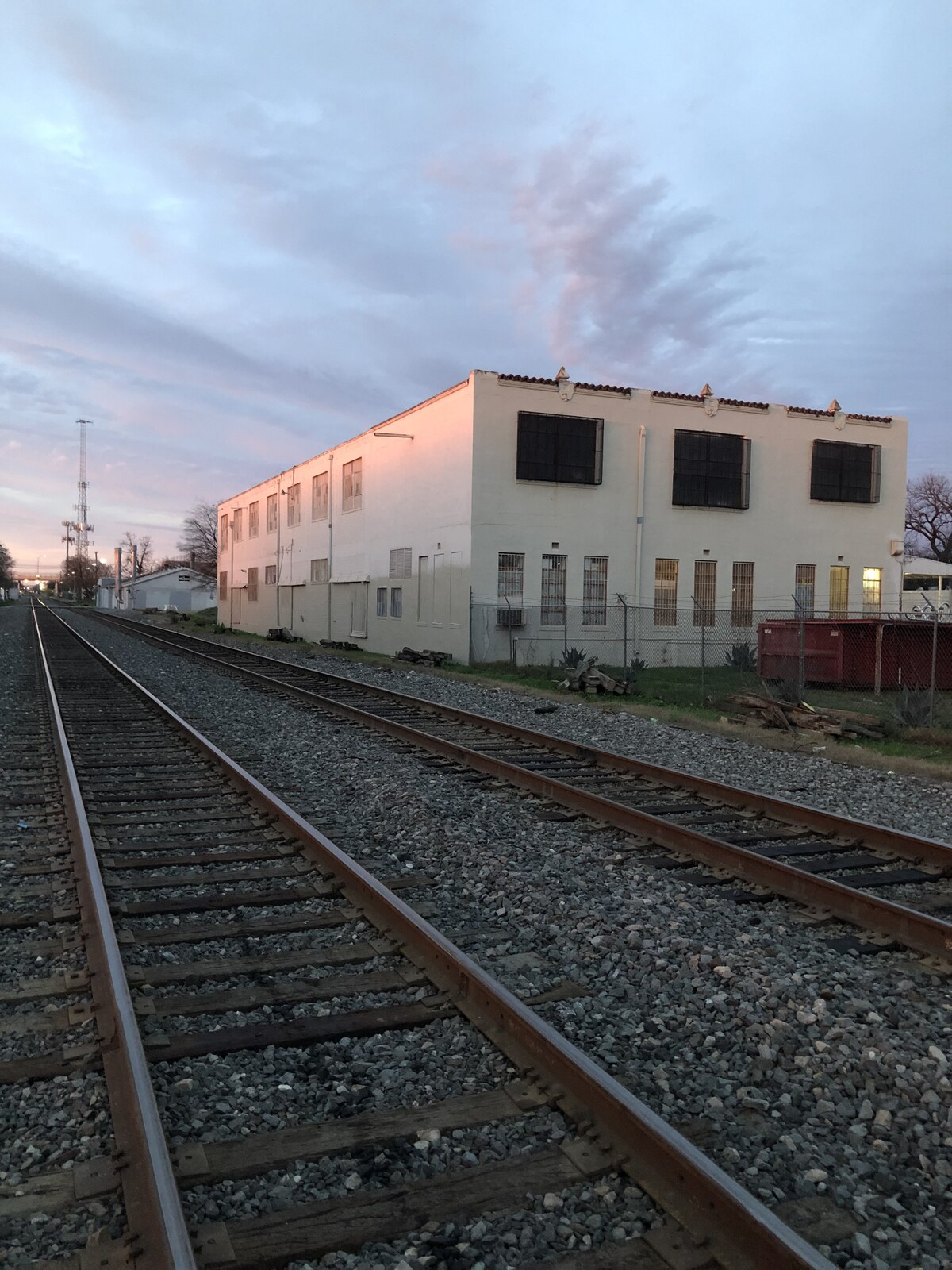
- A railroad right-of-way reference — given that the Southern Pacific siding runs directly behind the plant and the railroad’s own ROW comes within a few feet of the building’s west flank, a pavement marker at the gate could be tied to a survey of the rail ROW and its setbacks rather than to a city street survey.
Without the GMA attribution it’s hard to say which of those three. Any of them, though, is a piece of the building’s modern site-context paperwork in physical form, sitting at the same street boundary the building has had since 1932.
Open questions
- Who is GMA? The specific firm, agency, or registered surveyor behind the stamping is not yet identified. If you recognize the cap face — a galvanized domed cap with radial ticks and “G — M — A” stamped around a center-punch fix — the contact page is the right place.
- What does the marker mark? Property corner, Delaware Street ROW, Southern Pacific railroad ROW reference, or a public-works construction-control point — pinning the answer down most likely needs a copy of the relevant plat or recent survey on file with Bexar County or the City of San Antonio.
- When was it placed? No date is visible on the cap face. The pavement crack running through the marker’s setting suggests it has been there long enough for the surrounding pavement to fret and fail around it; that’s some kind of lower bound but not a useful date.
- Are there others? A property-corner monumentation of an industrial parcel typically uses multiple markers — at the front corners on the street, at the rear corners along the rail, at intermediate angle points. A walk-around of the parcel with this image in hand should turn up more pavement and curb markers, and any matching GMA stampings would tell us this is the H&H parcel’s corner monumentation rather than a single-point reference.