From a 25-pound lard-can roaster to the finest plant in the South — H and H coffee equipment, 1904–1960s
The story of Hoffmann-Hayman’s production equipment is a straight line from a single cast-iron drum small enough to carry by hand to a multi-roaster operation that the press called “one of the finest coffee-roasting plants in the entire South.” Three documented moments anchor the arc, with two surviving photographs and one machine still in the building.
1904 — the Spahn Bakery shack
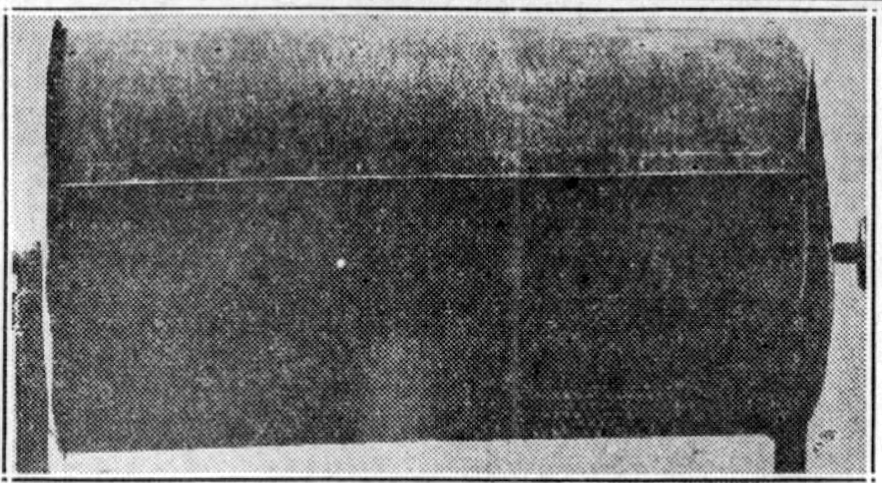
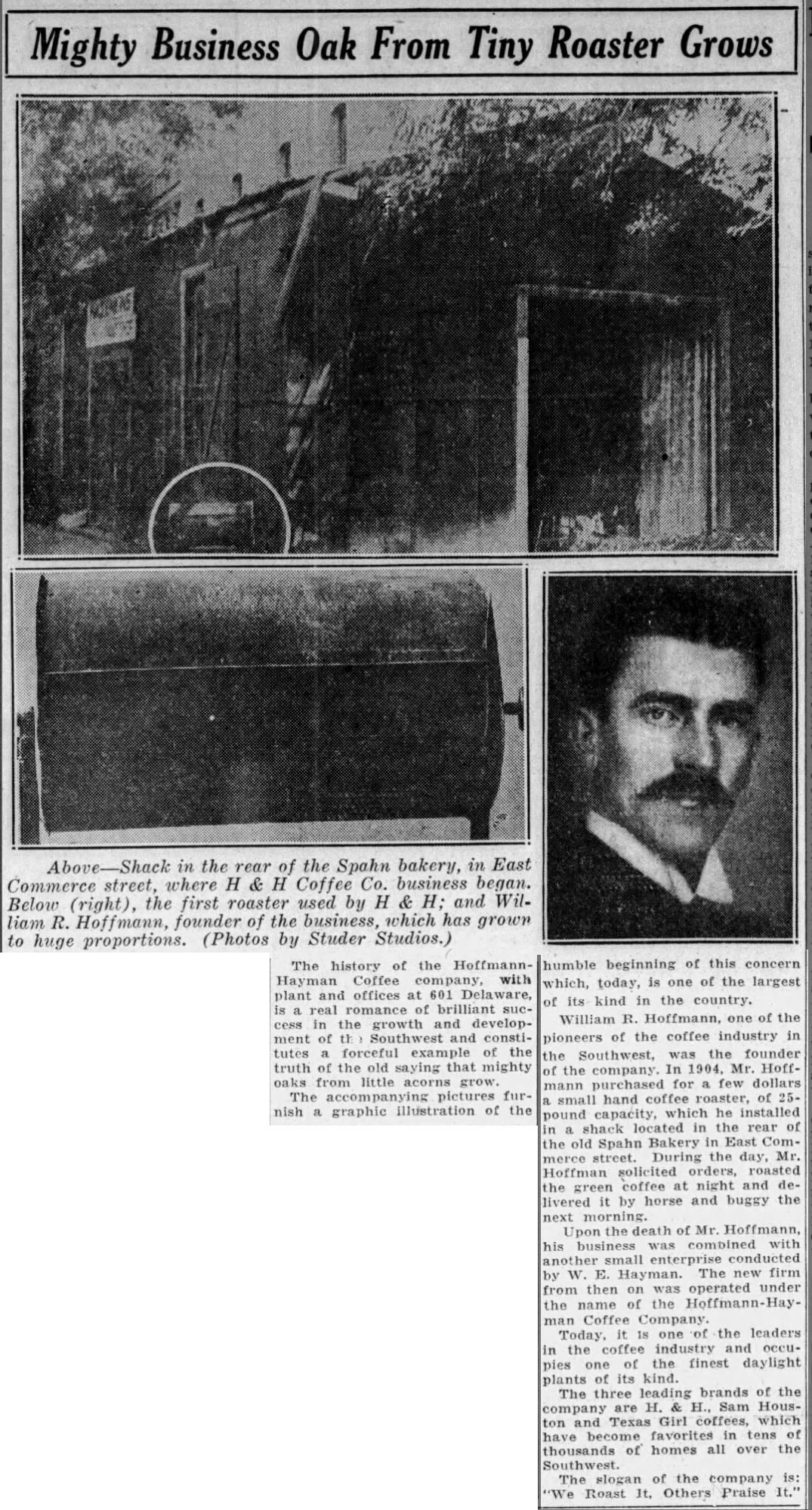
William R. Hoffmann purchased his first roaster for “a few dollars” in 1904: a hand-operated drum of 25-pound capacity, roughly the size of a 50-pound lard can. He installed it in a shack at the rear of the old Spahn Bakery on East Commerce Street — not a factory, not even a dedicated space, just a borrowed corner of a baker’s back lot. At the time he was employed during the day as a clerk in the grocery of George C. Sauer on Alamo Plaza. He solicited coffee orders during the day, roasted green beans at night, and delivered by horse and buggy the following morning.
That original roaster was photographed by Studer Studios in 1935 and appeared in the Express-News business section alongside a portrait of Hoffmann and a photo of the Spahn Bakery shack. By then both the shack and the man were gone, but the roaster had survived.
1908–1912 — East Commerce Street
By 1908 Hoffmann had moved to 208 East Commerce Street (warehouse on the Southern Pacific track) and was described in the press as “one of the leading business men of San Antonio” contemplating “one of the largest plants in the south.” His Hoffmann’s Package Coffee was “having quite a big run.” The 25-pound drum had served its purpose; the warehouse scale of 1908 required different equipment, though no specific model or maker is documented for this period.
Hoffmann died in January 1912. His business merged with W. E. Hayman’s Merchants Coffee to form the Hoffmann-Hayman Coffee Co.
1923 — Burnett Street and the Huntley Monitor
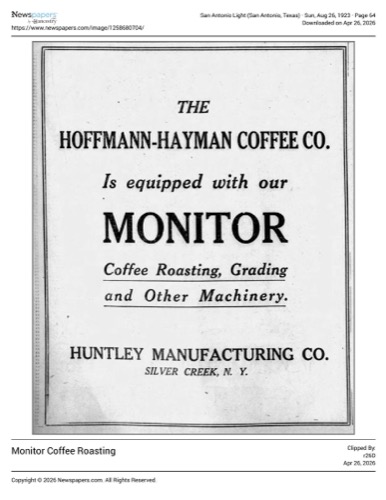
The 26 August 1923 San Antonio Light industrial feature on the Burnett Street plant — the same spread that introduced the world to the H and H factory floor — ran a trade display ad naming the equipment supplier:
The Hoffmann-Hayman Coffee Co. is equipped with our MONITOR Coffee Roasting, Grading and Other Machinery. Huntley Manufacturing Co., Silver Creek, N.Y.
Huntley Manufacturing Co. of Silver Creek, New York made the Monitor line of commercial coffee-processing equipment — roasters, graders, coolers, and related machinery. The Monitor name appearing in an H&H trade ad confirms that by the early 1920s the company had moved entirely into industrial production-scale equipment, away from the small batch roasters of the East Commerce era.
1924 — surplus equipment sold off
One month before the Light factory spread, H&H placed a classified ad in The Spice Mill (August 1924, p. 1703):
FOR SALE—BARGAIN—ROYAL COFFEE ROASTER. Capacity 40 pounds; complete; in perfect order. $150 F. O. B. San Antonio, Texas. Address HOFFMANN-HAYMAN COFFEE COMPANY, San Antonio, Texas.
A 40-pound Royal roaster — a different brand entirely from the Huntley Monitor line — being sold at $150 FOB San Antonio. The timing (one year after the Huntley Monitor testimonial) and the description (“complete; in perfect order”) suggest this was equipment displaced by the Monitor upgrade rather than a worn-out machine. Someone was buying a functioning roaster from a company that no longer needed one its size.
1932 — Delaware Street opens; the 1904 roaster comes home
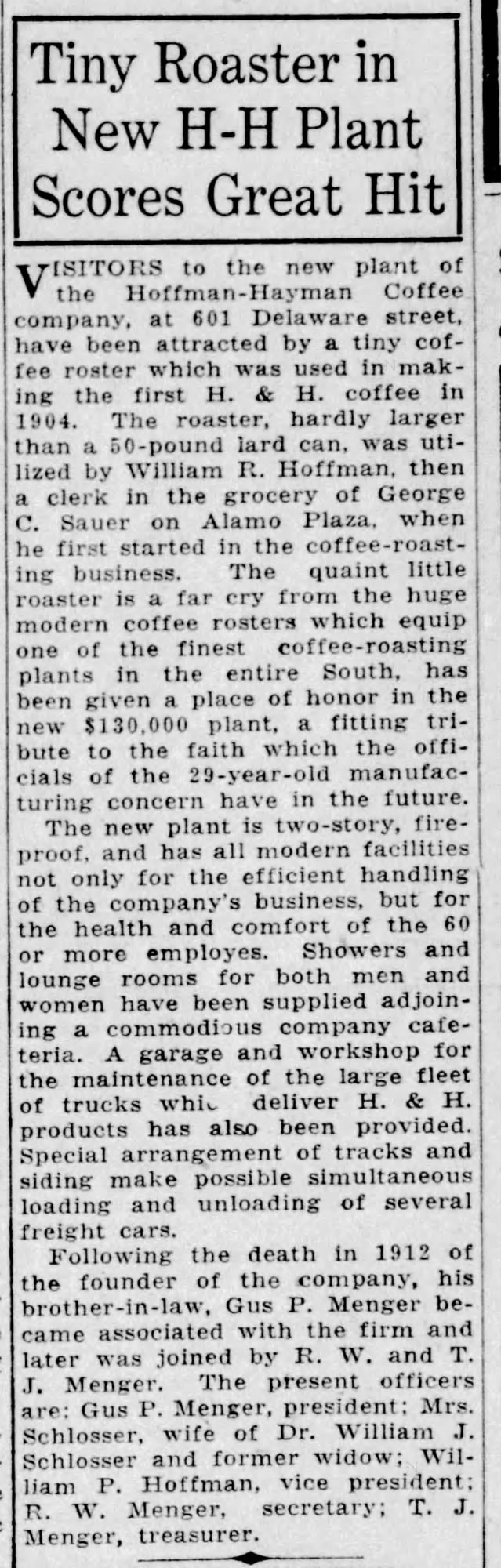
When H&H opened the $130,000 plant at 601 Delaware Street in December 1932, the press noticed something in the lobby:
“Visitors to the new plant … have been attracted by a tiny coffee roaster which was used in making the first H. & H. coffee in 1904. The roaster, hardly larger than a 50-pound lard can … is a far cry from the huge modern coffee roasters which equip one of the finest coffee-roasting plants in the entire South, has been given a place of honor in the new plant, a fitting tribute to the faith which the officials of the 29-year-old manufacturing concern have in the future.” — The News, 21 Dec 1932
The original 25-pound drum, retrieved from wherever it had been stored since the East Commerce days, was mounted on display in the new plant as a deliberate contrast to the production roasters behind the walls. The juxtaposition was the point: this is where we started, and look at what we built.
1940s–1950s — the man at the roaster
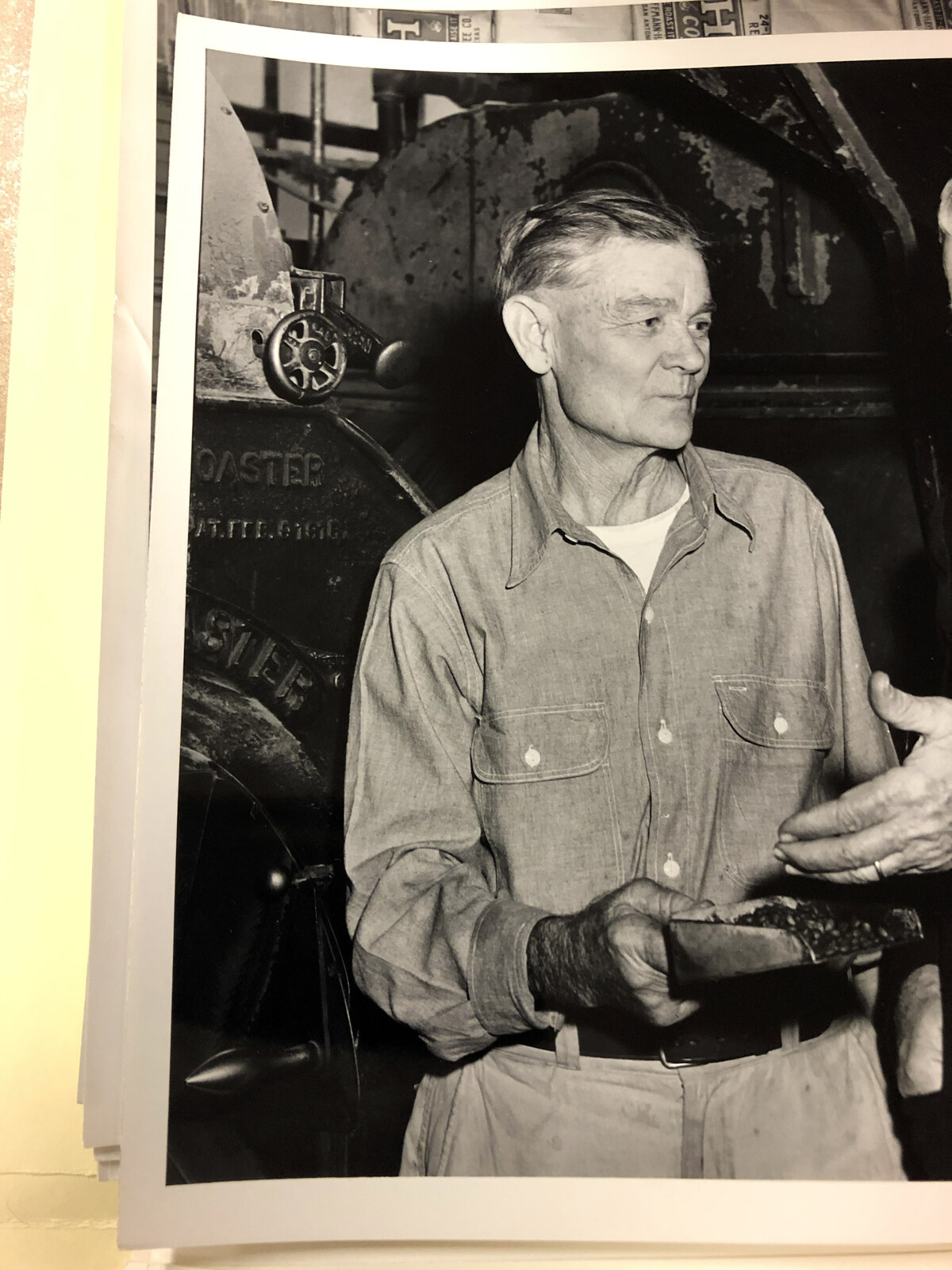
A press photograph — likely shot for a mid-century newspaper feature — shows a plant worker in denim holding a sample tray of roasted beans in front of a large industrial roaster. The machine fills the frame behind him. Cast iron lettering on the body reads “[R]OASTER” with the leading letters obscured by his shoulder, consistent with a Huntley Monitor Roaster nameplate. The drum is large enough to take up the full width of the frame — production capacity in the hundreds of pounds per batch, not the 25- or 40-pound scale of the early machines.
Whether this is the same Huntley Monitor equipment from Burnett Street relocated to 601 Delaware, or replacement equipment purchased for the 1932 plant, is not yet established from available sources.
What remains — the roaster circuit, not the roaster
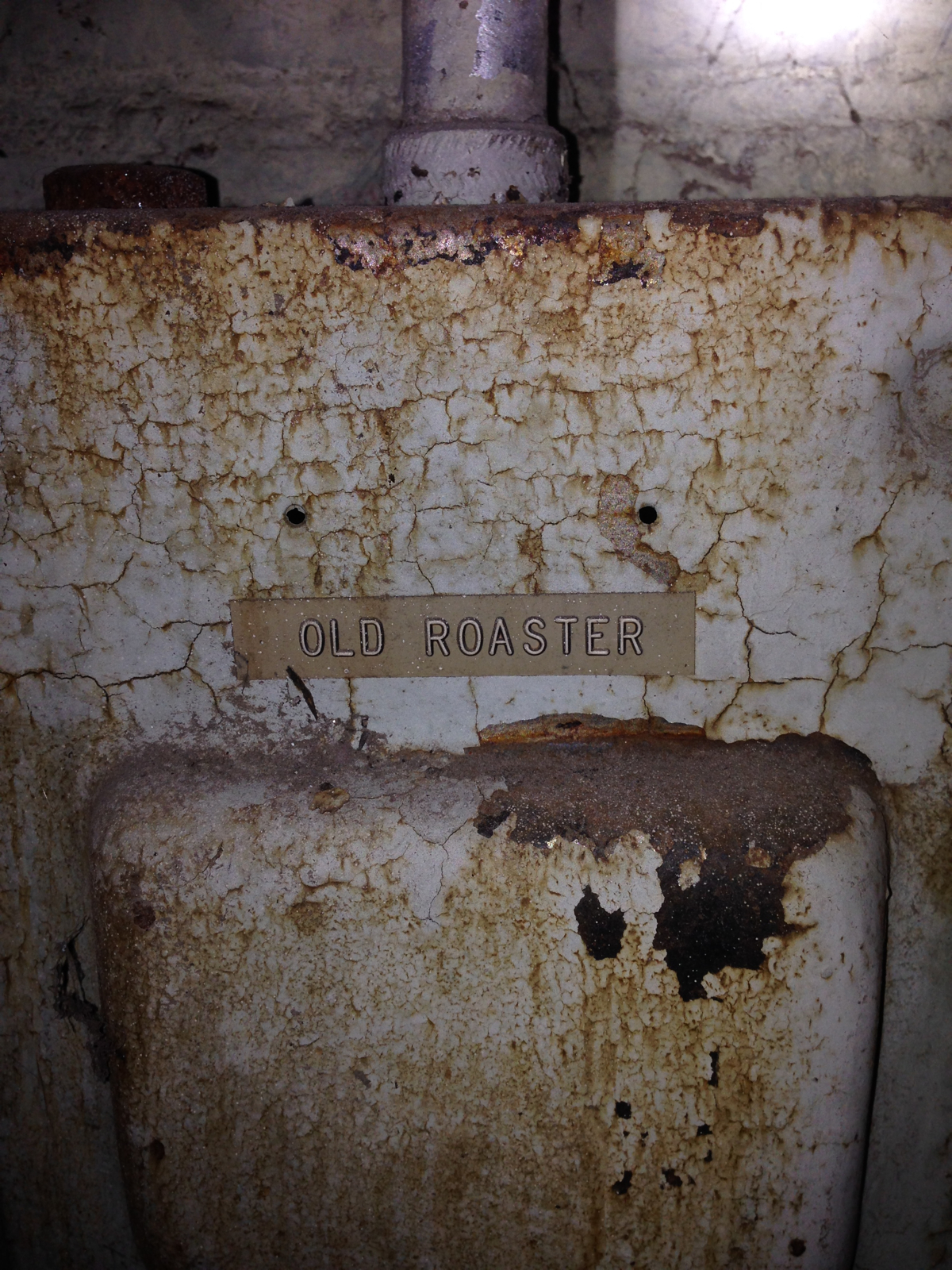
The roasting equipment itself is gone. What survives on the second floor of 601 Delaware Street is the power distribution unit — a wall-mounted sheet-steel motor starter or disconnect cabinet — that supplied electricity to the roaster. A Dymo embossed label strip adhered to its face reads “OLD ROASTER” — a plant electrician’s identification tag tying the circuit to its former load. Dymo tape labeling of this type was common industrial practice from the late 1950s onward. The building’s Trumbull panel directory labels the same circuit: “1 ROASTER MOTOR” / “3 GAS-AIR FAN.”
The enclosure is in advanced corrosion — alligatoring off-white enamel over burnt-orange rust — with rigid conduit entering the roof of the box. It is factory infrastructure, not the machine itself.
Equipment chronology
| Date | Equipment | Capacity | Location | Source |
|---|---|---|---|---|
| 1904 | Hand roaster (maker unknown) | 25 lb | Spahn Bakery shack, E. Commerce St | Express-News 22 Jul 1935 |
| c.1908–1912 | Unknown | Unknown | 208 E. Commerce St | — |
| 1923 | Huntley Monitor (roasting, grading, other) | Unknown | Burnett St plant | San Antonio Light 26 Aug 1923 |
| 1924 | Royal Coffee Roaster (sold as surplus) | 40 lb | — | The Spice Mill Aug 1924 |
| 1932 | “Huge modern coffee roasters” | Unknown | 601 Delaware St | The News 21 Dec 1932 |
| 1940s–50s | Large drum roaster (likely Huntley Monitor) | 200–600 lb est. | 601 Delaware St | Press photo |
| c.1950s | “OLD ROASTER” motor-starter cabinet (in situ) | — | 601 Delaware St, 2nd floor | Site photography — power distribution unit only; roaster itself removed |
Related: William R. Hoffmann · 601 Delaware Street · Factory modernization · Huntley Monitor ad, 1923 · Tiny Roaster, 1932 · Mighty oak from tiny roaster, 1935 · Royal Coffee Roaster for sale, 1924