The Canning Clan — Earl Chapin May, 1937: A History of the American Canning Industry Published the Year H&H Went Vacuum-Can
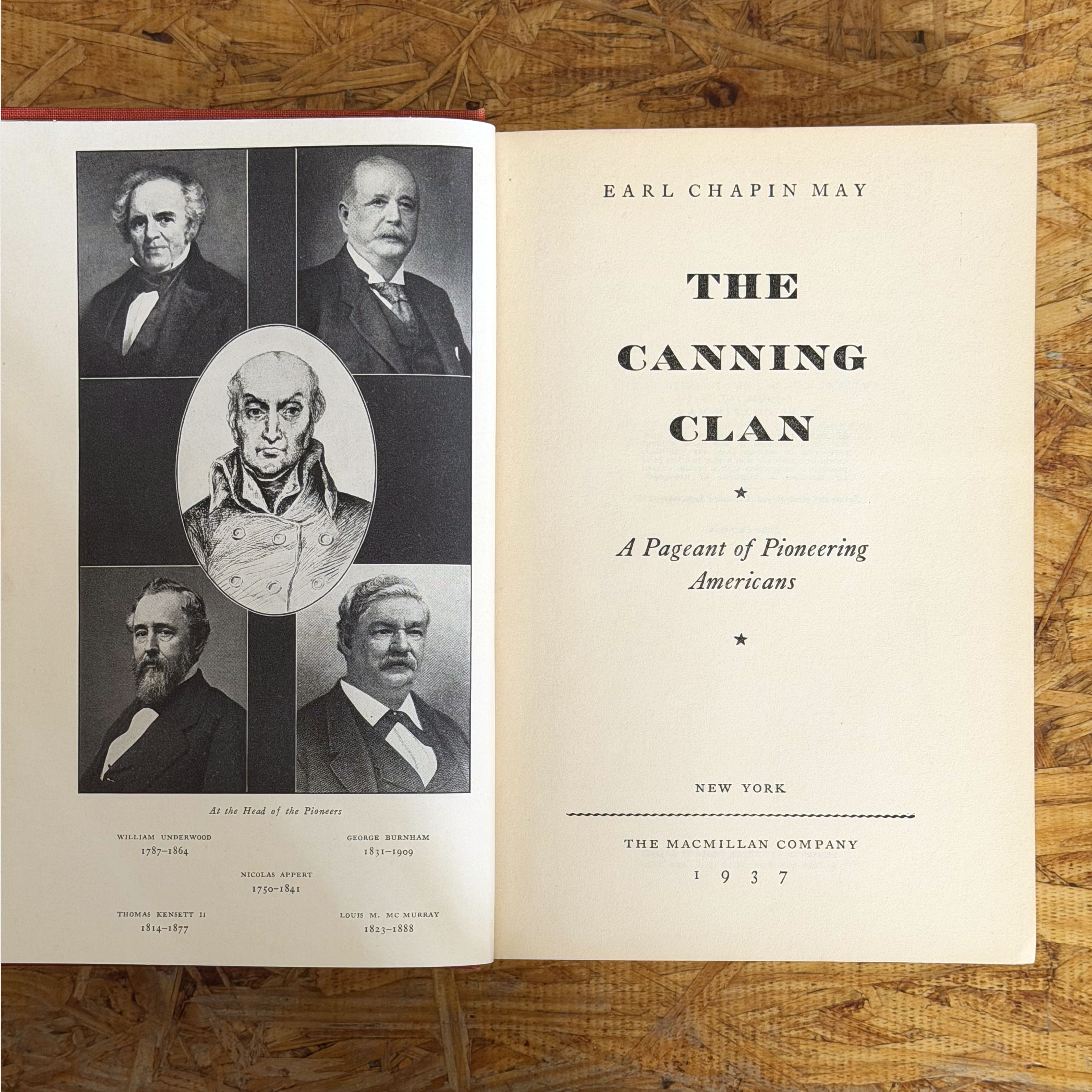
The Canning Clan: A Pageant of Pioneering Americans by Earl Chapin May arrived from Amazon — a 1937 Macmillan history of the American canning industry, published the same year H and H installed its first vacuum-can closing machine at 601 Delaware Street and the same year the Three Rivers Glass Company was formally dissolved. The title page’s five pioneer portraits — Nicolas Appert, William Underwood, Thomas Kensett II, George Burnham, Louis M. McMurray — frame the industry whose infrastructure H and H was entering as a participant when it made the switch from Crystalvac glass jars to vacuum-packed tins.
The date alignment isn’t coincidence: 1937 was the year the American canning industry’s older order was settling into the consolidated form that American Can Company and its competitors had spent decades building through patents, machinery, and service networks. H and H’s June 1937 installation of a Canco-type vacuum closing machine — the same equipment class that appears in the 1934 American Can Co. trade ad just ingested — was its entry into that world. May’s book documents the upstream history of the industry H and H was joining. It also covers the pioneer companies whose institutional successors supplied H and H’s can stock and closing machinery through the late 1930s into the 1950s.
Accession and references
- Accession: HH-BOOK-2026-0023
- Receipt: on file
- Related: 1937 — H&H Inflection Year · American Can Company · Three Rivers Glass Company