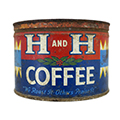
A-chi y A-che: H and H in the Tejano Market
In the South Texas grocery trade, customers had their own name for the coffee. A Chase & Sanborn salesman who had worked the territory remembered it years later, paraphrased through Nancy Draves’s 2015 research notes: Tejano shoppers called H and H “a-chi y a-che” — the two H’s of “H and H” naturalized into Spanish-language syllables. It is oral tradition, two tellers removed, and should be held lightly. But a nickname only settles onto a brand that is genuinely embedded — and H and H was in that market from the very start.
The geography was there by 1917. When H and H announced its purchase of Morrison Coffee, the San Antonio Express described a territory that ran “the ‘S. A.’ [interurban] from end to end, on the I. & G. N. from San Antonio to Laredo, on the Southern Pacific west to Del Rio, and throughout the Corpus Christi and Brownsville country.” Laredo, Del Rio, Corpus Christi, Brownsville: these are the commercial corridors of Tejano South Texas, and H and H was shipping through them from at least its second year.
The brand names tell the same story. A Spanish-named line ran through the company’s whole history — El Merito and Juanita came in with the Morrison acquisition; Anita appears on the 1942 wholesale sheet and again in the 1961 Master Chef lineup; Texco, an early flagship, carried a Tex-Mex flavor in its very name. Whether Juanita was simply rebranded into Anita is still an open thread — but the continuity itself reads as a deliberate market-segment strategy, a Spanish-named shelf kept alive for the Mexican-American grocery trade decade after decade.
The bilingual marketing is documented, not just inferred. The 1961 Master Chef appreciation-certificate campaign ran a Spanish-language advertisement in El Heraldo de Brownsville alongside the English-language press — direct evidence of H and H speaking to its border customers in their own language. And the habit outlived the company’s independence: Chris Jasso’s 1970 letter to G. P. Menger (again via Nancy Draves) notes that Continental-era H and H cans still carried a bilingual contents panel — with, he pointed out, “two Spanish words misspelled.”
Then there is the photograph. A documentary image in the manner of early-1940s Farm Security Administration work — acquired in 2023, its photographer and exact location still unconfirmed — shows a South Texas general-store porch papered with snuff, RC Cola, and tobacco signs, a Spanish-language Mujer Mexicana (1942) movie poster at one edge. Mounted squarely on the porch railing, facing the street, is a porcelain-enamel “H AND H COFFEE” sign. It is the brand exactly where the 1917 territory map and the “a-chi y a-che” nickname would put it: on a Tejano store porch, in the South Texas country, speaking to the customers who had a name for it.