The Other Side of the Deal: What Continental’s Corporate History Taught Us About H&H
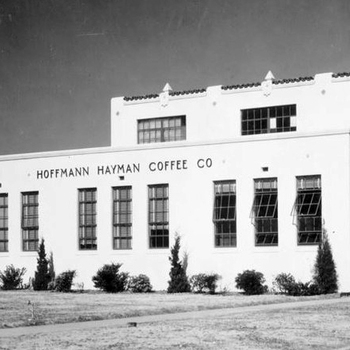
We’ve been building the story of the 1962 Continental acquisition from the Texas side — corporate filings, the Country Coffee Company shell, the December 11 handoff date, the five Chicago directors at One North La Salle Street. That’s the paper trail of the receiving end. What we never had was the other side: who at Continental made the decision, why, and what the meeting actually looked like.
A used copy of Jim Bowman’s More Than a Coffee Company: The Story of CFS Continental (Chicago Review Press, 1986, ISBN 978-0-914091-99-8) — purchased during the August acquisitions research round and OCR’d in full — filled that gap and several others we didn’t know we had.
The man who built Continental
Jacob Cohn was a Lithuanian immigrant who arrived in Chicago around 1906 at about age ten. At nineteen, on March 15, 1915, he started Continental Coffee Company with a wagon he’d bought for $25 and a horse he rented for $1.50 a day. He picked up green coffee at the train station, hauled it to a roaster, watched the roaster blend it the way he wanted, carried it back to a storefront on Ogden Avenue, ground it into one-pound bags — smaller than anyone else was selling — and delivered it to restaurants himself.
The thing that made Continental work was the route-man model. The delivery man was also the salesman, because the delivery man showed up every week while a salesman might not. He cleaned the customer’s coffee urn and made sure it was functioning properly. He rotated the stock. He took next week’s order on the spot. It was a system built on fresh coffee and weekly presence, and it scaled: by 1920 the company had fifteen employees and was roasting 10,000 pounds a week. By 1957 it had moved three times, each building bigger, and was operating out of a 120,000-square-foot plant at 2550 North Clybourn Avenue.
Cohn died of a heart attack on June 28, 1968 — three years after the company’s fiftieth anniversary, where employees had chipped in a dollar each to buy him a plaque.
He now has a page in the KB: Jacob Cohn (1894–1968).
Stanley Owens and the July 2 meeting
The person who actually negotiated the H&H purchase was Stanley Owens, Continental’s general manager. He’d joined the company in 1940 after five years at Mesirow & Co., a securities firm, and became controller within six months — Jacob Cohn’s right-hand man for twenty-eight years.
Bowman gives us the scene. Owens was vacationing with his family in Los Angeles when Cohn called and asked him to stop in San Antonio on his way back to discuss the purchase. Owens remembers the day — July 2, 1962 — as blazing hot and oppressively humid. He cabbed it from the airport to the Menger Hotel (no relation to the coffee Mengers). Next morning at 7:30, he and Albert Menger conferred in the hotel’s coffee shop for a few hours, then visited the plant, where Owens met Gus Menger, the father. All three went to the Menger home for lunch. There they were joined by the Mengers’ attorney, who had contacted Continental by letter suggesting the sale.
Continental bought the company.
That July 2 date resolves a question we’d been carrying. The corporate filing we hold — the Country Coffee Company articles — is dated December 11, 1962. Five months between a handshake at a hotel coffee shop and a synchronized corporate filing is exactly the kind of gap you’d expect for due diligence, legal structuring, and the assembly of the five-director Chicago board that appears on the Country Coffee charter. The dates don’t conflict; they bookend the same transaction. Owens now has his own page: Stanley Owens.
H&H was number seven of fourteen
The most important reframing the Bowman book provides is scale. We’d been telling the 1962 acquisition as a standalone event — a Chicago company reaching into San Antonio to buy a family coffee roaster. It wasn’t standalone. It was part of a systematic acquisition program:
| Year | Company | Location |
|---|---|---|
| 1948 | Karavan Coffee Company | Toledo, OH |
| 1953 | Commercial Importing Company | Seattle, WA |
| 1954 | Thomas J. Webb Coffee Company | Chicago, IL |
| ~1960 | Spray Coffee & Spice Co. | Denver, CO |
| 1962 | Hoffmann-Hayman Coffee Company | San Antonio, TX |
| 1962 | Eibert Coffee Company | St. Paul, MN |
| 1963 | J. A. Folger & Co. (institutional div.) | West Coast |
By the end of 1962, Continental had eight roasting plants — Chicago, Brooklyn, Toledo, Seattle, Denver, Glendale, San Antonio, and St. Paul. By 1965, the total was fourteen coffee companies acquired. H&H was the seventh. It was not ad hoc; it was the Southwest spoke on a wheel that already reached from Brooklyn to Seattle.
That pattern changes how we read the Country Coffee Company filing. The anonymized shell wasn’t paranoia — it was Continental’s standard playbook for absorbing regional roasters without telegraphing a national consolidator’s hand.
The Country Coffee Company page and the 1962 acquisition page in the KB now carry this context.
The foodservice pivot and what it means for Master Chef
After Jacob Cohn’s death in 1968, his sons — Alvin (“Mister Outside,” the national salesman) and Robert (“Mister Inside,” the strategic planner) — led a deliberate pivot. In mid-1960s planning sessions, seven top executives asked themselves what business they were actually in. The answer was not coffee. It was foodservice — supplying food and services to people eating away from home.
The numbers tell the story: coffee dropped from 90% of sales in 1965 to 8% by 1983. In the same period, Continental acquired seventy-five full-line distribution companies — wholesale food, tableware, paper goods, frozen products. Revenue went from $193 million (1971) to $1.4 billion (1984). They changed the name to CFS Continental in 1973. CFS stood for “coffee, foods and services.”
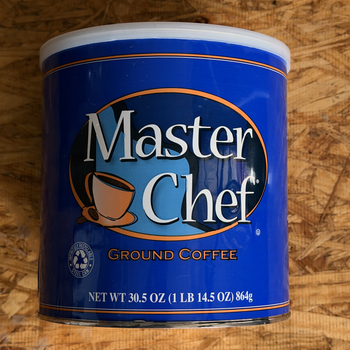
One of those full-line acquisitions was Polunsky’s Inc. of San Antonio in 1972 — a distributor of fish and frozen products, bought to complement the existing coffee routes at 601 Delaware. Sam Polunsky retired after a year and Continental sold the business back to the family. It’s a small note in the book, but it’s the first evidence of Continental using the San Antonio operation as a platform for non-coffee distribution — the context that makes the Master Chef subsidiary make sense as something more than a brand name on a tin.
One correction: the Staley price
The book also corrected a number we’d been carrying from secondary sources. The 1984 Staley acquisition of CFS Continental was not $360 million — it was $353.6 million, at $38 per share. The difference is small, but Bowman is a primary source (a commissioned corporate history written with company access), and $38-per-share is a verifiable figure. The KB now carries the corrected number with a note on provenance.
What the book didn’t answer
The Bowman history is a corporate narrative, not a site history, and it has the gaps you’d expect. It never mentions 601 Delaware Street, never names the H&H plant equipment, never describes what happened to the workforce after the acquisition. It doesn’t discuss the Master Chef subsidiary specifically — the brand and the San Antonio operation were small pieces of a $1.4 billion story by 1984. And it doesn’t touch the 1968–1998 trademark gap that we’ve been tracking through the CFS Holdings filing.
What it did was give us the people on the other side of the table — Jacob Cohn, who built the company that would buy H&H, and Stanley Owens, who sat in the Menger Hotel coffee shop on a blazing July morning and shook hands with Albert Menger. The deal had been a document. Now it’s a scene.