Four jars in seven weeks: a Crystalvac condition series
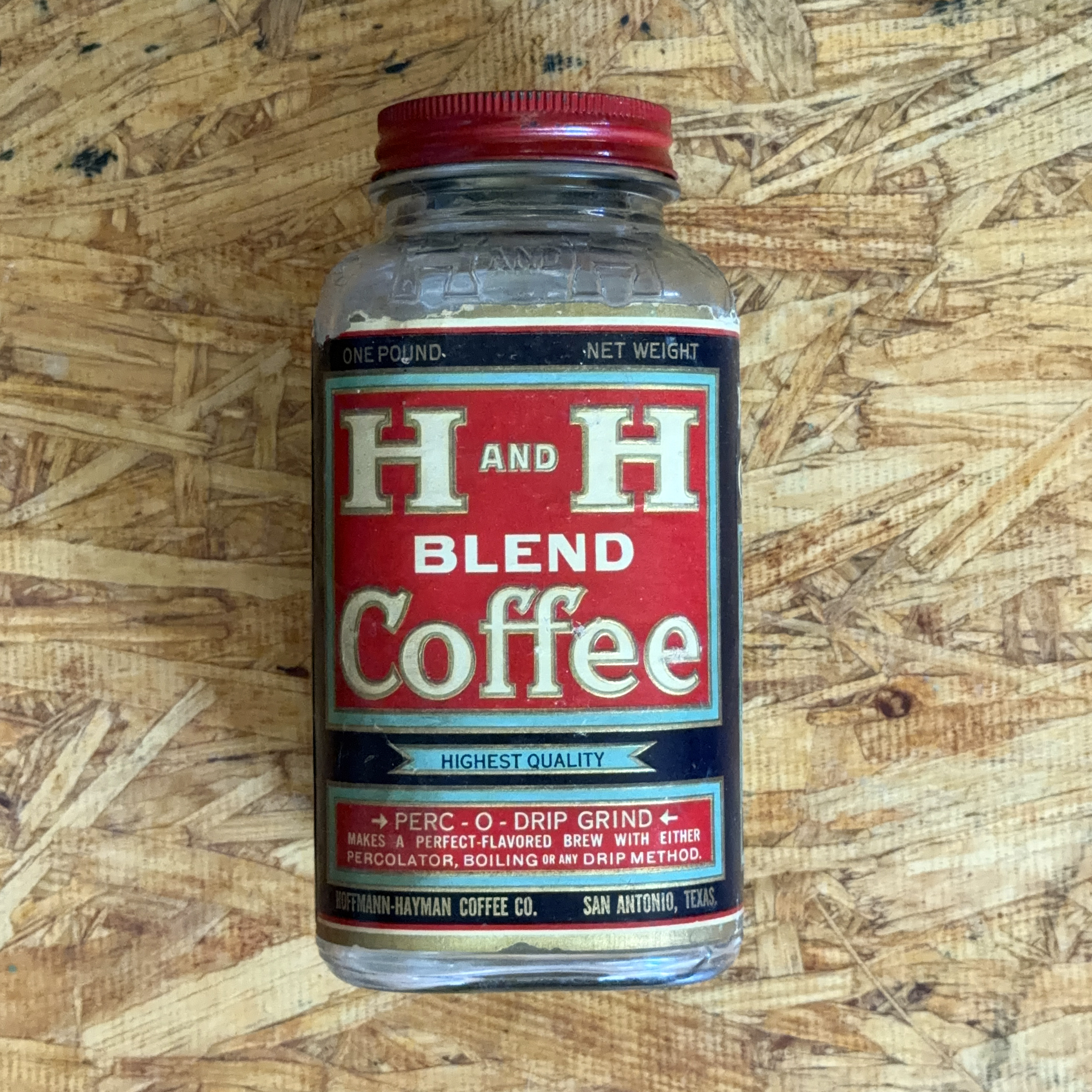
Between the sixth of June and the twentieth of July, four one-pound H and H Blend Crystalvac jars came into the collection. We did not plan them as a set. They arrived as a set anyway — and, as it turns out, at four different points along the same decay curve.
That accident is worth more than any one of them.
| Jar | Label | Made | Cost | |
|---|---|---|---|---|
| HH-BOTTLE-2026-0003 | none at all | 1936 | $55.10 | |
| HH-BOTTLE-2026-0002 | ~85% lost | 1937 | $74.64 | |
| HH-BOTTLE-2026-0005 | near-pristine | 1937 | $200.00 | |
| HH-BOTTLE-2026-0004 | reassembled composite | 1938 | $101.70 |
All four are the same object underneath: a square-section clear glass jar, one-pound size, smooth-bodied rather than waffle-gridded, with the same moulded “H AND H” shoulder band. They differ in what survived on the paper.
They also, it turns out, differ from what we expected on the glass.
The bases rewrite the dating
Every one of these jars carries an Owens-Illinois diamond-oval-I mark on the base, all from plant 7 at Alton, Illinois, with single-digit date codes running 6, 7, 7, 8 — 1936, 1937, 1937, 1938.
That is a problem for our own reference page. The Crystalvac item guide says a smooth body means post-1940, and puts Owens-Illinois in the supply chain from the 1940s onward. Four smooth-bodied Owens-Illinois jars from the late thirties say otherwise.
The good news is that the correction makes the history tidier, not messier. Three Rivers Glass — the South Texas works that had been making H&H’s jars — dissolved in January 1937. A changeover to Owens-Illinois in 1936–38 is exactly what you’d predict from that collapse. Our “1940s+” was almost certainly an inference from later specimens that nobody had pushed back against with an earlier one. Now there are four.
It also means smooth-bodied and waffle-gridded jars were being made at the same time in the late 1930s — so body texture is not the clean dating shortcut the guide treats it as.
What the ruined one tells you
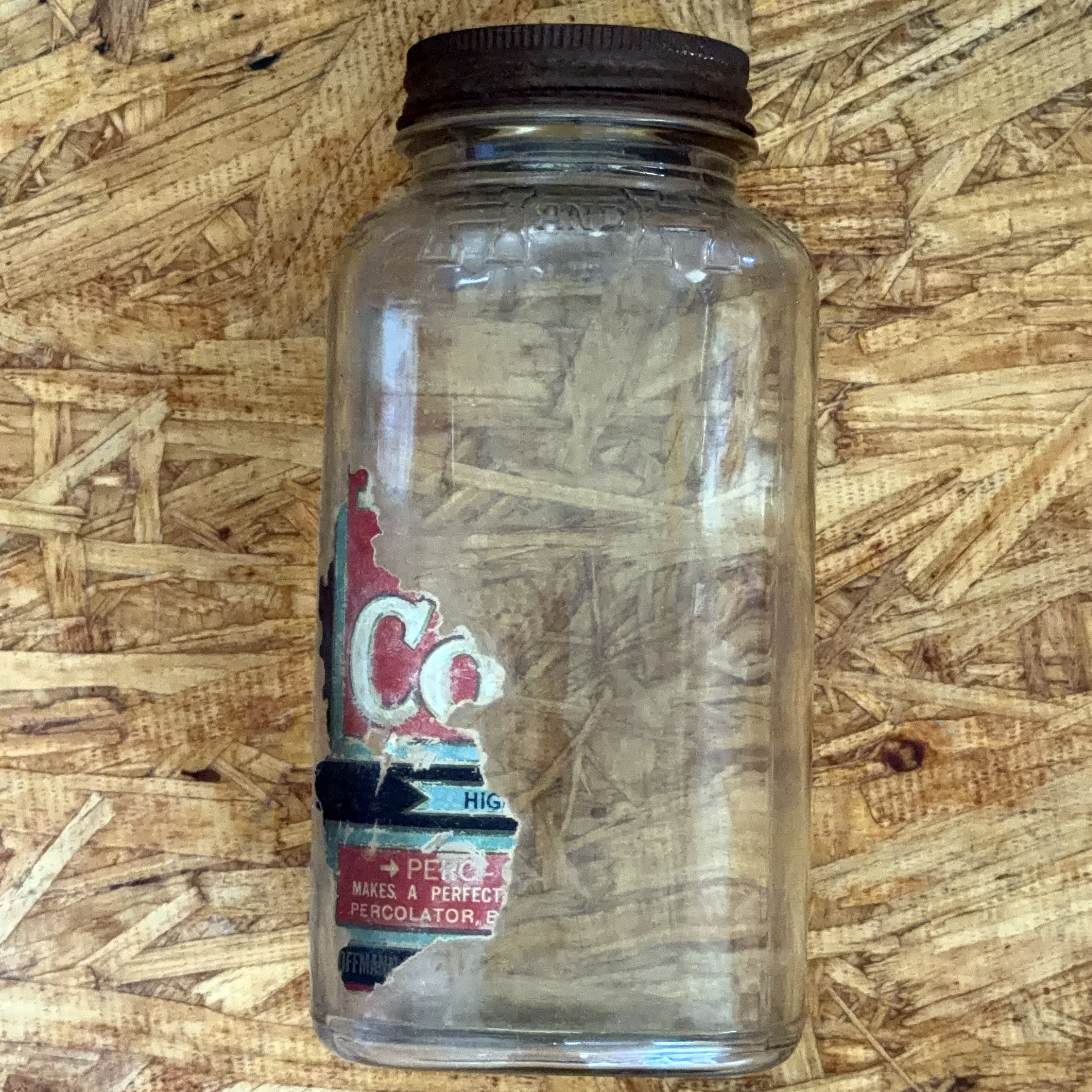
Start at the bottom. About eighty-five percent of this label is simply gone, torn away in a ragged diagonal that leaves a narrow strip down the left face. What remains: the tail of “…Co[ffee]”, the red PERC-O-DRIP panel with its arrow still intact, the percolator instructions, and a partial [H]OFFMAN[N] at the base.
Put it beside the intact jars and something clicks. Those fragments sit in exactly the same relative positions on all four. The label was a single standardized wrap — not a size variant, not a run variant. And the failure has a grain to it: the paper leaves from the right edge inward, along the seam where the wrap overlaps itself, and the left face is the last to go. Both this jar and the unlabeled one carry adhesive ghosting consistent with that pattern.
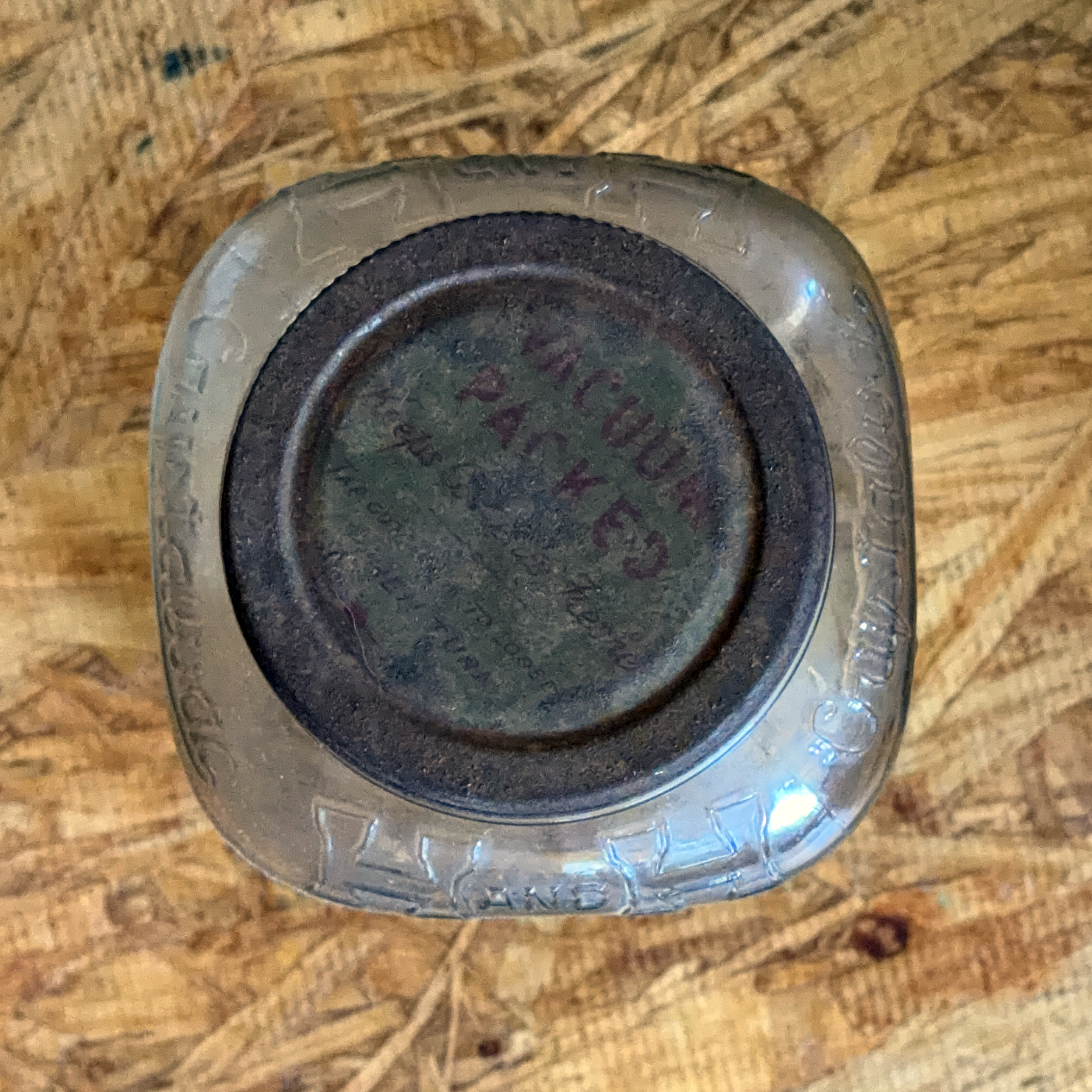
Its lid, shot face-up, reads VACUUM PACKED in red:
What the naked one tells you
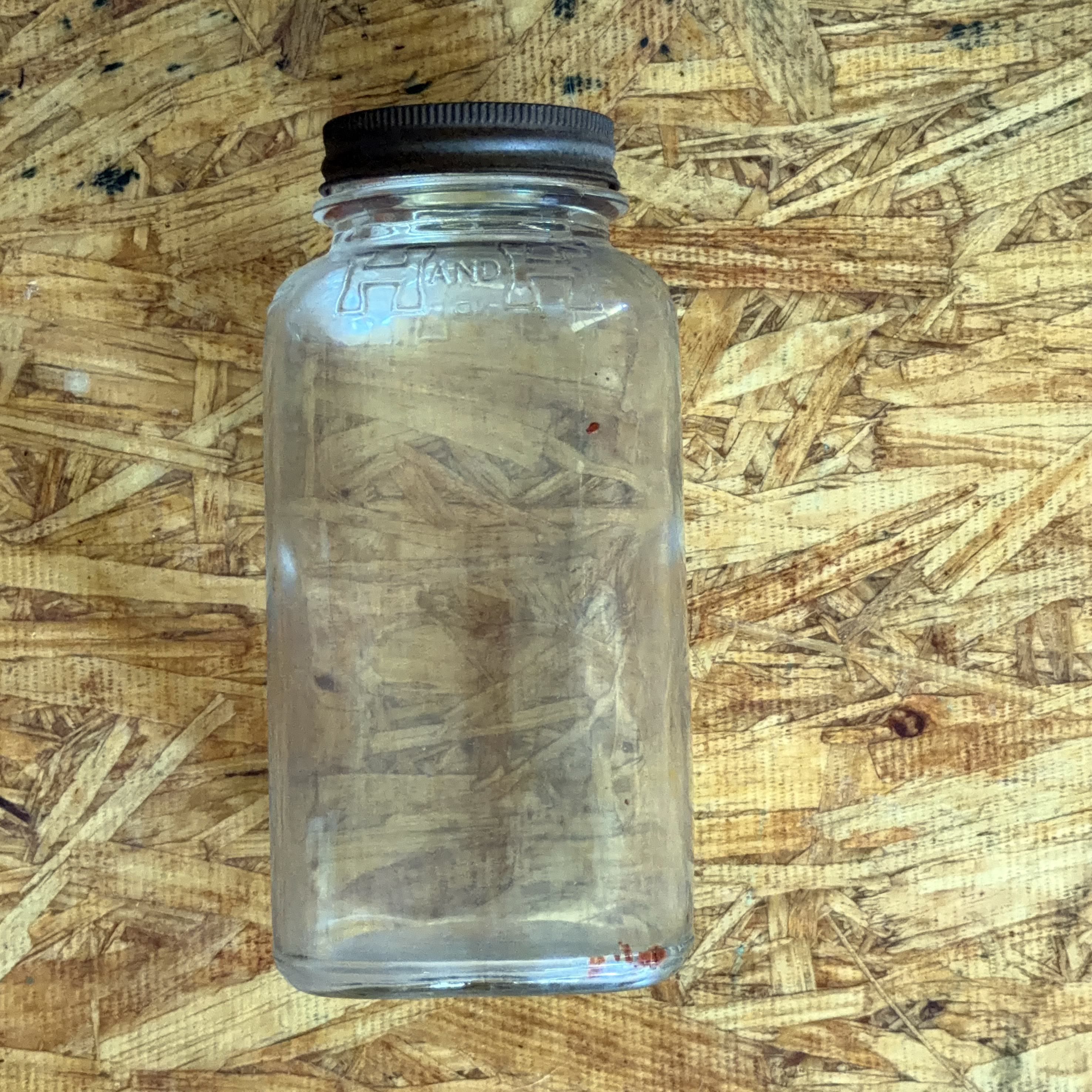
This one has no label whatsoever, and it was the cheapest of the four by a wide margin — the seller could only list it as a “Coffee Blend Jar,” because without paper there was nothing else to call it.
Except there was. Run raking light across the shoulder and the embossed blocks resolve into H, a small AND, and H. On the labeled jars that band is crowded by the paper; here it stands alone and reads cleanly. Which settles a question the other three can’t: the branding was in the glass, not just on the wrapper.
That has a practical edge. Total label loss is the normal end state for these jars, and it does not make them anonymous. An unmarked square jar at a flea market is still identifiable — and still cheap, because most sellers don’t know to look at the shoulder.
What the reassembled one tells you — and what it can’t
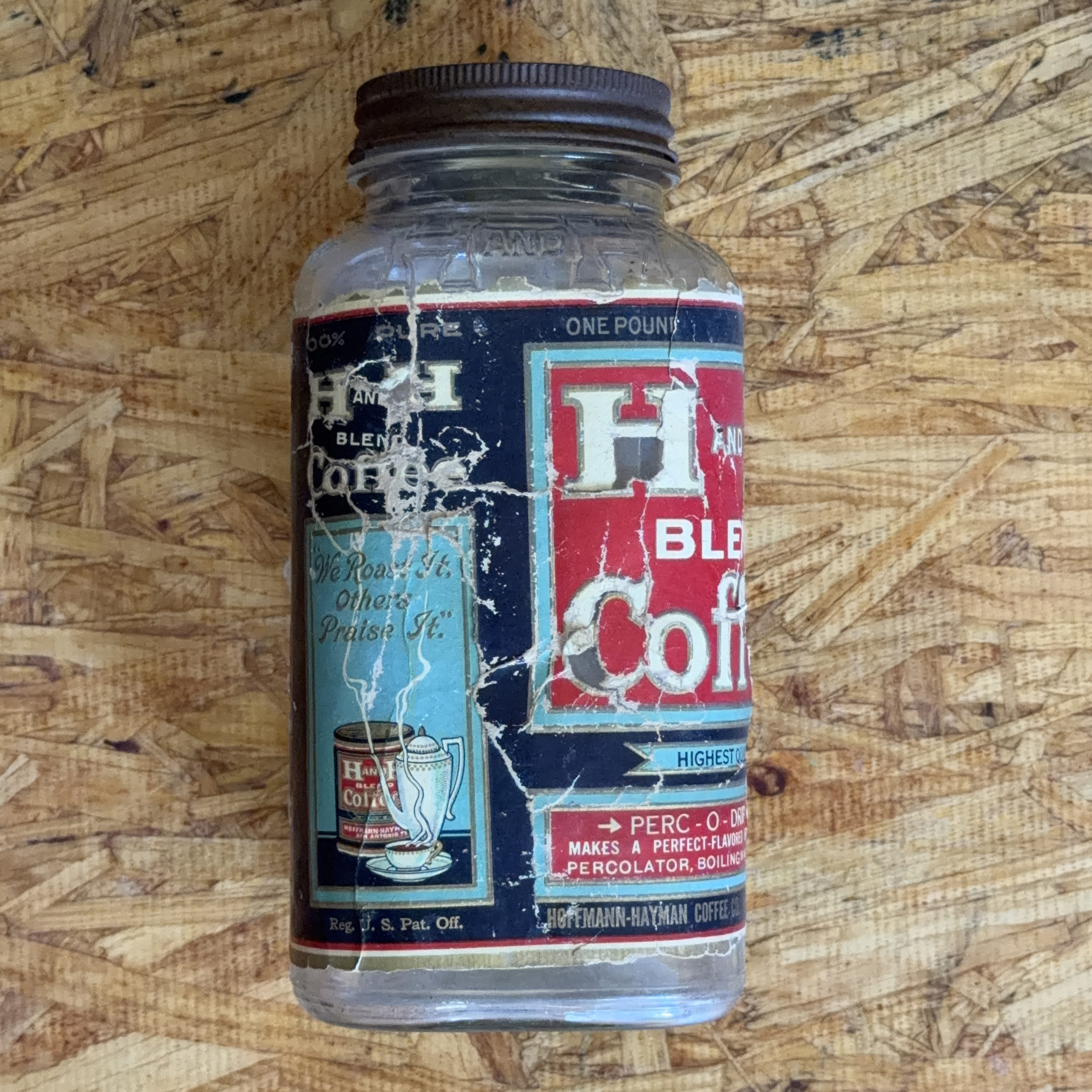
This jar arrived looking like the prize of the group: the only one where the label seemed to run the full way around. It isn’t. Close examination shows the label is a reassembled composite — large portions are missing, and the fragments that remain have been laid onto the body out of alignment. It was sold with no mention of that, at the second-highest price of the four.
So let’s be precise about what it can and cannot tell us.
What’s real is the artwork. The side panel carries “We Roast It, Others Praise It.” in gold script above a small vignette: a labelled H and H jar, a lidded coffee pot trailing steam, a filled cup and saucer. That is genuine H&H label stock, and finding the strapline on glass — on a jar whose base reads 1938 — matters, because we mostly know it from the tins. The company swapped its containers without swapping its pitch.
The vignette repays a second look. It is a jar with a picture of a jar on it. By this point H&H was selling the glass itself as the recognizable thing — the mature form of the campaign Crystalvac launched back in 1932.
And along the panel’s base, in small type: Reg. U. S. Pat. Off. We have spent a long time in this project running into the absence of surviving H&H federal registrations. Here is the company asserting one on the object. That is a claim, not a filing — but it is a claim with a mark and a period attached, and the 1938 base date narrows where to go looking.
What isn’t real is the arrangement. We cannot use this jar to say which panel sat beside which, how long the wrap was, or which face carried what. We also can’t yet be certain every fragment came from this jar. An earlier draft of this post drew conclusions from the panel order here; those are withdrawn.
What the perfect one tells you
The jar at the top of this post cost more than the other three combined, and it earns it by making them readable. Every reading above is a reconstruction, and reconstructions need something to check against.
It earns it twice over now. With the 1938 jar’s label revealed as a composite, this is the only undisturbed label of the four — which makes it the only one that can testify to layout at all. We paid $200 for condition. What we actually bought was evidential integrity.
Two things fall out of having a clean one in hand.
The caps were red. Look at the other three: uniformly brown, which invites you to assume brown was the finish. It wasn’t. That is forty-odd years of corrosion. This cap is bright ribbed red — and that matches the red lid on our three-pound jar, which suggests red closures across both sizes rather than anything size-specific.
The label and the embossing were designed together. With the wrap sitting where it should, the moulded H AND H clears the label’s top edge — visible, not buried. The naked jar shows the mark survives the paper. This one shows the two were meant to be seen at once.
Four jars, seven weeks, one accident. The naked one proved the glass was branded and pushed Owens-Illinois back to 1936; the ruined one showed how the labels fail; the reassembled one carried the slogan and the vignette while teaching us not to trust its arrangement; and the perfect one made the rest legible. None of them could have done it alone — and two of the four corrected something we had written down as settled.
Accession and references
- Accessions: HH-BOTTLE-2026-0002 · HH-BOTTLE-2026-0003 · HH-BOTTLE-2026-0004 · HH-BOTTLE-2026-0005
- Receipts: on file (eBay orders 04-14744-68689, 27-14796-38766 and 19-14880-36678).
- The fourth jar came by private sale and has no order record; see its accession for provenance.