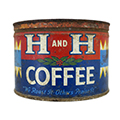
Factory Modernization
From a back-room roaster on Alamo Plaza to 16,000 square feet of fireproof concrete on Delaware Street — this is how a single-person roasting operation became the Southwest’s largest independent coffee plant in thirty years.
William R. Hoffmann started roasting in the evenings in George Sauer’s grocery, delivering the next morning. By 1912 the incorporated Hoffmann-Hayman firm was at 1223 West Commerce, roasting 75 bags a day. By 1921, three roasters at 331 Burnett Street were turning out 14,480 pounds daily with 17 machine operators on the floor. The August 1923 San Antonio Light “New Home of a Great Institution” spread — the most detailed contemporaneous documentation the project has — captured that Burnett Street era at its height: Monitor roasters, product line, portrait profiles of every officer.
Then 1932 changed everything. Architects Morris, Nooman, and Wilson and contractor George W. Mitchell broke ground at 601 Delaware Street on July 25. The new plant was two-story, fireproof, $130,000, with a railroad siding for simultaneous loading of several freight cars and a giant Crystalvac jar mounted on the roof, visible for blocks. At the December 21 Open House — broadcast live on Station WOAI — the company placed the original 1904 hand roaster (“hardly larger than a 50-pound lard can”) in a place of honor beside the modern equipment.
The same months that the Delaware plant was rising, H and H launched Crystalvac — the vacuum-packed glass jar program that would define the brand’s retail identity for a decade. By 1937, vacuum packing had expanded to tin cans as well.
The physical record is still in the building: the cream-enamel Old Roaster door, sales-report books recovered from the office ceiling, a Master Chef plywood sign in situ on the factory footprint. The brand operations transferred to Continental Coffee of Chicago in 1962; G. P. Menger sold the building itself in 1972 — but it still stands at 601 Delaware.
Read next
- The new home of a great institution — San Antonio Light, 26 Aug 1923
- Monitor coffee roasting — San Antonio Light, 26 Aug 1923
- H and H products — San Antonio Light, 26 Aug 1923
- Roasting process must be seen — San Antonio Light, 26 Aug 1923
- Trade week visitors invited to Hoffmann–Hayman plant — Express-News, 27 Jul 1924
- Fires damage home and coffee plant — San Antonio Light, 31 August 1928
- H and H Coffee Is Now Vacuum Packed — San Antonio Express-News, 6 June 1932
- Hoffmann-Hayman plant modern throughout — San Antonio Light, 24 July 1932
- H and H Coffee to have new home — The News, 6 Aug 1932
- The Southwest's finest plant to roast the coffee you praise — Express-News, 21 Dec 1932
- Increased demand necessitates H&H improvements — San Antonio Express-News, 20 May 1935
- Plant output is increased — San Antonio Light, 21 Nov 1937
- Large-format reprint — Sunday Light, 24 July 1932 (plant modern throughout)
- Surveyor's marker in Delaware Street, in front of the factory gate